
U18 Football Training Session: An Acquisition Day in the Game Model
This U18 football training session is the main acquisition day of the week for a pre-senior squad: the day when the team's game model is trained in the largest spaces, the longest blocks and with the most players. It runs for about 100 minutes, follows one sub-principle from activation to the 11v11, and is planned with the volumes and intensities of a group that will soon play senior football.
Do you organise tournaments? Create yours for free on DorsalCUP.
In this article
U18 football training session: context and the acquisition day
Group: U18 (and U19 in academies and colleges), players aged 16–18. Numbers: 20–24 players including three goalkeepers. Kit: size 5 balls, discs, mannequins if available, bibs in three colours, two full-size goals and two mini-goals. Space: a full pitch. Duration: about 100 minutes. Place in the week: with a match on Saturday, this is the Wednesday session (MD-3).
In tactical periodisation terms, the week has acquisition days between the recovery after one match and the activation before the next. MD-3 is usually the day with the largest spaces and longest exercises, close to match demands in volume. The aim is not to add fitness work on top, but to make the tactical work itself carry the load: the size of the area, the number of players, the duration of blocks and the rules decide the physical demand.
The game model below is an example: a 4-3-3 that builds through the thirds, attacks by overloading one side and switching, presses after loss and defends in a mid-block when the counter-press fails. Replace it with your own; the structure of the session works with any model.
| Moment | Principle | Sub-principle trained today |
|---|---|---|
| Organisation in possession | Progress through the half-spaces | Overload the ball side, then switch to isolate the far winger |
| Transition to defence | Immediate counter-press | Regain within 6 seconds or drop |
| Organisation out of possession | Mid-block 4-1-4-1 | Not trained in detail today; used in the final game |
| Transition to attack | First look forward | Find the winger who stayed wide |
| Part | Time | Activity | Load |
|---|---|---|---|
| Activation | 0–18 min | Prevention routine + game-model pattern | Low to moderate |
| Exercise 1 | 18–42 min | Positional game 7v7+3 | High, medium space |
| Exercise 2 | 42–70 min | Phase of play 10 v 8+GK | High, large space |
| Final game | 70–95 min | 11v11 conditioned, 2×15 min | Match-like |
| Cool-down | 95–100 min | Mobility, RPE | Low |
Activation: the pattern of the day
After 8–10 minutes of an injury-prevention routine, the team rehearses the pattern of the day unopposed. It is not a passing drill for its own sake: it shows the positions and timings the players will need to find later under pressure.
- Half pitch, two or three groups running the pattern on both sides at once.
- Sequence: centre-back to full-back; full-back inside to the 8 in the half-space; 8 sets back to the 6; 6 switches to the winger on the far side or plays forward to the 8 running beyond.
- Ten repetitions on each side, then add a passive defender who decides which option is open.
Coaching points: the pass to the 8 goes to the foot away from pressure; the 8 arrives in the half-space as the full-back receives, not before; the winger holds the width until the switch is possible. Players should say what they see: 'turn', 'set', 'switch'.
Exercise 1: positional game 7v7 plus 3
Organisation
- Area of 50×44 m divided into five vertical lanes (two outside lanes, two half-spaces, a central lane). Two teams of seven, three neutrals (two at the sides, one at the base).
- The team in possession may not have two players in the same lane at the same height (staggering). A point for a player who receives in a half-space beyond the first defensive line and plays forward; three points for a switch from one half-space to the other within three passes.
- Four blocks of 5 minutes with 2 minutes' rest. Maximum three touches.
Coaching points
- Occupy the five lanes; the ball side has a numerical advantage, the far side keeps one player wide.
- Receive on the half-turn in the half-space; if the defender closes, set back and look for the third man.
- After the loss, the nearest three players counter-press; the others cut the switch.
What to look for on video: players in the same lane at the same height (they block each other's lines), the time from receiving in the half-space to the forward pass, and the position of the far-side players when the ball is lost. For background, see positional play and the five lanes.
Exercise 2: phase of play, overload to isolate
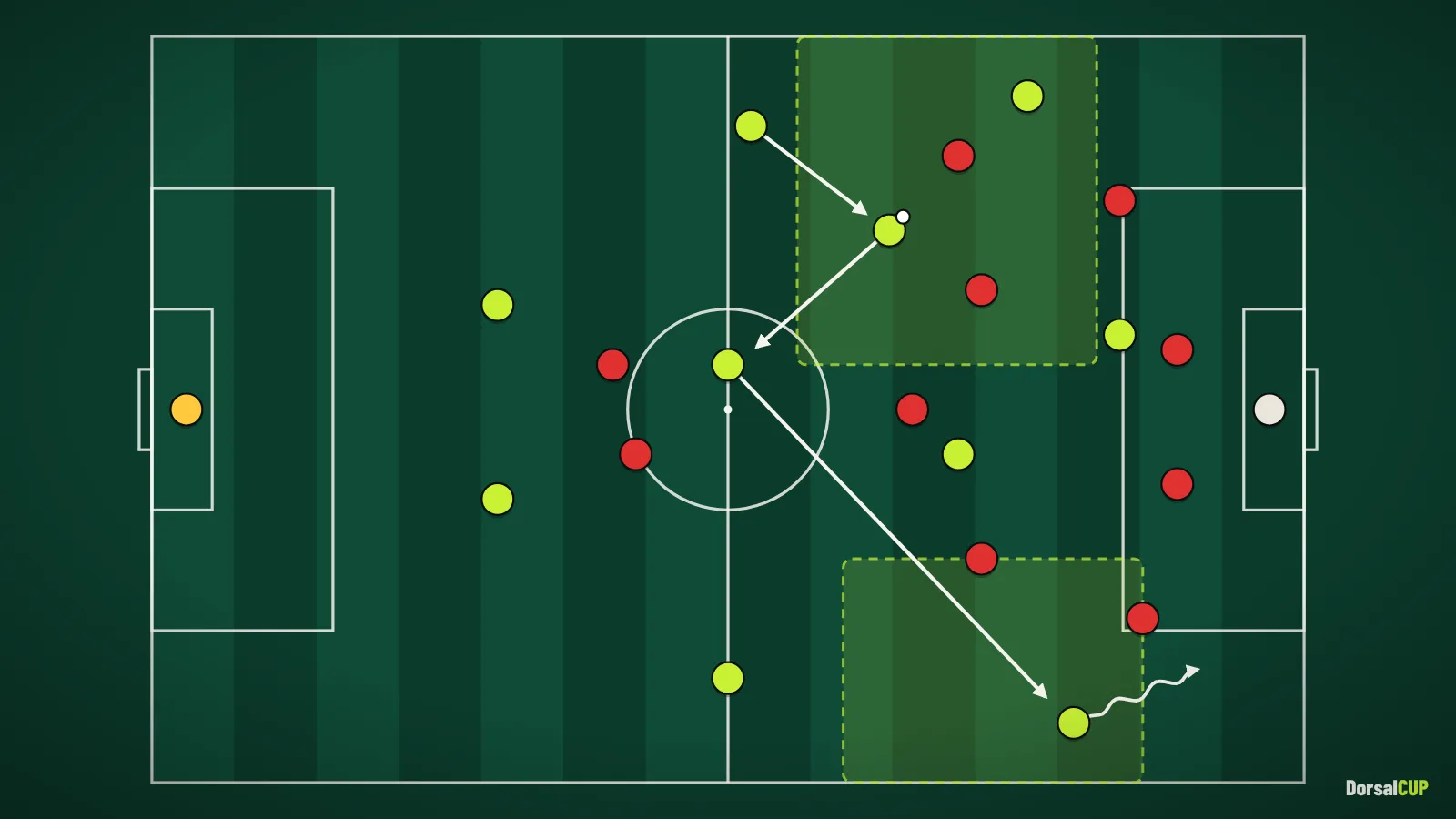
The phase of play brings the sub-principle onto the real pitch with real distances. Lime attack with ten outfield players; red defend with eight plus a goalkeeper in a mid-block.
Organisation
- From the halfway line to the red goal, full width. Lime: back four, three midfielders, front three. Red: goalkeeper, back four, midfield four.
- Each attack starts with a lime centre-back. Lime score in the big goal; a goal after a switch that leaves the far winger 1v1 counts double.
- Red score in one of two mini-goals on the halfway line after a regain. Lime counter-press for 6 seconds, then the two centre-backs and the 6 must defend the counter-attack.
- Four blocks of 6 minutes, 2 minutes 30 seconds' rest. Rotate the attackers and defenders at half time.
Key ideas
- Overload with the full-back, 8, 6 and winger on the ball side so that red's midfield shifts across.
- The switch is played when the far red full-back is pulled inside or the red midfield has shifted fully. Too early, and red have time to slide back.
- The far winger stays wide and high until the switch; the far full-back gives support from behind and inside.
- After the switch, the winger attacks the full-back 1v1 quickly, before cover arrives.
Contra-strategies: if red refuse to shift and stay narrow, the overload side is free for a cross or a run from the 8; if red's far winger drops to make a back five, lime's far full-back becomes the free player. Further reading: overload to isolate.
Common mistakes: the switch is played in the air and too slowly; the far winger drifts inside looking for the ball and closes his own space; nobody occupies the box when the 1v1 happens.
At tournaments and festivals, what you train during the week shows up in several games in a row. DorsalCUP runs the draw, the schedule and live results for free, and the tournament matchday checklist helps you forget nothing.
Final game: 11v11 conditioned
- 11v11, two blocks of 15 minutes, 4 minutes' rest.
- Goals after a switch that isolates a winger count double; after a loss, the team must regain within 6 seconds or drop into its mid-block.
- The coach stops the game only at natural restarts, with short questions to the units involved.
What to record during the game: the number of switches that reached a winger in a 1v1, how many of them came after a genuine overload (four lime players on the ball side), and the regains within 6 seconds. Two or three clips of each are enough for Thursday's video meeting; showing a good example from the players' own game teaches more than a clip from professional football.
Load and monitoring
This session is the highest-volume day of the week. Total time in exercises is about 80 minutes, with large spaces and long blocks. If GPS is available, distance and high-speed running should be close to a match in proportion to the minutes trained; without GPS, session RPE multiplied by minutes gives a usable weekly picture. MD-2 should be shorter and sharper, MD-1 short and light.
Adapting the session
- Fewer players (16): Exercise 1 as 6v6+2; Exercise 2 as 8 v 6+GK with lime's full-backs removed; the final game 8v8 between the boxes.
- MD-4 instead of MD-3 (a 'tension' day in tactical periodisation terms): reduce the spaces (Exercise 1 to 35×30 m), shorten blocks to 3 minutes and increase the number of duels.
- Two matches in one week: remove Exercise 2 and shorten the final game to 2×10 minutes.
- Different game model: keep the structure (pattern → positional game → phase of play → 11v11) and change the sub-principle and rules.
Related reading: tactical periodisation and the game model and the U16 session on build-up against a high press.
Frequently asked questions
What is an acquisition day in football training?
In tactical periodisation, the days between recovery and pre-match activation, when the team learns and reinforces its game model. MD-3 often has the largest spaces and longest blocks; MD-4 smaller spaces and more duels; MD-2 higher speed and shorter blocks.
How long should a U18 football training session be?
Most U18 sessions last 75 to 105 minutes. The main acquisition day can be close to 100 minutes, while the sessions before a match are shorter. What matters is the weekly pattern, not a single session.
How do you link training to a game model?
Choose one principle and one sub-principle for the day, and make every exercise train it: an unopposed pattern, a positional game, a phase of play and a conditioned game. The rules of each exercise should reward the behaviour you want.
Do U18 players need separate fitness sessions?
Most physical demands can come from well-designed football exercises, adjusted through space, numbers, duration and rules. Strength and injury-prevention work is still needed, ideally planned on the lower-intensity days.