
Tactical Periodisation: The Game Model and the Weekly Morphocycle
Tactical periodisation organises all training around the team's game model: the way the team should play in each moment of the game. Every exercise trains a principle of that model, and the week is structured as a morphocycle that alternates the type of effort between matches. Physical, technical and mental work are not removed; they are trained through tactical exercises. This article covers how to build the game model, how to plan the morphocycle, how to design exercises with a tactical purpose and how to control the load.
Do you organise tournaments? Create yours for free on DorsalCUP.
In this article
What tactical periodisation is, and what it is not
Tactical periodisation was developed by Vítor Frade at the University of Porto and became widely known through Portuguese coaches who used it at the top level. Its main idea is that the tactical dimension leads: the team's way of playing defines what is trained, and the other dimensions (physical, technical, psychological) are trained inside exercises that reproduce that way of playing.
It is not a weekly calendar copied from a top club, and it is not the absence of physical training. A team that uses tactical periodisation still runs at high speed, still does strength work and still has days of low load. The difference is that the high-speed running, for example, happens inside an exercise of attacking transition that the team uses in games.
The method rests on a few working principles:
- Specificity: every exercise is linked to the game model. Generic drills with no link to the way the team plays are left out or kept to a minimum.
- Propensity: exercises are designed so that the target behaviour happens many times. Rules, space and numbers create the conditions.
- Horizontal alternation: the type of effort changes from one day to the next (tension, duration, speed), so that players can recover from one demand while training another.
- Complex progression: the model is learned from simpler to more complex situations, and the most important principles appear first and most often.
Building the game model: principles, sub-principles and sub-sub-principles
The game model describes how the team plays in the four moments of the game (organisation in possession, organisation out of possession, the transition to defence and the transition to attack) and in set pieces. It is shaped by the coach's ideas, the players available, the club's culture and the competition.
Each moment is organised in levels:
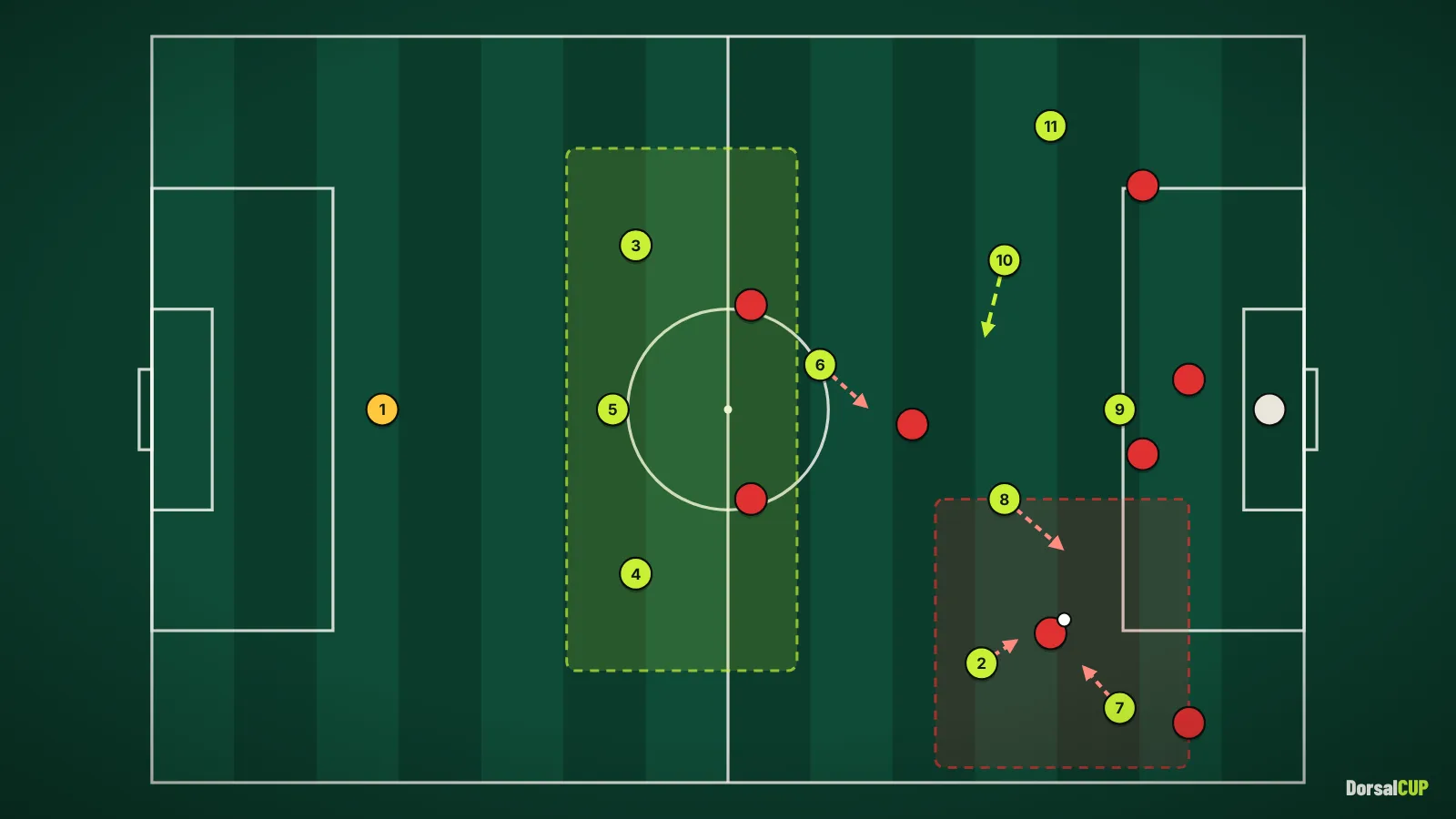
- Principles: the main behaviour of the team. Example for the transition to defence: 'after losing the ball, we try to win it back immediately in the zone of the loss'.
- Sub-principles: the behaviour of a sector or group. 'The three players nearest the ball close the ball carrier and his closest passing options; the rest defence controls the opponent's strikers'.
- Sub-sub-principles: the individual behaviour. 'The nearest player arrives with a curved run that blocks the back pass; the 6 steps forward to close the pass into the centre'.
| Moment | Example principle | Example sub-principle |
|---|---|---|
| Organisation in possession | Build up through the centre with a free player behind the first line | Back three plus a double pivot against two strikers |
| Organisation out of possession | Mid block that protects the central lane | Strikers screen the pivot; wide midfielders stay narrow |
| Transition to defence | Counter-press for 5 seconds in the zone of the loss | Nearest three press; 6 closes the central lane |
| Transition to attack | First pass forward if it is on | Far-side winger runs behind on recovery |
| Set pieces | Attack the near post and the six-yard box | Two blockers, one runner to the near post |
The weekly morphocycle
The morphocycle is the weekly pattern between two matches. With a Sunday game and a Sunday game the following week, the most common pattern for professional teams looks like this. The names refer to the days before (MD-) and after (MD+) the match.
| Day | Main emphasis | Typical exercises |
|---|---|---|
| MD+1 | Recovery for starters; compensatory work for others | Low-intensity work, small-sided games for non-starters |
| MD+2 | Off | |
| MD-4 | Tension: strength, accelerations, decelerations | Small spaces, few players, short bouts, sub-sub-principles |
| MD-3 | Duration: the main team principles | Large spaces, 9v9 to 11v11, longer bouts close to match demands |
| MD-2 | Speed: high speed in low volume | Large spaces, few players, long recovery between bouts |
| MD-1 | Activation and set pieces | Short, quick exercises, low volume, rehearsal of the plan |
| MD | Match |
Tension (MD-4) exercises use small spaces, roughly 50 to 100 m² per player, with frequent changes of direction and contact. They train individual and small-group behaviours: counter-pressing, duels, receiving under pressure. Duration (MD-3) exercises use larger spaces and numbers, around 150 to 250 m² per player, and train the collective principles over 8 to 12 minute bouts. Speed (MD-2) exercises allow maximal running in short actions with full recovery, typically with fewer players in large spaces. These references are approximate and should be adapted to the squad.
Amateur and youth teams with two or three sessions a week cannot reproduce the full pattern. A practical solution for a Tuesday-Thursday-Friday week: Tuesday as a tension day with a moderate volume, Thursday as the duration day and the main tactical session, Friday as a short speed and activation session. With only two sessions, combine tension and duration in the first and keep the second shorter and faster.
Designing exercises with tactical intention
An exercise is designed backwards: start from the game problem, identify the principle involved, then choose space, players, rules and scoring so that the principle appears many times.
- Game problem: in the last match, the opponent counter-attacked through the centre after every loss in the final third.
- Principle: counter-press for 5 seconds in the zone of the loss, with the 6 closing the central lane.
- Exercise: 8v8 plus goalkeepers in 60 x 50 m, with a central zone; a team that wins the ball back within 5 seconds of the loss scores a bonus point.
- Variables: reduce the space to increase pressure; add a neutral player to make possession easier and losses less frequent; change the scoring to reward the target behaviour.
The coach's feedback must match the principle. If the exercise trains counter-pressing, the comments are about proximity, the first reaction and covering the central lane. Comments about other topics are kept short.
A pre-season tournament or a four-team round robin mid-season gives you several matches in one day to test these ideas against different opponents. The DorsalCUP tournament fixture generator builds the matches, pitches and kick-off times in minutes, free and with no sign-up.
Controlling the load
Tactical periodisation does not replace load monitoring. It uses it to check whether the week follows the planned pattern.
- Session RPE: each player rates the session's effort on a scale of 0 to 10, multiplied by its duration in minutes. Simple, cheap and useful at any level.
- GPS and accelerometers: where available, total distance, high-speed running, sprints, accelerations and decelerations. The tension day should show many accelerations; the duration day the highest total distance; the speed day the sprint exposure in low volume.
- Wellness questionnaires: sleep, fatigue, soreness and mood each morning, to spot players who need an adjusted session.
- Youth players: monitor growth. During the growth spurt, reduce volumes of jumping and sprinting and watch for knee and heel pain.
Three example exercises with their load
MD-4, 5v5+3 counter-pressing game: 35 x 30 m, 6 x 2 min, 1 min rest. Focus: proximity, first reaction after the loss. MD-3, 10v10+GK on 70 x 68 m: 3 x 10 min, 3 min rest. Focus: build-up through the centre and the rest defence. MD-2, 3v2+1 transition: from halfway, 8 to 10 repetitions per group, 90 s rest. Focus: speed of the first pass and runs behind.
Common errors and what to look for on video
- Training that does not match the model. The model says the team builds up short, but every exercise is a game to big goals with no restriction. Compare: how many training clips show the principles from the last match analysis?
- A model that is too long. Forty principles that nobody remembers. Test the players: can they explain the main principle of each moment?
- Copying a professional morphocycle. A team that trains twice a week with a professional calendar ends up with no tension day and no duration day. Plan from the real schedule.
- Load not checked. The duration day ends up as intense as the tension day, and fatigue builds up. Check RPE or GPS by day type every week.
- Feedback off the principle. The coach trains counter-pressing and spends the session correcting passing technique. Record the coach's comments for one session and count how many relate to the exercise's objective.
On match video, edit clips by principle, not by minute. Five clips of the transition to defence in a game say more about whether the week worked than a full replay.
Frequently asked questions
What is tactical periodisation in football?
Tactical periodisation is a training methodology in which the team's game model guides all training. Every exercise trains a principle of the way the team plays, and the physical, technical and mental dimensions are trained inside those tactical exercises. The week is organised as a morphocycle that alternates the type of effort.
What is a morphocycle?
The morphocycle is the weekly pattern between two matches. A common version includes recovery after the match, a day off, a tension day with small spaces, a duration day with large spaces and the main team principles, a speed day, and a short activation day before the game.
What is a game model in football?
A game model describes how a team wants to play in each moment of the game: in possession, out of possession, the transition to defence, the transition to attack and set pieces. It is organised in principles, sub-principles and sub-sub-principles.
Can amateur teams use tactical periodisation?
Yes, with an adapted week. With three sessions, use the first as a tension day, the second as the main tactical session with large spaces and the third as a short speed and activation session. The key is that every exercise is linked to the game model.