
Small-Sided Games in Football: How to Design Them, 9 Games
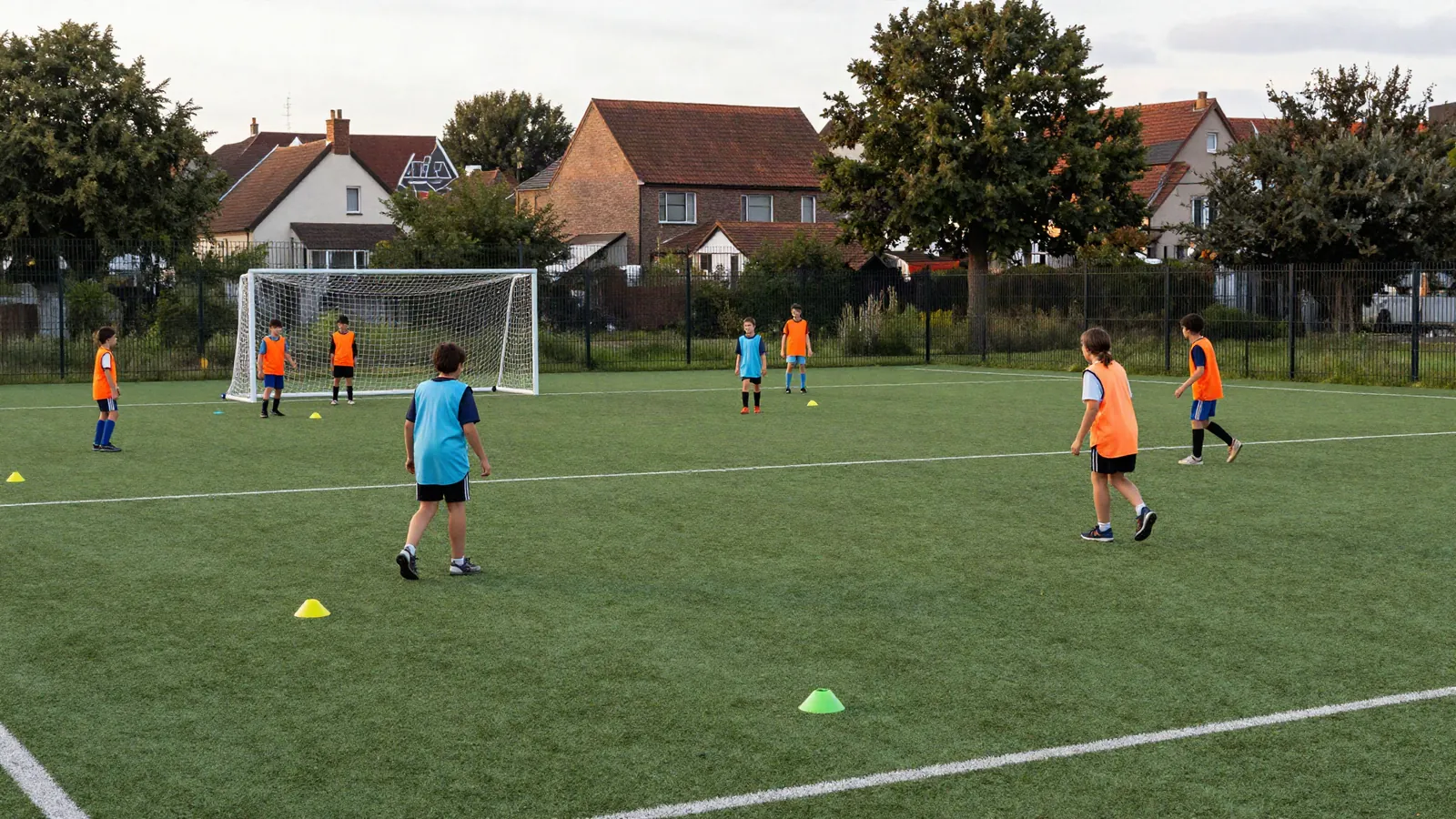
Small-sided games in football are matches with fewer players and a smaller pitch, set up so that one part of the game happens again and again. By changing four things (space, numbers, goals and rules) the coach decides what players will practise without stopping play to explain it. This guide shows how to design them and gives nine games you can run with youth or adult players.
Do you organise tournaments? Create yours for free on DorsalCUP.
In this article
Why small-sided games work
In an 11v11 match, a young player might touch the ball 30 times. In a 4v4, the same player touches it far more often, makes many more decisions and is never more than a few seconds from being involved. Small-sided games also keep the main elements of football together: there is a ball, opponents, teammates, direction and a goal. Players learn to recognise situations, not just to repeat techniques.
They are also honest. A player who drifts out of the game in a drill line cannot hide in a 3v3.
How to design small-sided games: the four dials
Think of each variable as a dial the coach can turn:
| Dial | Turn it up | Turn it down |
|---|---|---|
| Space | Bigger pitch: more time, more running, more long passes | Smaller pitch: more pressure, more 1v1s, quicker decisions |
| Numbers | Overload (e.g. 5v3): easier to keep the ball, build-up practice | Underload (e.g. 3v5): defending, transition, winning the ball |
| Goals | Several small goals: switching play, scanning | One big goal with goalkeeper: finishing, defending the box |
| Rules | Touch limits, passing targets, zones | Free play: let the game teach |
A rough guide for space is 80–150 square metres per outfield player for possession and attacking games, and less for pressing and 1v1 work. A 4v4 for U10s on 25 x 20 metres is tight; on 35 x 25 metres it gives time to pass.
Small-sided games with mini goals
Game 1: 4v4 to four mini-goals (focus: switching play)
Pitch 30 x 25 metres, two mini-goals on each end line, about 15 metres apart. Each team attacks two goals and defends two. No goalkeepers. Variants: a goal in the goal opposite to where the attack started counts double. Coaching points: look before receiving, if one goal is crowded, play to the other side.
Game 2: 3v3 dribble gates (focus: running with the ball, 1v1)
Pitch 25 x 20 metres with five or six 2-metre cone gates spread inside. A team scores by dribbling through any gate and keeping the ball. It cannot score through the same gate twice in a row. Good for U7–U10, and as a warm-up game for older players.
Small-sided games for attacking and possession
Game 3: 3v3 end-zone game (focus: penetration, timing of runs)
Pitch 30 x 20 metres with a 5-metre end zone at each end. A team scores when a player receives a pass inside the end zone they attack. Players may not wait in the zone; they must run in as the pass is played. Variant: the receiver must then dribble back out to score a bonus point.
Game 4: 4v4 + 2 floaters (focus: keeping the ball)
Grid 30 x 30 metres. Two neutral players always play for the team with the ball, giving a 6v4. Ten passes score a point. Floaters are limited to two touches. Rotate floaters every three minutes. For older players, put the floaters on the outside of the grid so the inside players must create angles.
Game 5: 5v5 with wide channels (focus: width and crossing)
Pitch 40 x 30 metres with goals and goalkeepers, plus a 5-metre channel on each touchline. Only one attacker can enter a channel and no defender may follow. A goal from a cross out of a channel counts double. This rewards wide players for staying wide.
Small-sided games for defending and transition
Game 6: 3v3 waves (focus: transition)
Pitch 30 x 20 metres with two small goals. Three teams of three. Team A attacks Team B; when the attack ends, Team B immediately attacks the other way against Team C, which enters from the end line. Teams rotate continuously. Players get no time to switch off after losing the ball.
Game 7: 4v4 with the regain bonus (focus: counter-pressing)
Pitch 30 x 25 metres with goals and goalkeepers. If a team wins the ball back within five seconds of losing it, any goal from that attack counts triple. Coaches can count regains aloud to help players notice them.
Game 8: Numbers game (focus: 1v1 to 3v3 decisions)
Pitch 25 x 20 metres, two goals. Two teams numbered 1 to 5 stand on opposite touchlines. The coach plays a ball in and calls one, two or three numbers; those players enter and play until the ball goes out or a goal is scored. Good for U8–U12 because everyone is involved and rest periods are built in.
Game 9: 6v6 with two-touch in own half (focus: playing forward)
Half a pitch, goals and goalkeepers. Players have a maximum of two touches in their own half and free touches in the opponents' half. This pushes teams to move the ball quickly out of the back and to carry it once they reach the final third.
Running small-sided games well
- Bouts of 3–5 minutes with short breaks keep intensity high; 4–6 bouts per game is enough.
- Spare balls at every goal so play restarts within seconds.
- Mix teams regularly. Put stronger players together sometimes so they are challenged, and spread them out other times.
- Coach in the breaks, not during play: one question per break ("Where was the free player?") is usually enough.
- Keep score. Competition raises effort and decision speed.
For U6–U8, use 2v2 and 3v3 with goals and no goalkeepers. For U9–U12, 3v3 to 5v5 with clear constraints. For U13 upwards and adults, 5v5 to 8v8 on bigger areas, with tactical constraints such as zones or touch limits.
Frequently asked questions
What are small-sided games in football?
They are matches with fewer players than the full game, usually 2v2 to 8v8, on a smaller pitch. Coaches use them to repeat specific situations, such as 1v1s, switching play or pressing, inside a real game.
What size pitch should a small-sided game use?
It depends on the aim and the age. As a guide, allow 80–150 square metres per outfield player for possession games and less for pressing or 1v1 work. A 4v4 for U10–U12 players typically works on 25 x 20 to 35 x 25 metres.
How long should small-sided games last?
Short bouts of 3–5 minutes with 1–2 minutes of rest keep intensity and focus high. Four to six bouts of one game is usually enough before changing the game or the constraint.
Are small-sided games better than drills?
They work best together. A short technical drill can introduce a skill, and a small-sided game then puts it under pressure with opponents and decisions. Most of the session time should be in game-like activity.