
Opposition Analysis in Football: From Scouting Report to Game Plan
Opposition analysis is useful only when it changes what the team does on Saturday. The analyst's job is to find the opponent's main patterns and weaknesses in the four moments of the game and in set pieces; the coach's job is to choose two or three ideas, train them during the week and give them to the players in a form they can use under pressure. This article covers the weekly cycle, the structure of the report and how to turn it into a game plan.
Do you organise tournaments? Create yours for free on DorsalCUP.
In this article
What opposition analysis is for
The aim is not to know everything about the opponent. It is to answer a few questions well. How do they try to hurt us? Where are they vulnerable? What do we need to change, if anything, in our own game model to deal with them? A 40-page report that nobody reads has less value than one clear idea per moment that the players apply in the game.
The analysis also has limits. Opponents change: a new coach, an injury, a different system for an away game. The analysis prepares the team for the most likely scenario and one or two alternatives, so that the staff can recognise quickly which version of the opponent is on the pitch.
At semi-professional and amateur level, the same process works with fewer resources: two recent games on video, one person who watches them with a structured template and a short meeting with the head coach.
The weekly cycle of the analyst and the coach
| Day | Analyst | Coach and staff |
|---|---|---|
| MD+1 | Review of own match, clips by moment | Debrief with staff, priorities for the week |
| MD+2 | Opponent footage: last 3 to 5 games, home and away | Off or individual work |
| MD-4 | Report to staff: patterns, weaknesses, set pieces | Choose the 2 to 3 key ideas, design exercises |
| MD-3 | Clips for the main tactical session | Train the plan inside the game model |
| MD-2 | Short player presentation, 8 to 12 minutes | Unit meetings: defenders, midfielders, forwards |
| MD-1 | Set-piece clips, final line-up checks | Rehearse set pieces, final instructions |
| MD | Live notes, half-time clips | In-game decisions, half-time message |
The order matters. The analysis has to be ready before the main tactical session, which is usually MD-3. A report that arrives on MD-1 can only change the set pieces.
Choose the games carefully. The most useful footage shows the opponent against teams that play like yours, and recent games with the same coach and similar players. Use a wide-angle view when possible: a television broadcast hides the positions of players away from the ball.
Match day: the live check
The analysis does not end with the report. During the first 15 to 20 minutes, the analyst, ideally in the stand with a view of the whole pitch, checks a short list prepared in advance and sends a summary to the bench.
- Is the opponent using the expected system in possession and out of possession?
- Is the pattern we planned to press happening, and is our trap winning the ball where we wanted?
- Has the opponent changed something against us: a different build-up, a man-marking job on one of our players, a new set-piece routine?
- Which of our planned ideas is not working, and why: the opponent, our execution, or our positions?
At half-time, two or three clips on a tablet are enough to show the players one thing to keep and one thing to change. The decision about what to show belongs to the head coach; the analyst prepares the options.
The scouting report: the four moments and set pieces
A useful scouting report follows the structure of the game model, so that each finding is linked to something the team trains.
- Line-up and system: usual starting XI, system in possession and out of possession, changes in the last games.
- Organisation in possession: who builds up, how the structure changes (a 6 dropping, a full-back inverting), goal kicks short or long, preferred side, main attacking patterns into the final third, who creates and who finishes.
- Organisation out of possession: block height, pressing structure and triggers, who jumps, distances between lines, which side or player is weakest defensively.
- Transition to defence: do they counter-press or retreat? How many players stay behind the ball? Where are they exposed after a loss?
- Transition to attack: who is the first option after a recovery, who runs, how quickly the ball goes forward.
- Set pieces: corners and free kicks for and against, marking system, blockers, delivery type, takers, throw-in routines.
- Key individuals: strong foot, preferred movements, habits under pressure, discipline record where it matters.
Numbers can support what the video shows: where the opponent loses the ball, how often they play long from goal kicks, how many passes they allow before making a defensive action. They are useful as a check on a trend, not as a replacement for watching the games.
For each key individual, a short profile is often more useful than a long description: strong foot, preferred receiving zone, what he does when pressed, and one habit that can be used against him. A centre-back who always turns onto his right foot, for example, gives the pressing team a clear direction to press.
Turning the analysis into a game plan
The staff now choose two or three ideas, rarely more. Each idea should be expressed as a cause and an action that the players can recognise in the game.
- In possession: 'Their right-back pushes very high when they attack and their right centre-back is slow to cover. When we win the ball, our left winger runs behind the right-back and the first pass goes into that space.'
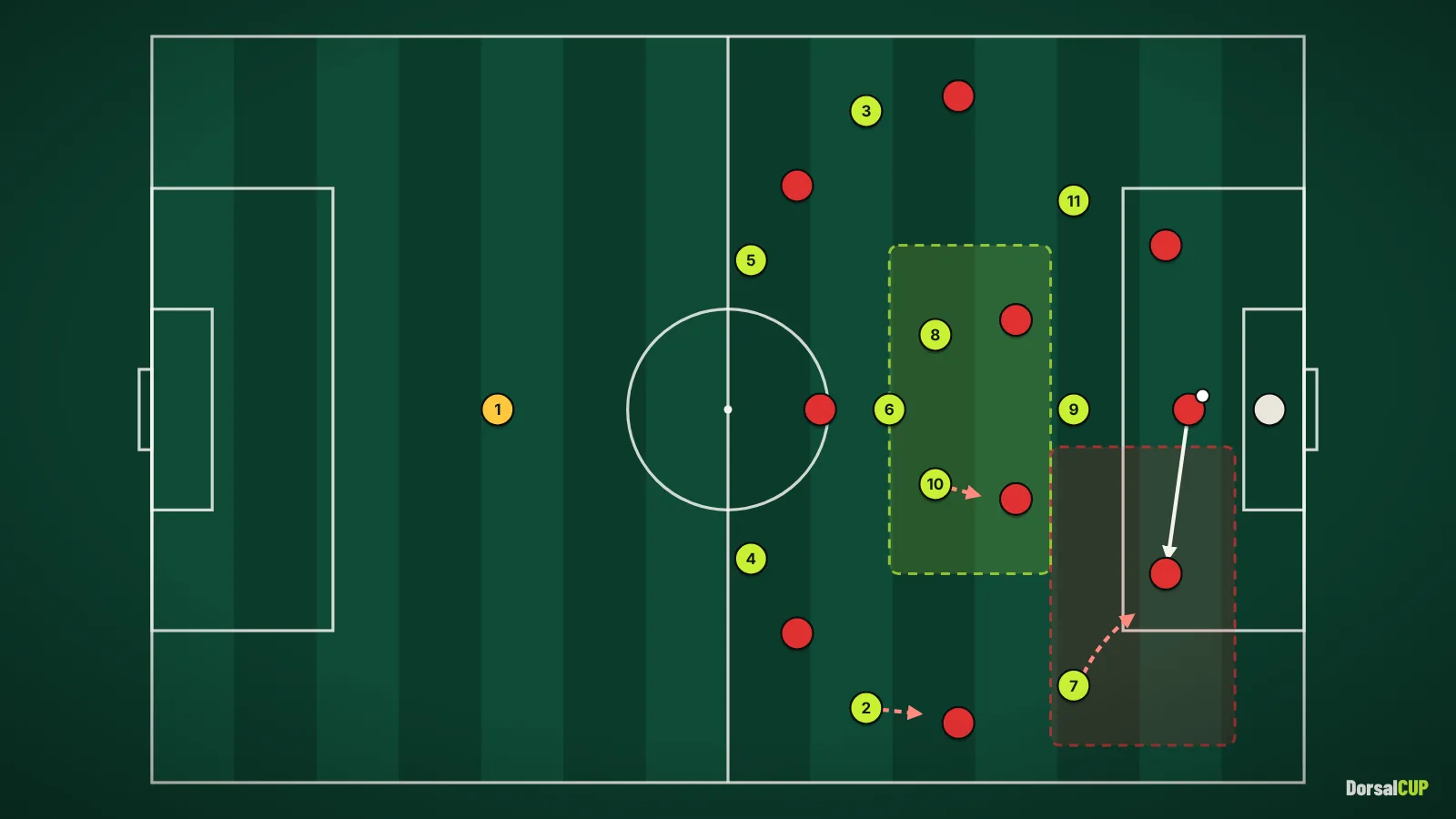
- Out of possession: 'Their 6 drops to build with three. Our 9 stays on the 6, the wide forwards press the outside centre-backs and close the pass to the full-back.'
- Set pieces: 'They defend corners with four zonal players on the six-yard line and three markers. The back-post edge of the six-yard box is free; our best header attacks it from a late run.'
Defensive ideas follow the same format. If the opponent's main attacking pattern is an inverted winger receiving in the half-space while the full-back overlaps, the plan names who takes the winger, who tracks the overlap and who screens the pass inside.
A pre-season tournament or a four-team round robin mid-season gives you several matches in one day to test these ideas against different opponents. The DorsalCUP tournament fixture generator builds the matches, pitches and kick-off times in minutes, free and with no sign-up.
How to train the game plan during the week
1. Opponent-condition game, 11 v 11
Objective: rehearse the plan against a realistic picture. Space: full pitch or 80 x 68 m. Players: the starting team against the rest of the squad, who play with the opponent's system and main habits (for example, the 6 dropping between the centre-backs). Rules: start each restart with the opponent's typical build-up; the starters score a bonus goal if the planned trap wins the ball in the target zone. Load: 3 x 10 min, 3 min rest, on MD-3. Coaching points: the trigger, the first player to press, the cover behind him.
2. Shadow play of the plan
Objective: positions and movements without opposition pressure. Space: full pitch. Rules: the coach moves the ball by hand or with a pass to cones that represent the opponent's players; the team moves as a unit to the planned positions. Then add passive opponents. Load: 10 to 12 minutes, low intensity, suitable for MD-2 or MD-1. Coaching points: distances between lines, the trap's starting position.
3. Set-piece rehearsal
Objective: the two or three set-piece ideas from the report. Organisation: a defending group that reproduces the opponent's corner set-up. Load: 6 to 8 repetitions per routine on MD-1, with full recovery. Coaching points: timing of the run, the delivery area, protection against the counter after the corner.
Common errors and what to look for on video
- Too much information. The players receive 20 points and remember none. Count the ideas in the player presentation: more than three is usually too many.
- Analysis that does not reach the training. The report is good but the week's exercises do not change. Check whether each key idea appears in at least one exercise.
- Old footage. The opponent has changed coach or system. Check dates and line-ups of the games you analyse.
- Only weaknesses. The plan attacks the opponent's weaknesses but forgets their main strength. Every plan needs one defensive idea against what they do best.
- No in-game check. On match day, the analyst should confirm in the first 15 to 20 minutes whether the opponent is playing as expected and report to the bench. Compare live notes with the report at half-time.
After the game, review the plan: did the opponent do what the report said, and did our ideas work? This review is the start of the next cycle and improves the next report.
Frequently asked questions
What should a football scouting report include?
The opponent's line-up and system, how they play in the four moments of the game (in possession, out of possession and both transitions), their set pieces for and against, and their key individuals. Each point should be linked to a decision for the game plan.
How many games should you watch for opposition analysis?
Three to five recent games is a common range, ideally including home and away games and games against teams that play in a similar way to yours. At amateur level, two well-chosen games are often enough.
How do you present opposition analysis to players?
In a short session of 8 to 12 minutes, with 6 to 10 clips under 15 seconds each, organised around two or three key ideas. Each clip should finish with what the team will do in that situation.
What is the difference between opposition analysis and match analysis?
Match analysis reviews your own team's performance to improve it. Opposition analysis studies the next opponent to prepare a game plan. Both use the same structure of the four moments and set pieces.