
In-Game Tactical Changes: Switching Systems and Managing the Score
In-game tactical changes are only useful when they answer a specific problem: an opponent's free player, a line that is outnumbered, or a score that requires more or less risk. A change of system, a substitution or a new instruction should be prepared in the week, named with a simple code and delivered with one message. This article covers how to read the problem, the most common system switches, how to manage the score, substitutions with a tactical purpose and how to communicate from the bench.
Do you organise tournaments? Create yours for free on DorsalCUP.
In this article
Why in-game tactical changes decide games
Every game plan is a hypothesis. The opponent may press higher than expected, play with a different structure, or target a player who is having a difficult day. A coaching staff that waits until half-time to react can lose the game in the first 30 minutes; one that changes too often confuses the players and loses the structure it trained.
The key is to separate the problems that the players can solve on the pitch from those that need an intervention. A full-back being beaten one-to-one can be helped with an instruction to the winger. An opponent's 3v2 in the first line of the press, every time the team builds up, is a structural problem: it needs a change of shape, a player in a different position or a different first pass.
At youth level, the same logic applies, but with fewer and simpler changes. An under-16 team that has trained one alternative structure during the season can switch to it in a game. A team that has never practised it will not.
Reading the problem: three questions
Before deciding anything, the staff should agree on the diagnosis. Three questions cover most situations.
- Where is the free player? In possession: who is the spare player in our build-up, and can we reach him? Out of possession: who is the opponent's spare player, and how does the ball reach him?
- Which line is outnumbered? Count the players in each line: our first line against their first pressing line, our midfield against theirs, our back line against their attackers. A line that is outnumbered for 15 minutes is not a coincidence.
- What does the score and the time require? Leading by one with 20 minutes to go needs a different risk level from trailing by one. The change must fit the game state, not only the tactical picture.
The assistant or analyst on the bench, or in the stand with a wider view, should have two or three key indicators for the first 20 minutes: how the opponent's first line presses, where they win the ball and where their dangerous attacks start. A short note at around 20 minutes gives the head coach a basis for the decision before half-time.
Changing formation during a game: four common switches
4-3-3 to 3-4-3
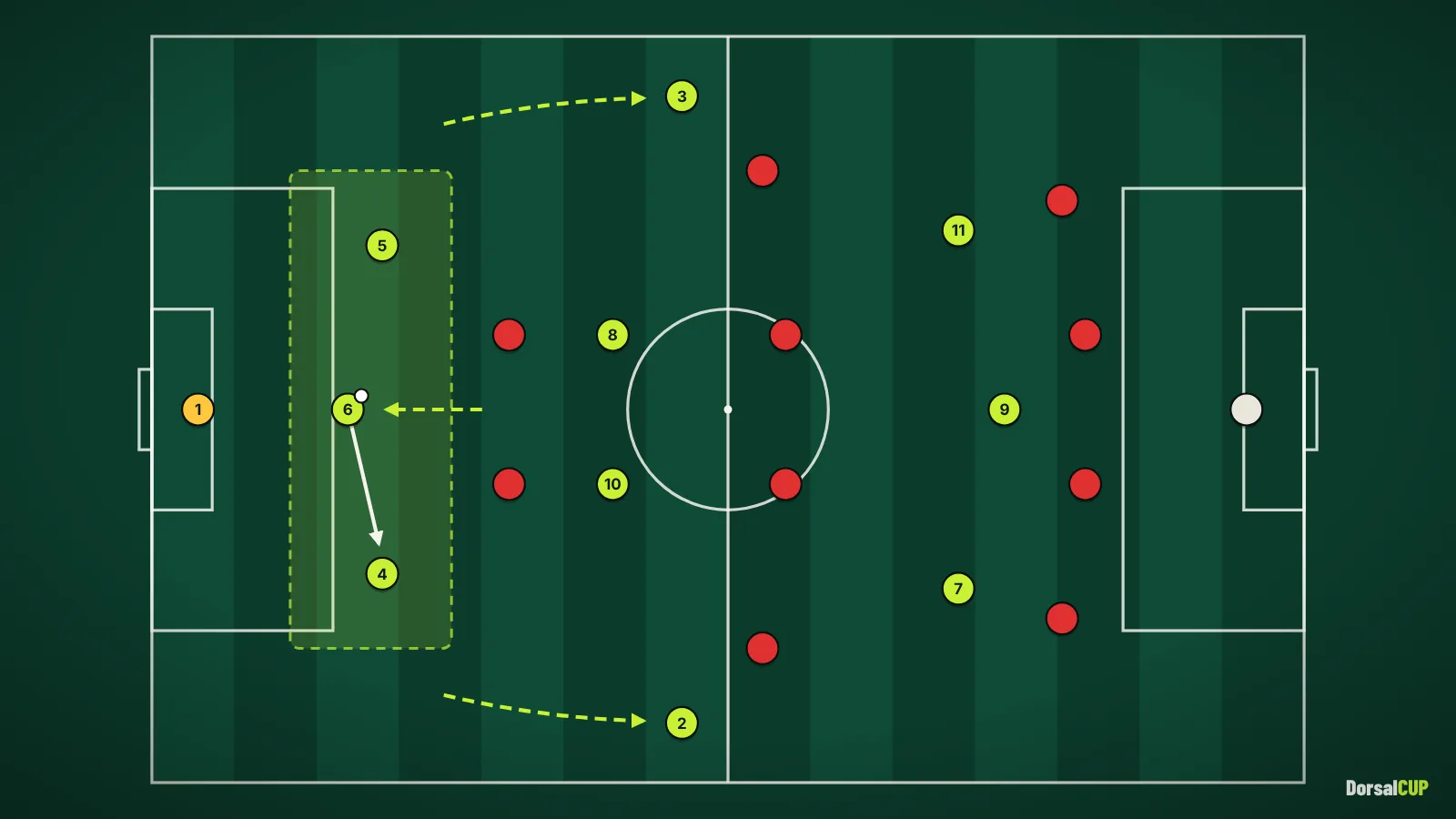
The most frequent use is to beat a press with two strikers. The 6 drops between the centre-backs, the full-backs push up to become wing-backs and the two 8s form a double pivot. The back three now has a 3v2 against the strikers, and the wide centre-backs can carry the ball into the half-spaces. The wingers can play narrower, between the opponent's full-back and centre-back, because the width comes from the wing-backs.
Out of possession, the same change gives five defenders against a team that attacks with wide forwards and overlapping full-backs. The cost is one fewer player in central midfield, so the two central players must be good at defending wide spaces.
4-4-2 to 3-5-2
Against a 4-3-3, a 4-4-2 often has a midfield problem: three opponents against two central players. Changing to a 3-5-2 gives a back three against the opponent's front three, wing-backs who can step to the opponent's full-backs and three central midfielders against three. The switch can be made with a substitution, a defender for a striker, or by dropping a central midfielder into the back line and moving the wide midfielders to wing-back.
Changing to the diamond
A 4-3-1-2 adds a player in the centre. Against a 4-3-3 with a single pivot, the diamond creates a 4v3 in the middle and places the 10 behind the pivot, in the space between the opponent's midfield and defence. The width comes from the full-backs, so they must be fit enough to cover the whole flank.
Back to a back four
When the team is behind and the opponent defends deep, a back three becomes a luxury. Moving to a back four, or even a back three with only one midfielder in front, adds an attacker. This is a decision for the last 15 to 20 minutes, not the first half.
Game management: playing with the score
| Game state | Typical adjustment | Risk to control |
|---|---|---|
| Leading by one, last 20 minutes | Lower the block by 5 to 10 m, add a fifth defender or a defensive midfielder | Giving up all possession; keep a striker who can hold the ball |
| Leading by two | Keep the system, rest players, control tempo with possession | Losing intensity after the goal |
| Level, last 20 minutes | Fresh legs in the front line, change the profile of the 9 | Opening the game too early |
| Trailing by one, last 15 minutes | Back three, 3-1-6 or 2-3-5, a second striker, earlier crosses | Counter-attack against a small rest defence |
| Trailing by two | Change two or three players at once, direct play to a target | Conceding a third goal that ends the game |
Chasing a game with all the players in the final third works only if the rest defence is still organised. A 3+1 behind the ball, with the goalkeeper high, can control one or two opposition attackers. Without it, a team that is losing by one often ends up losing by two.
When leading, the most common error is to drop the whole block towards the penalty area without a plan to keep the ball. Some possession in the opponent's half, a player who can win free kicks and well-timed substitutions are often as useful as an extra defender.
A pre-season tournament or a four-team round robin mid-season gives you several matches in one day to test these ideas against different opponents. The DorsalCUP tournament fixture generator builds the matches, pitches and kick-off times in minutes, free and with no sign-up.
Tactical substitutions and communication from the bench
A substitution can change energy, the system, a player profile or the rhythm of the game. Every change should have one of these purposes and be explained to the player in one sentence.
- Energy: like-for-like changes in pressing positions, usually from 60 minutes onwards. Pressing teams often change the front line as a unit.
- System: a defender for a forward to switch to a back three, or a second striker to switch to a 4-4-2.
- Profile: a fast winger against a tired full-back, a strong 9 when the team needs to play more directly, a ball-playing midfielder when the opponent sits deep.
- Timing: before a set piece, after a goal, or at a stoppage that the team can control. Under the 2026/27 Laws, the player being replaced must leave the field within 10 seconds of the board, so the substitution itself no longer gains time.
Many competitions allow five substitutions in three stoppages plus half-time. Check the competition rules: youth leagues often allow rolling substitutions, and the number of windows matters as much as the number of players.
Communicating the change
- Give each structure a short code that the players have used in training, such as a number or a word.
- Pass the message to two or three relay players: the goalkeeper, a centre-back and the 6. They organise the others.
- One change at a time. Two new instructions in the same stoppage reach the players as noise.
- At half-time, give the players two minutes to recover, then make two or three points, with one or two clips if video is available. Finish with the first action after the restart.
Under-12 and under-14 coaches should keep it even simpler: one instruction to one player, delivered calmly, at a stoppage near the bench.
How to train in-game tactical changes
1. 11 v 11 with a switch on signal
Objective: move from one structure to another in seconds. Space: full pitch. Players: two teams of 11. Rules: the coach calls the code of the second structure; the team must be organised in it within 15 seconds and the next goal counts double for the team that adapted correctly. Load: 3 x 12 min, 3 min rest. Coaching points: the first player who moves, the relay players' communication, the line heights after the change.
2. Scenario games
Objective: play with the score. Space: 75 x 68 m. Players: 9+GK v 9+GK. Rules: each block starts with a game state, for example 1-0 with 12 minutes left. The team that is behind can use one extra player for the last 4 minutes. Load: 4 x 12 min, 2 min rest. Coaching points: decisions of the team that leads (keep the ball or defend deep), rest defence of the team that is behind.
3. The bench rehearsal
Objective: staff decision-making. Format: before match day, the staff watch 20 minutes of the opponent's previous game and decide when and how they would intervene. Duration: 30 to 40 minutes. Points: whether the diagnosis is shared, whether the code exists and whether the players have trained it.
Common errors and what to look for on video
- Changes without diagnosis. A substitution is made because the team is losing, not because of an identified problem. Ask after the game: which problem did each change answer?
- New system, old references. Players change formation but keep the distances from the old one. On video, check the line heights and the width 2 minutes after the switch.
- Changing too late. The problem appears in minute 15 and the change comes at minute 65. Mark the time of the problem and the time of the answer in the analysis.
- Too much information at half-time. Players return with five instructions and apply none. Count the messages; two or three are enough.
Frequently asked questions
When should a coach change formation during a game?
When a structural problem repeats: a line that is outnumbered, an opponent's free player that reaches the ball every time, or a game state that requires more or less risk. A single error by one player is not a reason to change the system.
How do you switch from a 4-3-3 to a 3-4-3?
The 6 drops between the centre-backs or a full-back moves to a third centre-back, the full-backs become wing-backs and the two 8s play as a double pivot. It is most useful against an opponent who presses with two strikers.
What makes a good tactical substitution?
A clear purpose: more energy in pressing positions, a change of system, a player profile that attacks a weakness, or a change of rhythm. The purpose should be explained to the player in one sentence before he enters.
How do you manage a game when leading by one goal?
Lower the block a little, protect the centre, keep a striker who can hold the ball and use substitutions to keep energy in pressing positions. Avoid dropping all the players into the penalty area without a way to keep possession.
Sources
Verified in October 2026. Rules and age groups vary by association and by season; check your local regulations.