
Inverted Full-Backs: From 4-3-3 to a 3-2-5 in Possession
Inverted full-backs move from the touchline into midfield when the team has the ball, turning a 4-3-3 into a 3-2-5 or a 2-3-5. Done well, the move adds a player to the centre of the build-up, frees the wingers to hold the width and leaves a compact rest defence in place for the moment the ball is lost. Done badly, it clogs the centre and leaves an empty flank behind it. This article sets out the structures, the positional references, the opponent's likely answers and three exercises to coach it.
Do you organise tournaments? Create yours for free on DorsalCUP.
In this article
Why inverted full-backs change the build-up
A classic 4-3-3 in possession often ends up as a 2-1 at the base: two centre-backs and a single pivot, with both full-backs high and wide. Against a 4-4-2 that presses with two strikers, the centre-backs have no numerical advantage and the pivot is marked by the striker dropping into his cover shadow. The ball goes wide by default, and the touchline becomes the opponent's extra defender.
Moving a full-back inside solves three problems at once. First, it creates a second pivot, so the opponent's first line now has to deal with two players behind it instead of one. Second, it lets the winger keep the width on that side, so the front line can occupy all five vertical lanes. Third, and this is the part many teams discover only after conceding on the break, it places a midfielder-shaped player in front of the centre-backs at the moment of the loss, which is where counter-attacks are stopped.
The idea is associated with positional coaches in the last fifteen years, but the logic is older: occupy the space between the opponent's lines with enough players to circulate the ball, and keep enough players behind the ball to defend the transition. The full-back is simply the most available player to do both jobs.
3-2-5 and 2-3-5: the two main structures
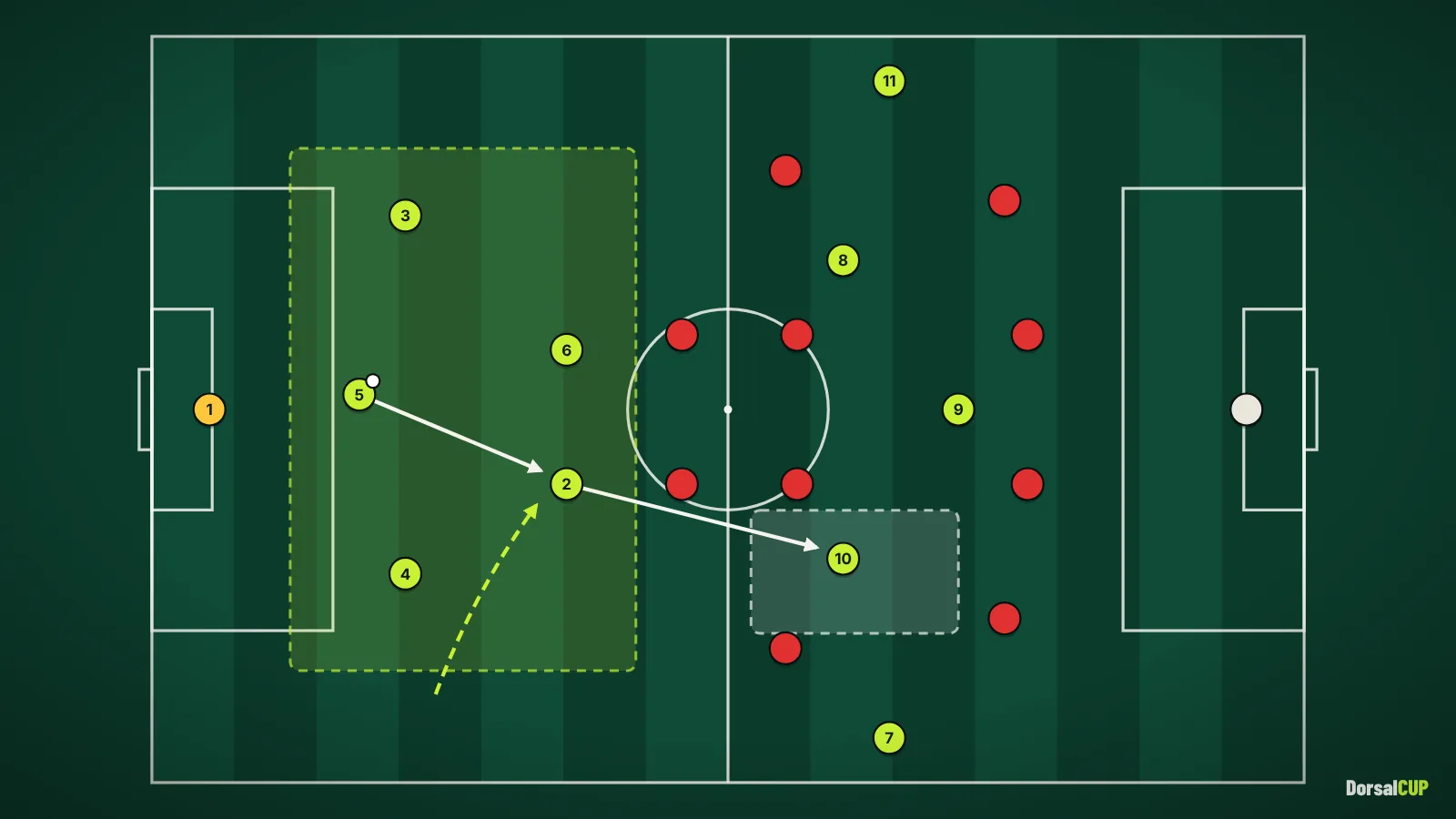
The asymmetric 3-2-5. One full-back inverts and the other stays as the third centre-back. With the right-back inside, the left-back stays low and narrow at roughly 15 to 20 m from the left touchline, the left centre-back takes the central position and the right centre-back slides towards the right half-space. The back three should cover about the width of the penalty area, 35 to 40 m, so that each defender is 15 to 20 m from the next. In front of them, the 6 and the inverted full-back stand 10 to 14 m apart, either side of the opponent's strikers.
The 2-3-5. Both full-backs invert. The two centre-backs split to the edges of the penalty area, the goalkeeper provides the third player in the first line, and three players sit behind the opposition's strikers. This structure is strongest against a single striker, such as a 4-1-4-1 or a 4-5-1, because the 2+GK v 1 gives the centre-backs time to carry the ball. It is weaker against a front three, because the centre-backs can be pressed one-to-one and the goalkeeper's passing becomes decisive.
| Structure | Best against | Main risk |
|---|---|---|
| 3-2-5 (one full-back inside) | 4-4-2 with two strikers; 4-2-3-1 | Overload on the side of the inverted full-back is lost if the winger does not hold width |
| 2-3-5 (both inside) | 4-1-4-1, 4-5-1, lone striker | Front-three press on 2 centre-backs; space behind both full-backs |
| 3-1-6 (one inside, one high) | Deep 5-4-1 | Only one player in front of the back three when the ball is lost |
The choice should follow the opponent's first line. A useful rule: the build-up needs one more player than the opponent's first pressing line, plus a free player behind that line. Two strikers means a back three plus a double pivot. One striker means two centre-backs plus the goalkeeper, with three players behind.
Sub-principles: position, timing and body shape
The move itself is simple. The detail decides whether it works. Coaches should define the following references and check them on video.
- Height: the inverted full-back stands behind the opponent's first line, not on it. If he is level with the strikers, he can be pressed from behind and cannot see the field.
- Lane: he occupies the half-space on his side, roughly the line of the edge of the penalty area, not the central lane, which belongs to the 6. Two pivots in the same lane give one passing line instead of two.
- Timing: he moves inside when the ball is in the opposite half of the back line or with the goalkeeper. Moving while the ball travels to his centre-back leaves him in transit when the press arrives.
- Body shape: open towards the opposite goal, with his back to the touchline. Receiving on the half-turn lets him play forward first time into the 10 or 8 in the half-space.
- Distance to the 6: 10 to 14 m. Closer and one opponent can screen both. Further and the passing lane between them is cut by a single striker.
The front five must make the inversion worth it. The winger on the inverted side stays on the touchline to fix the opposition full-back, and the 8 or 10 in that half-space stands between that full-back and the nearest centre-back. This is what gives the inverted full-back a forward pass: his job is rarely to dribble, but to connect the back three with the players between the lines.
How opponents respond, and the answers
A well-coached opponent will not let the extra pivot go free for long. The most common answers, and how to respond, are these.
The winger tracks the inverted full-back
If the opposition's wide midfielder follows the full-back inside, the lane outside the right centre-back is empty. The centre-back carries the ball into that lane until a player commits to him. As soon as the winger or full-back steps out, the 10 or the winger is free. The trigger for the centre-back is clear: a free lane in front of him and no player within 8 to 10 m.
A striker drops onto the 6 and the other screens the full-back
Two strikers can screen both pivots by standing between them and the back three. The answer is a vertical rotation: the 8 on the far side drops into the space that the screening striker left, or the goalkeeper takes part as a fourth player to change the angle of the first pass. If both pivots are screened, the back three has a free player by definition, and that player must carry.
The opponent goes man-to-man in midfield
Against man-orientation, the inverted full-back can drag his marker out of the central lane and then the 8 or 10 drops into the space behind the marker. Direct play to the 9, with the wingers attacking the space behind, becomes a valid option because the opposition has no spare player in its back line.
The opponent attacks the empty flank on the transition
The space that the inverted full-back leaves behind him is the real cost of the system. If the opponent keeps a winger high on that side, the right centre-back must start slightly wider and deeper, and the inverted full-back's first movement after the loss is a diagonal sprint back to that lane, not to the ball.
If you run tournaments at your club, DorsalCUP handles registrations, the draw, the multi-pitch schedule and live results for free. The guide how to organise a football tournament walks through every step, from the rules to matchday.
Consequences for rest defence
The main benefit of inverted full-backs is not in possession. It is the structure behind the ball at the moment of the loss. A 3+2 rest defence with the back three and the double pivot controls two opposition strikers with five players: three in the last line, two screening the passing lanes into them. Against a single striker, a 2+3 or a 3+1 can be enough, freeing an extra player to attack.
- The last line holds the halfway line or higher when the ball is in the opposition's third, so the distance between the rest defence and the counter-pressing group is 25 to 30 m at most.
- The two pivots stand in front of the opponent's strikers, not level with them, so that a clearance or a forward pass into the strikers can be intercepted or pressed from behind.
- The goalkeeper stands high, around 20 to 25 m off his line, to deal with balls played into the space behind the last line.
- The rest defence is set before the ball enters the final third. Players adjust while the team attacks, not after the ball is lost.
How to train inverted full-backs: three exercises
1. Positional rondo 4+3 v 3 with an inside full-back
Objective: receive behind the first line and play forward. Space: 30 x 25 m. Players: 4 outside players (back three plus goalkeeper or a neutral), 3 inside (6, inverted full-back, 8) against 3 defenders. Rules: the outside team scores a point when a pass reaches an inside player who plays first time to the opposite side. Defenders who win the ball play into one of two mini-goals on the end lines. Load: 4 x 3 min, 1 min rest. Coaching points: body shape before receiving, distance between the two pivots, the moment the full-back leaves the touchline.
2. Build-up game 8+GK v 6 with three gates
Objective: move from the back line into the half-spaces. Space: from the goal line to 50 m, full width. Players: GK, back four, 6, 8 and 10 against two strikers and four midfielders. Rules: team A scores by dribbling or passing through one of three 8 m gates at 50 m; a goal through a side gate counts double if the inverted full-back touched the ball in the move. Team B scores in the big goal and attacks for a maximum of 8 seconds. Progression: add an opposition winger with the freedom to track the full-back; then add a third striker to force a change to a 2-3-5 or a back three. Load: 5 x 4 min, 90 s rest. Coaching points: which structure fits the opponent's first line, the trigger for the centre-back to carry, and whether the winger holds width.
3. 11 v 11 with rest-defence conditions
Objective: link possession and the loss. Space: full pitch or 80 x 68 m. Rules: when team A loses the ball in the opposition half, it must have five players behind the ball within 3 seconds or concede a penalty point; the opposition can only score from a counter-attack within 10 seconds of winning the ball. Load: 3 x 8 min, 2 min rest. Coaching points: height of the last line, the pivots' positioning in front of the strikers, and the inverted full-back's first sprint after the loss.
Common errors and what to look for on video
- Inverting too early. The full-back moves inside before the centre-back has the ball and both arrive in the same lane. On video: freeze the moment of the pass and check that the full-back is already set and open.
- Two pivots in the central lane. The full-back and the 6 end up side by side in front of the same striker. Correction: mark the half-space with cones in training and give the full-back a lane, not a zone.
- Winger tucks in too. If the winger follows the full-back inside, the team loses width and plays into a crowded centre. Check the wide lane in a wide-angle shot: it must be occupied in every build-up phase.
- Rest defence too deep. The back three drops while the team attacks, so the gap to the counter-pressing group grows beyond 35 m. Use the tactical camera to measure the distance between the last line and the ball at the moment of the loss.
- No reaction to a man-oriented press. Players keep the positions even when every pivot is marked. Train the rotation, the drop of the 8 or the direct ball, and review it as a decision: which player was free?
For youth teams, the concept works from under-15 on 11-a-side pitches, provided that the full-backs have the technical security to receive under pressure. At 9v9, the same logic applies to a back three with a wing-back who steps inside, but keep the references simpler: one player inside, one player on the line.
Frequently asked questions
What is an inverted full-back?
An inverted full-back is a full-back who moves from the wide position into central midfield when his team has the ball. He usually becomes part of a double pivot next to the 6, which turns a 4-3-3 into a 3-2-5 or a 2-3-5 in possession.
What is the difference between a 3-2-5 and a 2-3-5 formation?
In a 3-2-5 one full-back inverts and the other stays as a third centre-back, giving three defenders and two midfielders behind the front five. In a 2-3-5 both full-backs invert, so only two centre-backs and the goalkeeper form the first line. The 2-3-5 suits opponents who press with one striker.
Why do teams use inverted full-backs?
To add a player in the centre of the build-up, to let the wingers hold the width, and to have a compact rest defence in front of the centre-backs when the ball is lost. The cost is the space behind the full-back on the counter-attack.
Can youth teams play with inverted full-backs?
Yes, from about under-15 on an 11-a-side pitch, if the full-backs are comfortable receiving with pressure from behind. With younger players, keep a simple rule: one full-back inside, the other in the back line.