
How to organise a football tournament: a step-by-step guide
Updated 4 October 2026
A well-run football tournament starts months before the first whistle. This guide sets out the decisions a club or association needs to make, in the right order, from choosing the date to what to do once the trophies have been handed out. It applies to youth, adult and veterans' tournaments, from 3-a-side to 11-a-side.
1. Plan three to six months ahead
The first decision is the date. Avoid weekends with league fixtures, bank holidays and other local tournaments aimed at the same age groups. For youth football, the end of the season and school holidays are the busiest periods, so invitations need to go out earlier.
Next, confirm the venue: how many pitches there are and what size, whether there are floodlights, enough changing rooms and space for spectators. A full-size pitch can often be split into two 7-a-side pitches, which doubles capacity for the younger age groups.
- Date and start and finish times, with room for delays.
- Number and size of the available pitches.
- Changing rooms, first aid, parking and refreshments.
- Contact with the council or landowner if permission is required.
2. Age groups, format and number of teams
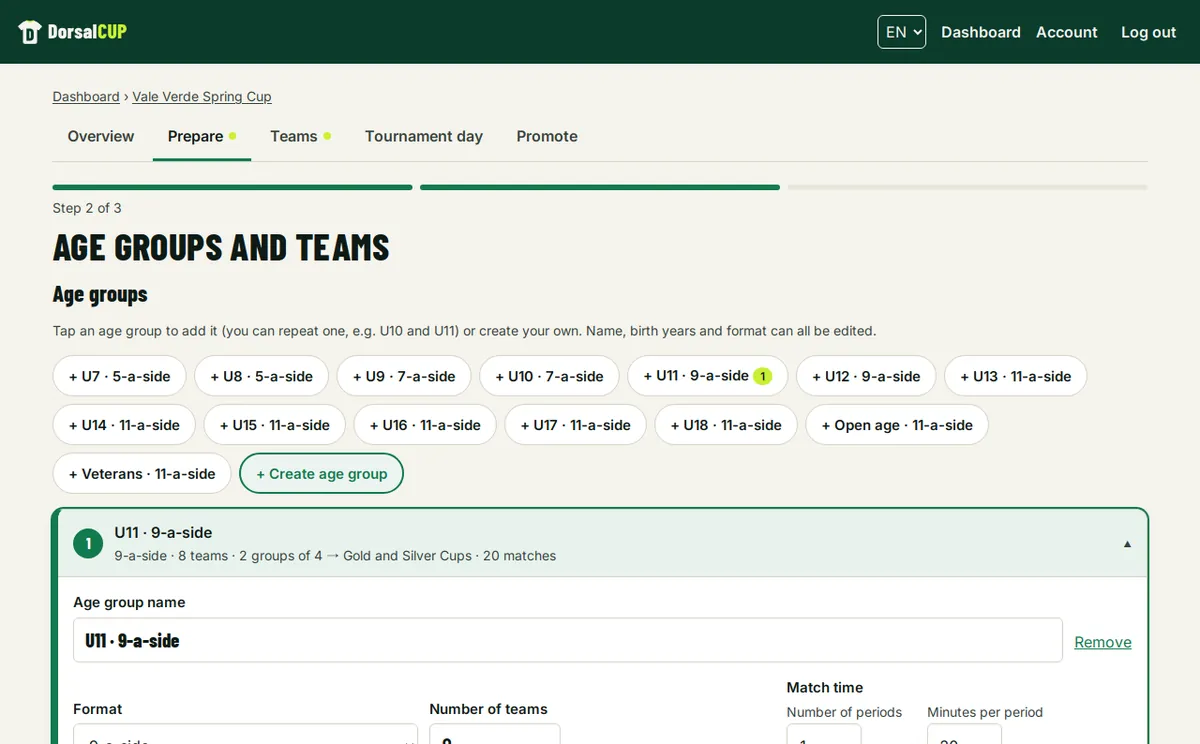
Defining age groups by year of birth avoids arguments on the day. You can follow your national association's table (FA, FPF, RFEF, FFF, DFB or FIGC) or create your own, such as "born in 2015 and 2016". For each age group, choose the format (anything from 3-a-side to 11-a-side), the length of each half and the number of teams.
The number of teams determines the format and how long the tournament lasts. Before sending invitations, work out how many matches fit into the day. In DorsalCUP, the three-step wizard suggests a format and shows the number of matches and the estimated duration before you go any further. For the youngest players there is also a non-competitive mode that hides scores.
3. Budget, meals and rules
The budget covers referees, trophies and medals, insurance, water, equipment and often meals for players and coaching staff. Asking each club for its expected number of players and staff, and the meals it needs, lets you place realistic orders.
The tournament rules should be written down and published in advance. At a minimum they should answer the following:
- Match length, number of periods and half-time.
- Points for a win, a draw and a defeat.
- Group-stage tie-breakers and what happens after a draw in the knockout rounds.
- Maximum squad size and substitution rules.
- Discipline: cautions, sendings-off and suspensions.
- Who decides when there is doubt and how complaints are handled.
4. Invite clubs and take entries
The invitation should state the date, venue, age groups, format, entry fee (if any) and reply deadline. Send it two to three months in advance and follow up once or twice with clubs that have not replied.
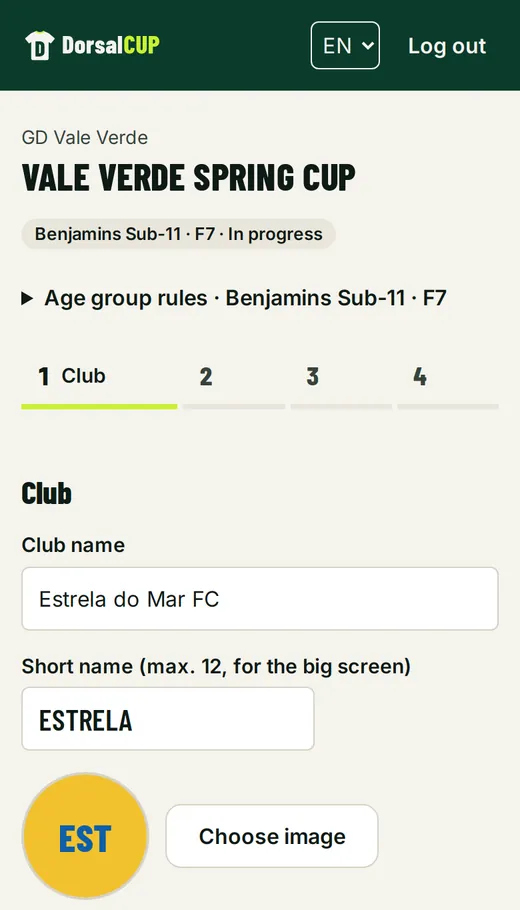
In DorsalCUP, invitations go out by email in each club's language, and you can also share a public registration link: the club submits a request, you accept it and the details (crest, colours, number of players and staff, meals) are filled in later in the team area. No personal data about players is requested.
5. The draw and the fixture schedule
Once the teams are confirmed, it is time for the group draw. A transparent draw avoids suspicion: announce the time and method beforehand and publish the result straight afterwards. DorsalCUP supports a verifiable draw, in which a commitment is published in advance and the draw is made either immediately or at a scheduled time using public randomness.
The schedule must respect the minimum rest between matches for the same team, lunch breaks and the rule of leaving finals until the end. Generating it automatically and then adjusting it by hand saves hours of work. The guide to scheduling across several pitches covers this step in detail.
6. Organising team and pitch officials
Each pitch needs at least one person to record results and keep time, in addition to the referee. A short briefing the day before, with clear roles, avoids last-minute improvisation.
- A tournament coordinator who can be reached all day.
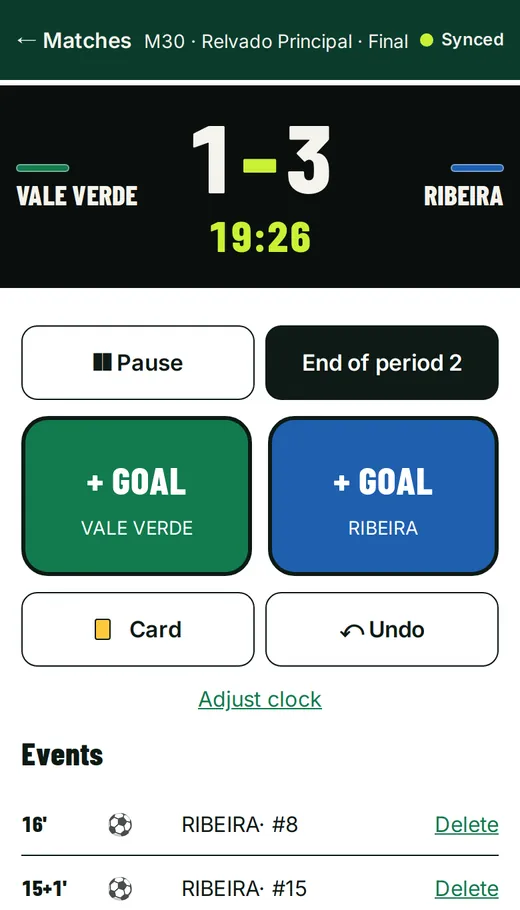
- One official per pitch to record goals, cards and substitutions.
- A welcome desk for teams and paperwork.
- Someone in charge of refreshments, meals and tidying up.
- Someone responsible for the presentation of trophies.
7. On the day
Open the venue at least an hour before the first match, mark out the pitches, set up the welcome desk and test how results will be recorded. Pitch officials should have the schedule for their pitch and know who to contact if something goes wrong. The matchday checklist, in a separate guide, covers each task.
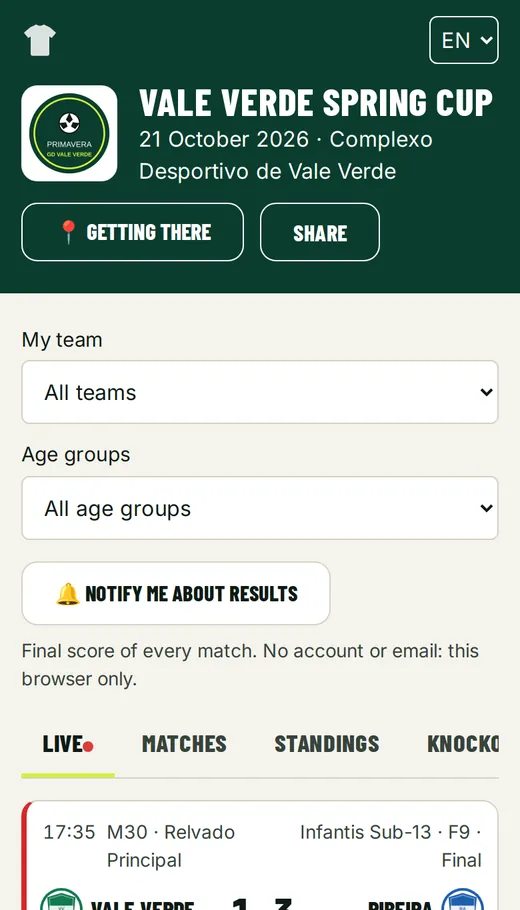
Publishing results live cuts down the questions at the organisers' desk: parents and coaches follow the public page on their phones by scanning a QR code displayed around the venue.
8. After the tournament
Once the last match is over, it is time to present the trophies, thank the clubs and publish the final standings. In the following days, hold a debrief with your team: what went well, where the delays were and which clubs to invite back. Exporting the results to Excel and keeping the documents makes it much easier to prepare next year's edition, which you can announce on the day.