
Football tournament formats for 8, 12 and 16 teams
Updated 4 October 2026
Choosing the right format means balancing the number of matches each team plays against the time available on the pitches. This guide covers the most common formats for 8, 12 and 16 teams, with the exact number of matches in each and a simple way to estimate how long the tournament will take.
The two sums you need
In a group where everyone plays everyone once (a round robin or league), the number of matches is n × (n − 1) / 2, where n is the number of teams. A group of 3 has 3 matches, a group of 4 has 6, a group of 5 has 10 and an 8-team league has 28.
In a single-elimination knockout with N teams there are N − 1 matches, because each match eliminates one team and only one is left at the end. Add one more if there is a third-place play-off.
- Semi-finals and final (4 teams): 3 matches, or 4 with a third-place match.
- Quarter-finals to final (8 teams): 7 matches, or 8 with a third-place match.
- Round of 16 to final (16 teams): 15 matches, or 16 with a third-place match.
Estimating the duration
A rough duration comes from this formula: number of matches × (match length + changeover time) ÷ number of pitches. Changeover time is the gap between matches for teams to leave and come on, usually 3 to 5 minutes. Add breaks (lunch, presentations) and a margin for delays.
Treat the result as a best case: finals are usually played on a single pitch and teams need rest between matches, so not every pitch is in use all the time.
8 teams
Two groups of 4 followed by semi-finals (winner of group A against runner-up of group B and vice versa), a final and a third-place match: 12 group matches plus 4 knockout matches, 16 in total. Each team plays 3 matches, or 5 if they reach the semi-finals. With 12-minute matches and 3-minute changeovers on 2 pitches: 16 × 15 ÷ 2 = 120 minutes, around two and a half hours with a margin.
An 8-team league (everyone plays everyone) has 28 matches and guarantees each team 7 games. With 15-minute matches, 5-minute changeovers and 2 pitches: 28 × 20 ÷ 2 = 280 minutes, nearly five hours before breaks. It works well for a full day with younger players, especially in non-competitive mode.
12 teams
Three groups of 4 make 18 matches. Quarter-finals need 8 teams: the top two in each group (6) plus the two best third-placed teams. Then come the quarter-finals (4), semi-finals (2), final (1) and third-place match (1): 18 + 8 = 26 matches.
Four groups of 3 make only 12 matches. The top two in each group go through to the quarter-finals: 12 + 8 = 20 matches. If only the group winners go through to the semi-finals, the total is 12 + 4 = 16. The drawback of groups of 3 is that each team plays only two group matches and one team sits out each round.
To compare teams from different groups (the best third-placed teams, for example), the usual order is points, then goal difference, then goals scored. If groups are of different sizes, it is fair to discount results against the bottom team in the larger group. Put this rule in writing in the tournament rules.
- 3 groups of 4 + quarter-finals: 26 matches; on 3 pitches with 20-minute slots (15 + 5): 26 × 20 ÷ 3 ≈ 173 minutes.
- 4 groups of 3 + quarter-finals: 20 matches; under the same conditions, about 133 minutes.
16 teams
The classic format is four groups of 4 (24 matches), followed by quarter-finals with the top two from each group, semi-finals, a final and a third-place match (8 matches): 32 matches in total, or 31 without the third-place match. On 4 pitches with 12-minute matches and 3-minute changeovers: 32 × 15 ÷ 4 = 120 minutes.
A 16-team league would have 120 matches, which is rarely feasible in a single day.
Gold and Silver Cups
In this format every team keeps playing after the groups. With 16 teams in four groups of 4 (24 matches), the top two in each group contest the Gold Cup and the rest the Silver Cup. Each cup is an 8-team knockout: 7 matches, or 8 with a third-place match. The total is 24 + 8 + 8 = 40 matches.
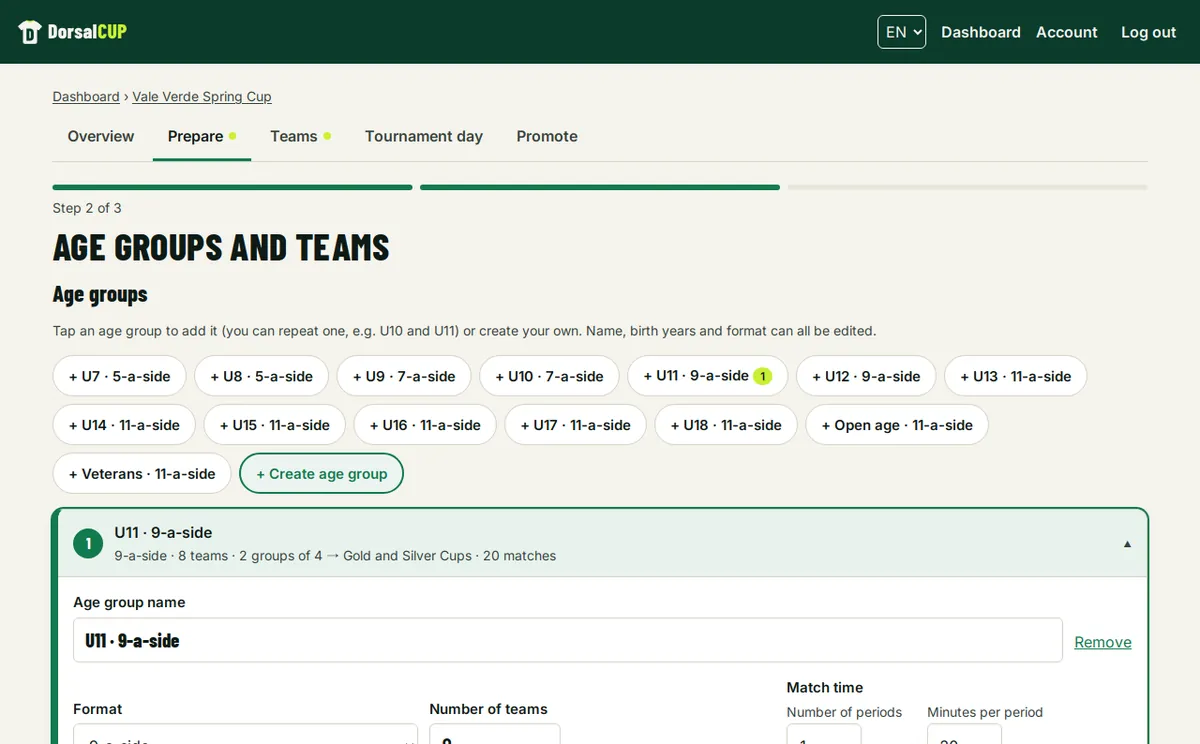
On 4 pitches, with 15-minute matches and 5-minute changeovers: 40 × 20 ÷ 4 = 200 minutes, about three hours and twenty minutes, plus lunch. It works the same way with 8 teams: two groups of 4 (12 matches), the top two in each group go into the Gold Cup semi-finals and the others into the Silver Cup semi-finals (4 matches each, including a third-place match), giving 20 matches and 5 guaranteed games per team.
Which one to choose
In youth football, the priority is plenty of game time and nobody going home after two matches; Gold and Silver Cups and leagues both achieve that. For adult and veterans' tournaments, groups followed by a knockout build excitement towards the end of the day. DorsalCUP suggests a format for your number of teams and shows the number of matches and the expected duration, so you can compare options before finalising the rules.