
How to build a tournament schedule across multiple pitches
Updated 4 October 2026
The schedule is what decides whether a tournament runs smoothly or falls further behind as the day goes on. With several pitches and age groups, allocating matches by hand in a spreadsheet is slow and error-prone. This guide explains the rules a good schedule should follow and how to deal with the unexpected.
What you need to start
Before allocating any matches, gather the basic information:
- Start time and latest finish time.
- Available pitches and the format each one suits (for example 7-a-side or 11-a-side).
- Match length: number of periods, minutes per period and half-time.
- Changeover time between matches on the same pitch.
- Fixed breaks: lunch, opening ceremony, presentations.
- Minimum rest between two matches for the same team.
Rest between matches
No team should play two matches back to back. In youth football, a minimum rest of at least one match slot (15 to 30 minutes) is normal; for longer matches or hot days, allow more. Rest should also be fair: if one team always gets an hour off and another always gets fifteen minutes, the second is at a disadvantage.
In groups of 3, one team sits out each round, which helps guarantee rest. In groups of 4, the two matches in each round can be played at the same time on different pitches.
Age groups and pitches
When there are several age groups, it is practical to tie each one to specific pitches: 7-a-side on the small pitches and 11-a-side on the full-size one. That avoids moving goals and markings during the day and makes it easier for parents to find their way around.
It also helps to stagger age groups across the day so the youngest are not waiting until late afternoon. If the venue is shared, younger groups can play in the morning and older ones in the afternoon.
Breaks, finals and buffer time
The lunch break should be a real one, with pitches empty, or run in shifts, with different age groups eating at different times. Finals should come at the end of each age group and, where possible, be played one at a time on the main pitch so everyone can watch.
A buffer of 10 to 15% of the total time stops small delays from piling up. A simple approach is to leave an empty slot before the knockout stage: if all goes well, teams get extra rest; if not, the schedule catches up.
A worked example
Take an age group of 8 teams in two groups of 4, with 12-minute matches, 3-minute changeovers and 2 pitches. Each group-stage round has 4 matches (2 per group), filling both pitches for two 15-minute slots. The three rounds of the group stage therefore take 6 slots, or 90 minutes. Because each team plays in one slot and rests in the next, a minimum rest of 15 minutes is guaranteed.
Next come the semi-finals, played at the same time on both pitches (one slot), followed by the third-place match and the final. If the final is played on its own on the main pitch straight after the third-place match, the age group takes 9 slots, or 135 minutes. Add a 15-minute buffer before the semi-finals, which also gives the teams from the last group match a rest, and the total is about two and a half hours.
Generating the schedule automatically
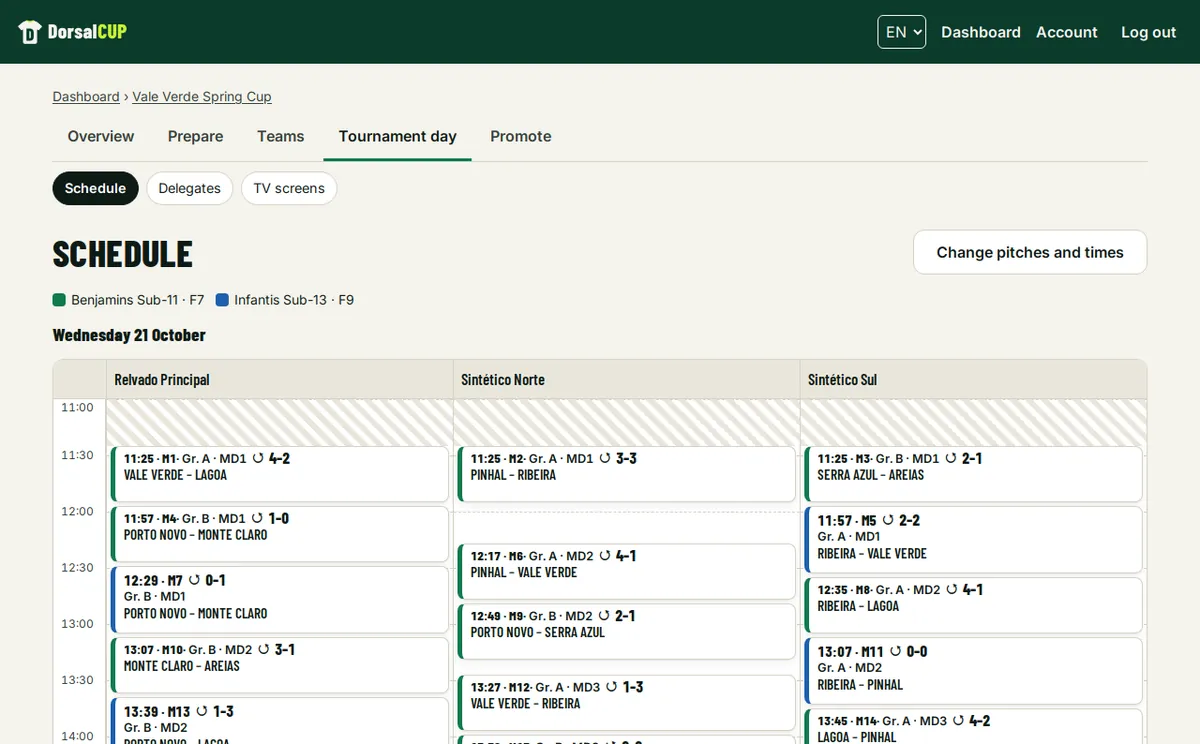
Meeting all these rules at once, across several pitches and age groups, is hard to do by hand. DorsalCUP generates the schedule automatically from the pitches, times, breaks and minimum rest, and leaves the finals until the end. You can then drag matches to a different time or pitch and lock the ones that must not move, such as a match fixed at a particular time at a club's request.
Each team can also add its matches to a phone calendar with an .ics file, which cuts down requests for kick-off times at the organisers' desk.
Dealing with delays
Delays happen: an injury, a team arriving late, a match that has to be replayed. What matters is deciding quickly and communicating clearly.
- Shorten changeovers before shortening matches.
- Use the buffer you planned before the knockout stage.
- Move a match to a free pitch, if the pitch size allows.
- As a last resort, shorten the following matches equally for everyone.
- Update the public schedule straight away so parents and coaches can see the new times.
Check before you publish
Before sending the schedule to clubs, check that no team has overlapping matches, that minimum rest is respected, that breaks are kept clear and that the finish time is realistic. Printing one sheet per pitch for the officials is a good way to spot mistakes, because it forces you to look at the day pitch by pitch.