
Low Block Football: Defending in a 5-4-1 and Counter-Attacking
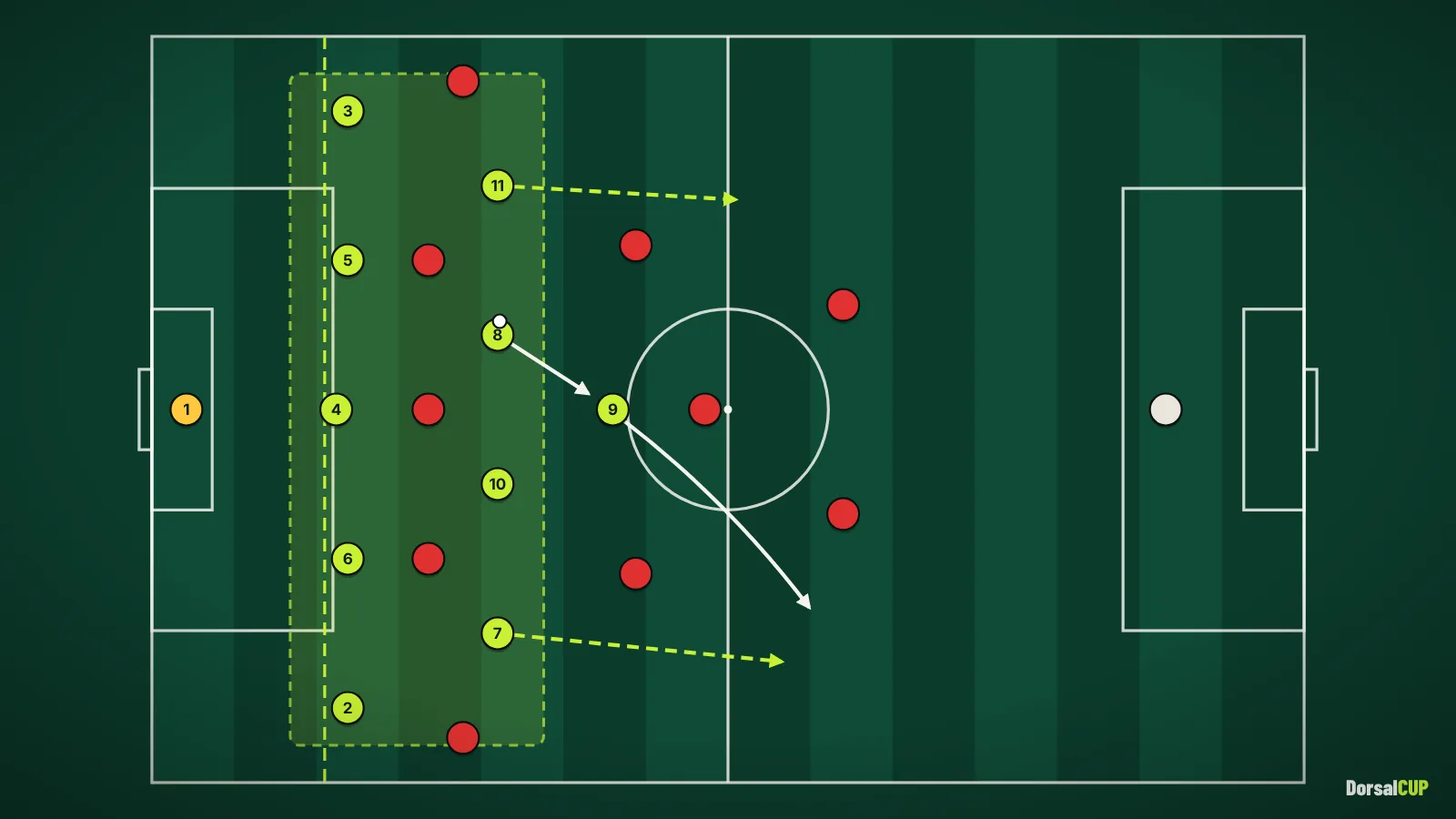
A low block defends close to its own goal by choice: the back line sits around the edge of the penalty area, the lines are no more than 8 to 12 m apart and the central lane is closed. A 5-4-1 or a 5-3-2 gives the width to do this without leaving the flanks open. The low block only pays off if the team can also leave it: who stays up, where the first pass goes and how many players join the counter-attack are decided before the game. This article covers both halves of the plan.
Do you organise tournaments? Create yours for free on DorsalCUP.
In this article
When a low block is the right choice
A low block is not the absence of a plan. It is a decision to give the opponent the ball in areas where it does little damage, to remove the space behind the defence and to attack the space the opponent leaves when it commits players forward. It fits three situations: an opponent that is clearly better in possession, a lead to protect late in a game, and a team whose main attacking weapon is speed in transition.
The cost is that the opponent will have the ball near the penalty area for long periods. That means crosses, shots from the edge of the area and second balls. A low block that cannot defend crosses, that does not block shots and that never counter-attacks only delays the goal it concedes.
At youth level, a low block can be useful for a specific game, but it should not be the only defensive idea a player learns. Under-15 and under-17 teams should also defend in a mid block and press high, so that the players understand when each height makes sense.
Low block structure: 5-4-1 and 5-3-2
Line heights. The back five holds between 14 and 20 m from its own goal, around the edge of the penalty area. Deeper than the penalty spot and the team defends inside its own six-yard box after every cross. The midfield line stands 8 to 12 m in front of the back five. In a 5-4-1 the striker is 8 to 10 m in front of the midfield; the whole block is around 25 to 30 m deep.
Width. The five defenders cover the width of the pitch, so the four midfielders can stay narrow, 35 to 40 m between the two wide midfielders. The wing-backs defend the opponent's wingers; the central three defend the penalty area width. This is the main reason for a back five in a low block: the midfield does not have to run to the touchline every time the ball moves wide.
Central protection. The closest priority is the zone in front of the penalty area, between the two central midfielders and in front of the three centre-backs. Passes into that zone must be blocked, pressed from behind or forced backwards. The striker's job is to place the opponent's pivot in his cover shadow, so that the opponent circulates the ball wide and around the block, not through it.
5-3-2. With three central midfielders and two strikers, the 5-3-2 protects the centre and keeps two players high for the counter-attack, but the midfield three must slide across the pitch to the ball side, and the wing-backs must defend wider and higher. It suits teams whose opponents build up with two centre-backs and a single pivot, because the two strikers can block the first pass while the midfield three stays compact.
Managing the space between the lines
The opponent's best players will try to receive in the space between the back five and the midfield. A low block defends that space in three ways.
- Vertical compactness: a maximum of 10 to 12 m between the lines, so that a receiver in that space is pressed within a second from in front and from behind.
- The outside centre-back steps out: when the ball goes into the half-space pocket, the outside centre-back on that side leaves the line to press the receiver with his body behind him. The central centre-back and the wing-back close the gap he leaves.
- The midfielder presses from behind: the nearest midfielder turns and closes the receiver from the other side, so the receiver is trapped between two players and cannot turn.
- Clear rules: the centre-back steps out only if the receiver is facing his own goal and the pass is still travelling. If the receiver is already turned or the pass is a lofted ball, the line holds and drops.
Opponent strategies against a low block and how to respond
Wide overloads against the wing-back
The opponent combines a winger and an overlapping full-back or a half-space midfielder against the wing-back. The near-side wide midfielder must drop to make it 2v2; in a 5-3-2, the near-side central midfielder slides out and the strikers tuck in to protect the centre.
Long circulation and switches
A quick switch from one side to the other is the main tool against a compact block. The block must shift as a unit while the ball travels, with the far-side wing-back already narrowing towards the far post. A switch that is played by a centre-back behind the first line gives time to shift; a switch played by a player in the half-space is more dangerous and must be pressed.
Shots and crosses
When the block holds, the opponent shoots from outside or crosses. Every shot from the edge of the area needs a player in the shooting line within 2 to 3 m. Against crosses, the back five gives a numerical advantage in the box, but only if the wing-back on the far side defends the back post instead of watching the ball.
Rotations to pull centre-backs out
The opponent's striker drops to pull a centre-back out and a winger runs behind him. The central centre-back and the wing-back cover the run; the centre-back who steps out only goes if the cover is already in place.
A pre-season tournament or a four-team round robin mid-season gives you several matches in one day to test these ideas against different opponents. The DorsalCUP tournament fixture generator builds the matches, pitches and kick-off times in minutes, free and with no sign-up.
Leaving the block: the counter-attack
The counter-attack starts before the ball is won. In a 5-4-1, the striker stays on the last line of the opponent's rest defence, ready to receive with his back to goal or to run into the channel. The far-side wide midfielder is the second outlet, because he is not involved in the duel that wins the ball. In a 5-3-2, the two strikers split: one shows short, the other runs behind.
- First pass forward, if it is on. The player who wins the ball looks first for the striker or the far-side wide midfielder. If neither is free, he secures the ball with a second pass and the team counters through the next player.
- Carry if there is space. When the ball is won around the edge of the penalty area with space in front, carrying the ball for 15 to 20 m pulls opponents and lets team-mates join.
- Three to four players attack. The striker, the two wide midfielders and one central midfielder attack. The back five and one midfielder stay as protection against the counter-counter.
- Run into the space behind the opposition's rest defence, not towards the ball. The aim is to reach the opposition's half in 3 to 4 passes and 8 to 10 seconds.
How to train the low block and the counter-attack
1. Block defending game 7+GK v 8 with counter gates
Objective: distances, the step-out of the centre-back and the first pass. Space: full width, 40 m from the goal line, plus two gates at 52 m. Players: goalkeeper, back five and two central midfielders against eight attackers. Rules: attackers score in the big goal. When the defending team wins the ball, it scores by passing or carrying through a gate within 8 seconds. Progression: add a striker for the defending team who must receive the first pass; then allow attackers to counter-press for 5 seconds. Load: 4 x 5 min, 2 min rest. Coaching points: distance between the lines, who steps into the pocket, body shape of the wing-backs, the first pass forward.
2. 11 v 11 with a counter-attack bonus
Objective: the full sequence, from defending deep to finishing. Space: full pitch. Rules: team B attacks with nine outfield players; team A defends in a 5-4-1. A goal for team A scored within 10 seconds of winning the ball counts triple. Team B can only leave two players behind the ball, which makes the counter-attack realistic. Load: 3 x 10 min, 3 min rest. Coaching points: the striker's starting position, the far-side wide midfielder's run, protection behind the ball.
3. Transition game 4v4+3 in three zones
Objective: the decision after recovery. Space: 50 x 40 m divided into three zones. Rules: play 4v4 in the middle zone with a neutral player in each end zone. When a team wins the ball, the first pass must go to the neutral in the zone it attacks, who plays back to a runner. Load: 6 x 2 min, 90 s rest. Coaching points: look forward on recovery, the angle of the support, runs beyond the ball.
Common errors and what to look for on video
- The back line drops too deep. The line ends up inside the penalty area and the block gives up the edge of the box. On video, check the back line's height whenever the ball is in the wide area: it should stay at the edge of the penalty area.
- Gaps between the lines. The midfield follows the ball forward while the back five holds. Measure the distance between lines at random moments; anything over 15 m is a gap.
- Nobody stays up. All eleven players defend and the cleared ball comes straight back. Check where the striker and the far-side wide midfielder are at the moment the ball is won.
- First pass sideways or back. The team wins the ball and gives it away again under pressure. Track each recovery: was there a forward option, and did the player see it?
- Stepping out without cover. A centre-back leaves the line with nobody covering. Freeze the frame before he steps and check the positions of the central centre-back and the wing-back.
Frequently asked questions
What is a low block in football?
A low block is a defensive organisation in which the team defends close to its own goal, with the back line around the edge of the penalty area and the lines close together. The aim is to remove the space behind the defence and in the centre, and to counter-attack when the ball is won.
Is a 5-4-1 or a 5-3-2 better for a low block?
The 5-4-1 covers the width of the pitch better and protects against wide overloads. The 5-3-2 protects the centre and keeps two strikers higher for the counter-attack, but its midfield three must slide across the pitch. The choice depends on the opponent's build-up and on the players available.
How do you beat a low block?
With quick switches of play, overloads against the wing-back, players who receive in the space between the lines and turn, shots from the edge of the area and crosses with runners attacking the back post. The defending team's answers to each are described in this article.
Who stays up for the counter-attack in a low block?
In a 5-4-1, the striker stays on the opponent's last line and the far-side wide midfielder is the second outlet. In a 5-3-2, the two strikers stay higher, with one showing short and the other ready to run behind.