
Defending Crosses: Zonal, Man-Marking and Mixed Systems
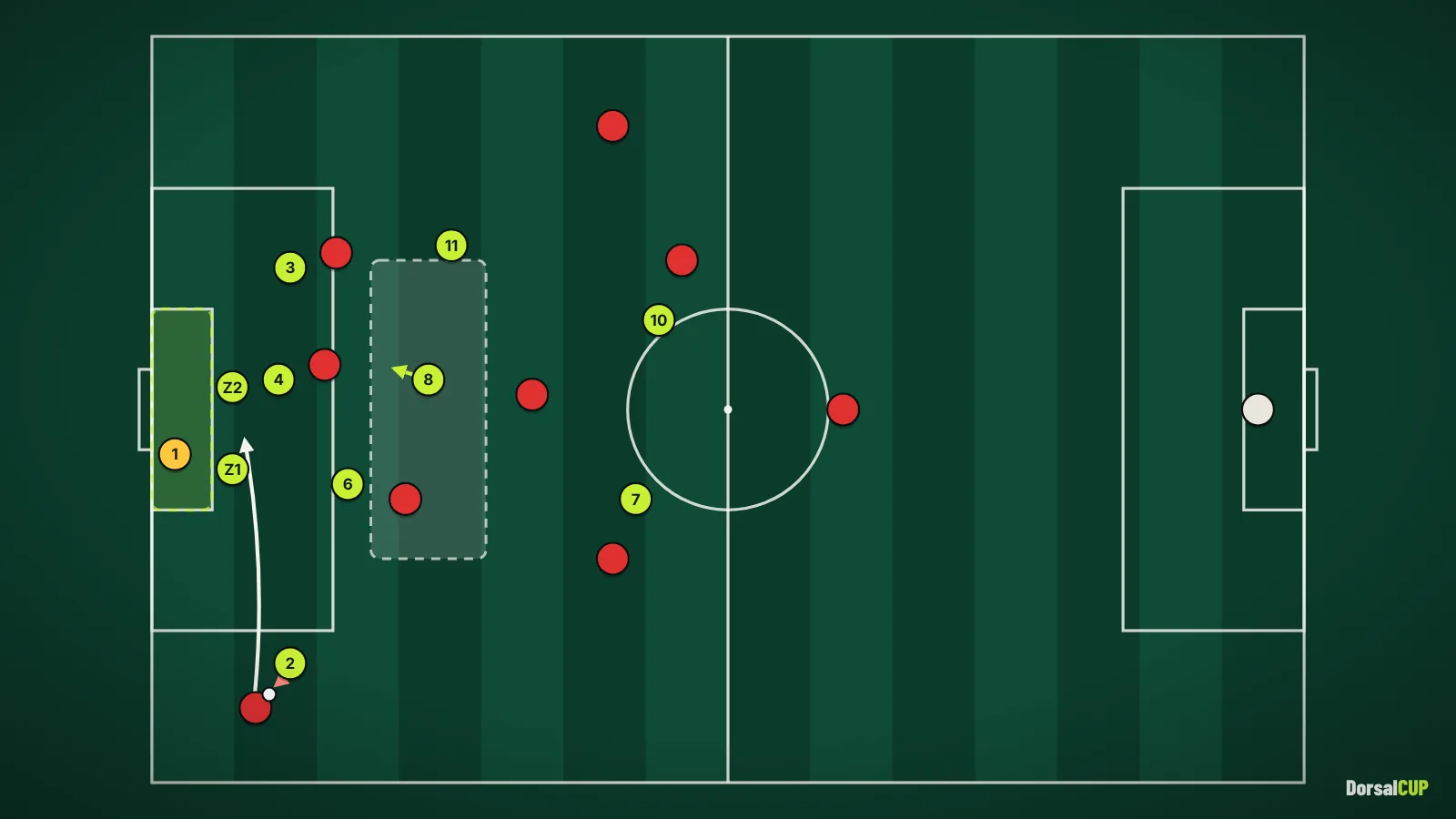
Defending crosses is a chain of jobs, not a single duel: stop the cross at source when possible, occupy the dangerous spaces in the box, attack the ball, and win what drops at the edge of the area. Whether a team uses zonal, man or mixed marking, the same spaces must be covered: the front post, the six-yard box, the penalty spot and the cut-back zone. This article sets out the systems, the goalkeeper's references, what opponents will do to beat them and three exercises to train it.
Do you organise tournaments? Create yours for free on DorsalCUP.
In this article
Why defending crosses needs a shared plan
Most goals from open-play crosses are scored inside a small area: between the posts, from the six-yard line to around the penalty spot, and from cut-backs to the zone in front of the penalty spot. A team that lets its players react individually to each cross leaves gaps in that area every time two defenders follow the same runner or one defender watches the ball and loses his man.
A shared plan answers four questions before the ball is crossed. Who defends the crosser? Who protects the front post and the six-yard box? Who goes with the runners? Who stays outside the box for second balls and cut-backs? The system (zonal, man or mixed) is only the way each team answers the third question. The other three are the same in every system.
At senior level the plan is defined in detail and trained every week. At under-15 and under-17 level, the priority is the references: body shape to see ball and man, the first step towards the ball, and attacking the ball at its highest point instead of waiting for it.
Zonal, man and mixed systems for defending crosses
Zonal. Defenders are given spaces, not opponents. A typical zonal set-up has two or three players across the six-yard box (front post, centre, back post) and two or three players on a second line near the penalty spot. Its strength is that defenders attack the ball from a set position and are not dragged by decoy runs. Its weakness is that an attacker running at speed into a zone between two players arrives with momentum while the defender starts from standing.
Man-marking in the box. Each attacker is followed by a defender who is goal-side and slightly ball-side, so that he can see the ball and the runner without turning his head more than a quarter turn. Its strength is that every runner is contested. Its weakness is that blocking and crossing runs separate defenders from their men, and the space in front of the goal is left to the goalkeeper alone.
Mixed. This is the most common solution at senior level. Two players defend zones at the front post and in the centre of the six-yard box; the rest mark the runners; one or two players protect the edge of the box. The zonal players are usually the best headers of the ball, because every ball into their zone is theirs.
| Space | Typical player | Reference |
|---|---|---|
| Front post | Zonal player or near-side centre-back | Stands just outside the near post, attacks anything into the near half of the six-yard box |
| Centre of six-yard box | Zonal player, best header | Holds the line of the six-yard box, attacks forward, never backwards |
| Runners | Centre-back, far-side full-back | Goal-side and ball-side, contact allowed only within the Laws |
| Penalty spot and cut-back | 6 or near-side midfielder | Between ball and penalty spot, ready to block the low pass |
| Edge of the box | 8 or 10 | Second balls, first pass on the counter |
The goalkeeper and the defensive line
The goalkeeper's position depends on where the cross comes from. From deep, wide areas (25 to 35 m from goal), he stands 4 to 6 m off his line and centrally, because the ball will spend time in the air and the danger is the space between the defensive line and the goal. From the byline, he moves to the near post, a half step off the line, because the near-post shot and the low cross are the first threats. From the half-space, the cross is usually inswinging; he stays closer to the centre and slightly deeper, with an open body to see both the ball and the runners.
The line's height follows the same logic. Against an early cross from deep, the back line holds at around the edge of the penalty area until the crosser is about to strike, then drops in a controlled way to 10 to 12 m from goal. Dropping too early pushes the line into the goalkeeper's space and gives the attackers a run onto the ball. Dropping too late lets the ball go behind the line. The cue is the crosser's last touch and the planted foot, not the ball in flight.
Opponent variations and how to respond
Cut-backs from the byline
When an attacker reaches the byline inside the box, defenders run towards their goal and the space in front of them opens. The answer is to give the cut-back zone, roughly from the penalty spot to the edge of the six-yard box, to a specific player. In most systems, the 6 or the near-side midfielder drops into that space as soon as the ball goes past the full-back.
Overloads at the back post
Many teams attack the back post with a far-side wing-back or winger who arrives late. Against a back four, this creates a 2v1 against the far-side full-back. The answers: the far-side winger tracks the runner all the way into the box, or the system places one zonal player at the back post when the opponent plays with wing-backs.
Near-post flicks and blocking runs
A near-post runner who flicks the ball on can beat a zonal set-up that has nobody ahead of the front post. A defender at the front post must stand slightly ahead of the near post, not on it. Against blocking runs in a man system, the defender keeps contact with his man early and holds his line instead of following a run across the face of the goal.
Early crosses behind the line
Teams with fast strikers cross early from the half-space into the space between the line and the goalkeeper. The goalkeeper must be high enough to attack that space, and the line must not drop before the crosser strikes.
If you run tournaments at your club, DorsalCUP handles registrations, the draw, the multi-pitch schedule and live results for free. The guide how to organise a football tournament walks through every step, from the rules to matchday.
How to train defending crosses: three exercises
1. Six-yard unit: 3+GK v 4 with two crossers
Objective: zonal references and attacking the ball. Space: penalty area. Players: goalkeeper, two zonal defenders and one marker against four attackers, plus two unopposed crossers on the flanks. Rules: crosses alternate from deep and from the byline. Defenders score a point for every clearance beyond the penalty area and two points for a goalkeeper claim. Load: 3 sets of 8 crosses, 90 s rest between sets. Coaching points: starting position of the front-post player, the first step forward, goalkeeper call.
2. Box defending game 6+GK v 7 with crossing channels
Objective: the full defensive sequence, from the cross to the counter. Space: half a pitch, with 10 to 12 m channels on each side. Players: a back four, the goalkeeper and two midfielders against seven attackers, two of them starting in the channels. Rules: attackers in the channels are unopposed at first. When the defending team wins the ball, it scores by passing into one of two mini-goals at the halfway line within 10 seconds. Progression: allow the full-back to enter the channel and defend the crosser; then let attackers make late runs from outside the box. Load: 4 x 4 min, 2 min rest. Coaching points: pressure on the crosser, goal-side position of the markers, the 6 in the cut-back zone, the first pass after the clearance.
3. Second-ball game 3v3 at the edge of the box
Objective: win the ball after a clearance. Space: 30 x 20 m in front of the penalty area. Players: 3v3 plus the coach as server. Rules: the coach plays a high or bouncing ball into the zone to imitate a headed clearance. The defending three score by passing to a target player at the halfway line; the attacking three score by shooting first time from outside the area. Load: 6 x 90 s, 60 s rest. Coaching points: body shape facing the ball's flight, the second player's covering position, first touch out of pressure.
Common errors and what to look for on video
- Ball-watching. Defenders turn their head towards the ball and lose the runner. On video, freeze at the moment of the cross: can each marker see both the ball and his man?
- Zonal players stepping backwards. A zonal defender who moves towards his goal to head the ball loses the duel. The correction is a starting position on the six-yard line, attacking forward.
- No player in the cut-back zone. Everyone drops towards the goal. Check the space from the penalty spot to the edge of the area at the moment the ball reaches the byline.
- Line too deep, too early. The line drops on the crosser's preparation, not on his strike, and pushes the goalkeeper back. Use a wide-angle shot to compare the line's height with the crosser's last touch.
- No pressure on the crosser. The cross is defended worst when the crosser has time to look up. Track the distance between the crosser and the nearest defender: more than 3 to 4 m usually means a free cross.
For under-13 and under-14 teams moving to 11-a-side, start with man-marking and one player at the front post. The zonal concepts can follow once the players attack the ball reliably and the goalkeeper commands the six-yard box.
Frequently asked questions
Is zonal marking or man-marking better for defending crosses?
Neither is better in every case. Zonal marking protects the most dangerous spaces and lets good headers attack the ball from a set position. Man-marking contests every runner. Most senior teams use a mixed system with two zonal players and markers on the main runners.
Where should the goalkeeper stand for a cross?
For crosses from deep, a few metres off the line and central. For crosses from the byline, near the front post, a half step off the line. For inswinging crosses from the half-space, closer to the centre with an open body to see ball and runners.
How do you defend cut-backs?
Give a specific player, usually the 6 or the near-side midfielder, the job of dropping into the zone between the penalty spot and the six-yard box when the ball reaches the byline. That player blocks the passing lane instead of running towards the goal.
What are good defending crosses drills?
A six-yard unit drill with two crossers for zonal references, a half-pitch box defending game with crossing channels and a counter-attack to mini-goals, and a 3v3 second-ball game at the edge of the area.