
Goalkeeper Training in Youth Football: Technique and Drills by Age
Goalkeeper training in youth football should cover four things: a safe handling technique, footwork that gets the body behind the ball, sensible diving and 1v1 work, and distribution with both hands and feet. Most grassroots teams have no specialist coach, so the head coach needs a few simple drills that can run alongside the rest of the session. Young goalkeepers also need to play outfield regularly, because modern keepers are footballers first.
Do you organise tournaments? Create yours for free on DorsalCUP.
In this article
Goalkeeper training by age in youth football
In England, 3v3 at U7 is played without goalkeepers. Keepers appear at 5v5 (U8–U9), and from then on the role becomes more specialised with each format. What to teach depends far more on the format than on the child's ambition to be 'the keeper'.
| Age group (format) | Priority | What to avoid |
|---|---|---|
| U8–U9 (5v5) | Ready position, catching, rolling and passing out; everyone takes turns in goal | Fixing one child in goal all season |
| U10–U11 (7v7) | Handling shapes, footwork, low collapse dives, playing out from the back | Full-length dives on hard ground; long kicks every time |
| U12–U13 (9v9) | Diving technique, 1v1s, crosses on bigger pitches, communication | Ignoring footwork because the keeper 'is a good shot-stopper' |
| U14+ (11v11) | Starting position, high balls, organising the defence, longer distribution | Training only shot-stopping without game situations |
Handling: the ready position and catching shapes
Everything starts with the set position: feet about shoulder-width apart, weight on the front of the feet, knees slightly bent, hands in front of the body at waist height, eyes on the ball. The keeper should be set, not moving, when the shot is struck.
- Scoop for low balls along the ground: feet close together or one knee down sideways, body behind the ball, hands scooping it into the chest.
- Contour or 'W' catch for chest to head height: thumbs almost touching behind the ball, fingers spread, elbows soft.
- Basket catch for balls at the belly: elbows close together, arms forming a basket, ball pulled into the body.
- Above the head: the W shape, with the ball caught in front of the eyes, not behind the head.
Drill 1: footwork gate and handling
Organisation: two cone gates 1 m wide set 3 m in front of the goal, left and right of centre. A server stands 8–10 m out with a supply of balls. One goalkeeper at a time; two or three keepers rotate every six balls. Duration 8–10 minutes.
Rules: the keeper shuffles sideways through a gate, sets, and the server throws or volleys a ball at chest height. Catch, roll the ball back, shuffle through the other gate. Variants: low balls for the scoop; serve before the keeper is fully set to teach a quick set position. Coaching points: side-steps without crossing the feet, set before the serve, head still, ball into the body.
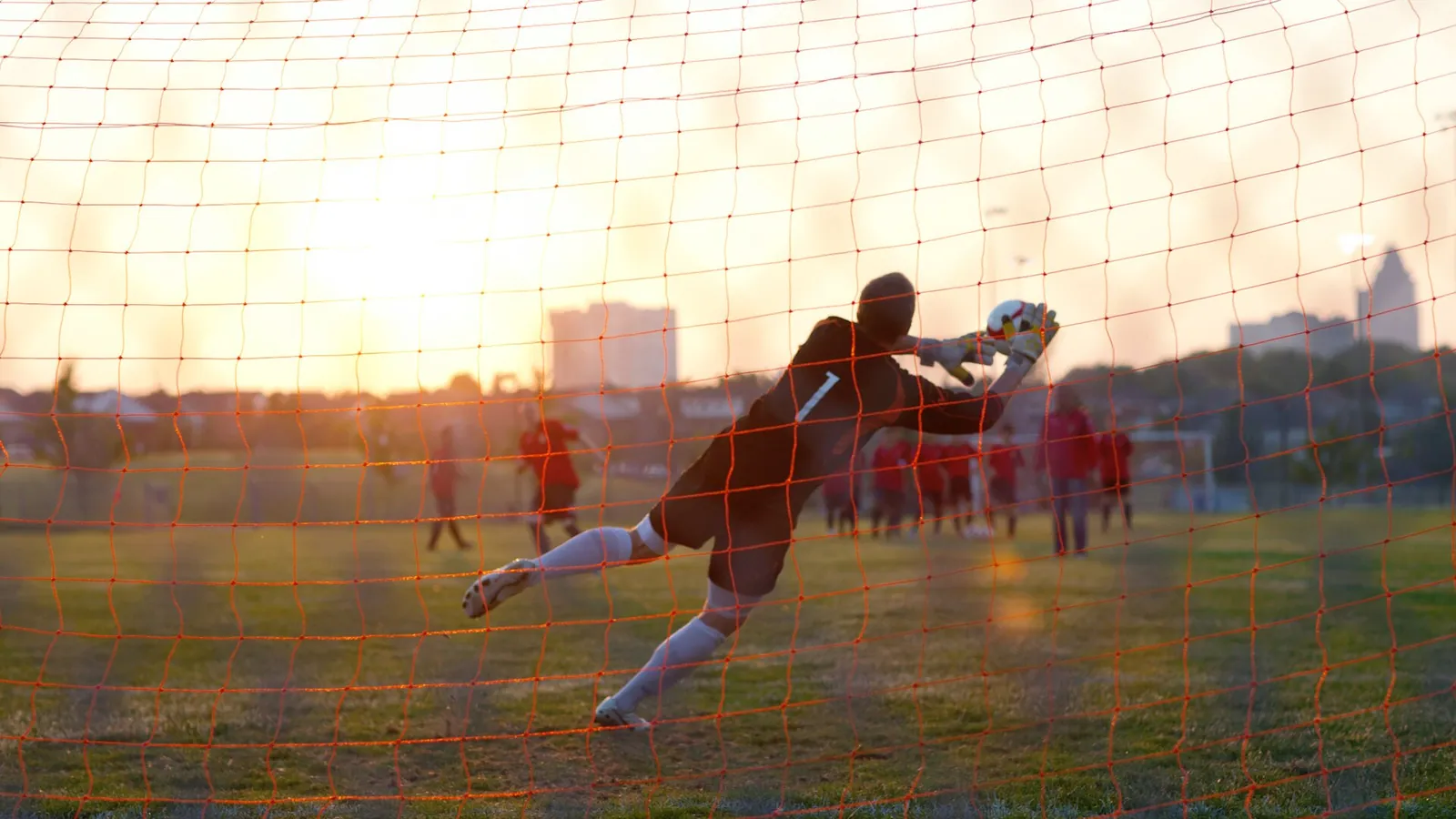
Diving and falling safely
Many young keepers are afraid of diving because they have fallen badly on hard ground. Start low and build up. The collapse dive teaches the keeper to drop sideways onto the hip and shoulder, never the elbow or knee, with hands leading to the ball.
- Kneeling: the server rolls the ball just to one side; the keeper falls sideways and gathers.
- Crouching: the same, from a low squat.
- Standing: the server rolls or throws the ball one metre to the side; the keeper steps towards it and collapses.
- With a short side-step: only when the first three are comfortable, usually from U11 or U12.
Drill 2: collapse dives either side
Organisation: goalkeeper in the middle of the goal, server 6–8 m away. Use grass or a soft surface, or crash mats indoors. Sets of six balls, alternating left and right, three sets per keeper.
Coaching points: step diagonally forward towards the ball, not backwards; fall on the side of the body; top hand behind the ball, bottom hand on the floor side; bring the ball in and get up quickly. Progression: after the save, the keeper gets up and saves a second ball from a different server.
1v1 situations and starting position
From 7v7 upwards, 1v1s against a forward who has broken through are one of the most common ways young keepers concede. The keeper's job is to reduce the angle, stay big and make the forward decide. Charging out wildly and diving at the attacker's feet head-first is dangerous and should not be taught.
- Come off the line while the attacker has the ball at their feet, and stop moving when they are about to shoot.
- Stay on the feet as long as possible. Many young forwards shoot early or try to go round.
- The 'spread' or 'star' shape at close range: legs and arms wide, body facing the ball, used only when the attacker is very close.
- Keep the head and arms away from the attacker's kicking foot.
Drill 3: 1v1 breakaways
Organisation: a 7v7 penalty area and the space up to about 25 m from goal. Attackers start with a ball at a cone 22 m out, one at a time; a second cone line on each side for variety. Each attacker has 6 seconds to score. Rotate keepers every five attempts. Duration 10 minutes.
Coaching points: start position a few metres off the line, advance when the ball is away from the attacker's foot, set when it is close, stay big. Variant: a defender chases from 3 m behind the attacker, so the attacker must shoot early and the keeper faces a quicker decision.
Distribution: hands and feet
A youth goalkeeper touches the ball with their feet more often than with their hands. Back-passes cannot be handled, and in mini soccer the retreat line gives keepers time to play out from goal kicks. Teach the keeper to receive on the half-turn, look up and pass to a free teammate, the same way an outfield player would.
- Roll: low and along the ground, to a nearby defender, ideally to the foot furthest from the opponent.
- Overarm throw: from U11 upwards, for switching play quickly to a winger.
- Passing with the feet: both feet, short and medium range, after a back-pass or from a goal kick.
- Kicking from hands: only when it is the right choice, not every time the keeper catches the ball.
Drill 4: keeper plus three
In a 30 x 25 m area, one goalkeeper and three outfield players keep the ball against two pressers. Every pass must return to the keeper within three passes. The keeper uses hands only when the ball arrives in the air. After 2 minutes, swap pressers. This builds the habit of supporting the ball and playing forward after a back-pass.
Common mistakes and how to correct them
- Moving when the shot is struck: call 'set' just before each serve until it becomes a habit.
- Catching with straight arms: ask for soft elbows and 'bring the ball home' into the chest.
- Diving backwards: put a cone just in front of the keeper's feet and ask them to dive past it.
- Standing on the line: mark a starting position a few metres out with a disc for 1v1 and crossing practices.
- Kicking long every time: set a target, such as three successful short passes before any long ball in training games.
Finally, praise brave decisions, not only saves. A keeper who comes off the line and gets it wrong has still made the decision the team needs. A keeper who never leaves the line will concede more over a season.
Frequently asked questions
At what age should a child become a full-time goalkeeper?
Most coaches recommend rotating the position until around U11 and only gradually specialising after that. Even then, regular time playing outfield improves a goalkeeper's footwork and passing.
How do you teach a young goalkeeper to dive?
Start from kneeling with balls rolled just to the side, then crouching, then standing, then with a side-step. Use soft ground, teach them to land on the side of the body and always step forward towards the ball.
Do U7s have goalkeepers in England?
No. From 2026/27, U7 play 3v3 without goalkeepers. Goalkeepers start at 5v5 in U8 and U9.
How often should a youth goalkeeper train specifically?
Ten to fifteen minutes of goalkeeper work in each session is enough at grassroots level, with the keeper joining the rest of the team for games. Older keepers may benefit from an extra specialist session each week.