
Centre-Back Training Drills: Defending, Duels and Playing Out
Good centre-back training drills teach five things: where to stand in relation to the ball, the goal and the opponent; how to win a duel without diving in; how to cover a teammate; how to start attacks with the ball; and how to talk. A young centre-back does not need to be the biggest player. They need to read the game early, stay on their feet and make simple, brave decisions with the ball.
Do you organise tournaments? Create yours for free on DorsalCUP.
In this article
How to play centre-back: the core principles
In English youth football, the centre-back role really takes shape at 9v9 (U12–U13), where offside applies and the pitch is long enough for balls in behind. In 7v7 (U10–U11), one or two central defenders still matter, but the priorities are the same at a smaller scale.
- Goal-side and ball-side: stand between the opponent and your own goal, slightly towards the ball, so you can see both.
- Body shape: half-turned, side-on, so you can move forward to intercept or backwards to run with a forward.
- Distance: close enough to the forward to challenge when the ball arrives, far enough not to be turned or beaten by a ball over the top.
- Delay first, tackle second: stay on your feet, show the attacker away from goal and tackle when they make a mistake.
- Cover: when your partner goes to the ball, drop behind them at an angle.
- Talk: 'away', 'step', 'hold', 'mine', 'time'. A quiet back line is a disorganised one.
Cover and balance between the two centre-backs
Most goals conceded by youth teams through the middle come from both centre-backs going to the same ball, or from one stepping out with no one behind. The fix is a simple rule: one presses, one covers.
When the ball goes wide, the near centre-back shifts across to support the full-back, and the far centre-back tucks in behind. The far full-back narrows to balance. The back line moves like a chain, staying connected rather than flat across the pitch.
Drill 1: back-line shadow shifts
Organisation: four defenders and a goalkeeper in the defensive third. The coach and three attackers pass a ball around a semicircle 30–35 m from goal, without trying to score at first. Duration 8 minutes.
Rules: every time the ball moves, the line shifts: the player nearest the ball steps up, the next one covers, the far side tucks in. On the coach's call, the attackers go live and try to score. Coaching points: short distances between defenders, step and drop together, the player covering calls out the instructions.
Winning duels: 1v1 and in the air
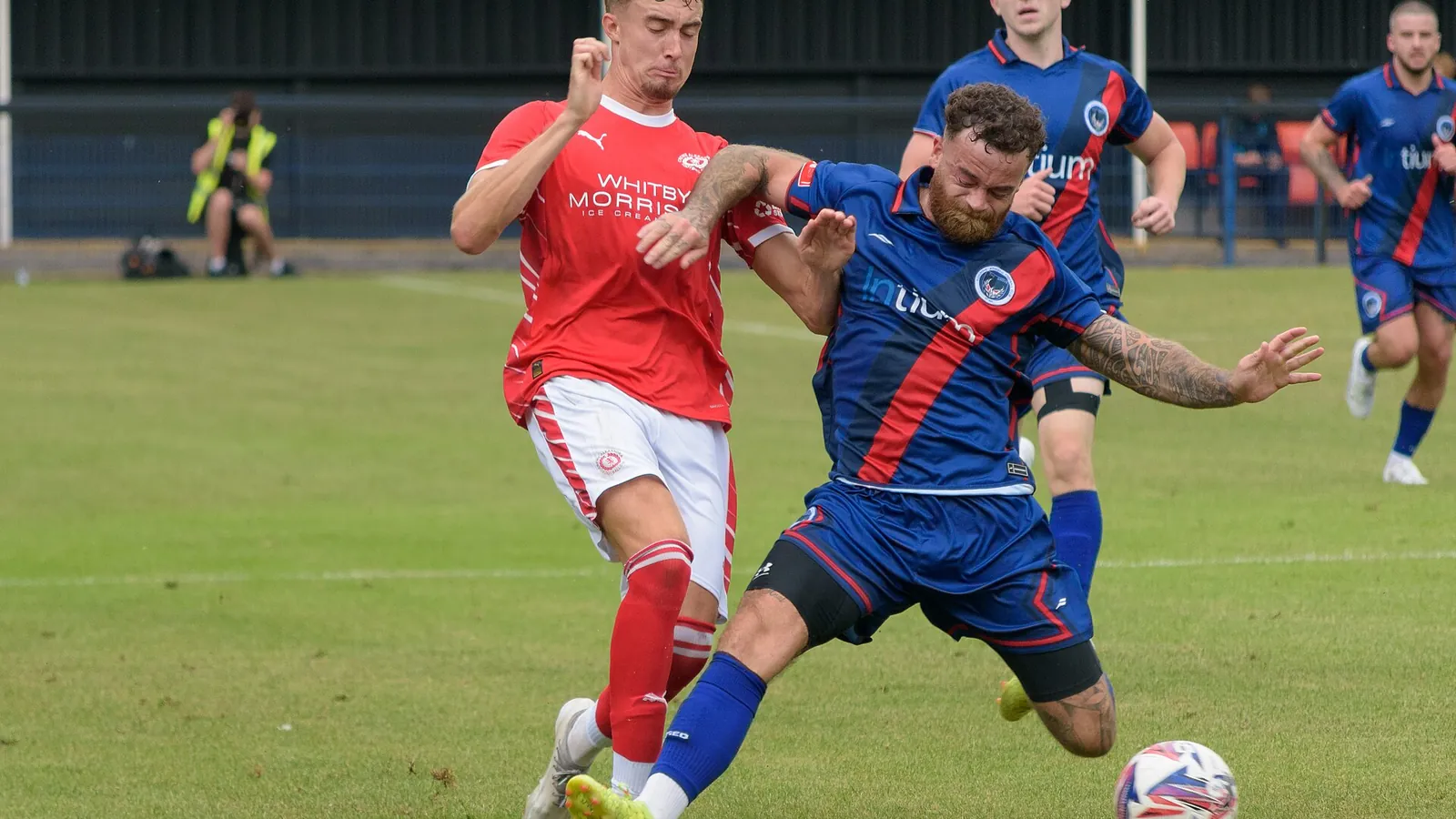
Young centre-backs often lose 1v1s by diving in. Teach them to close down quickly while the ball is travelling, slow down in the last few metres, get low and side-on, and wait for a heavy touch. Tackling is a timing skill, not a strength contest.
Drill 2: 1v1 to 2v2 in a channel
Organisation: a channel 20 m wide and 30 m long in front of a full-size or 9v9 goal with a goalkeeper. Defenders start on the edge of the penalty area, attackers 30 m out with the ball. Two rounds of 6 minutes.
Rules: the defender passes to the attacker, then closes down. The attacker tries to score; the defender wins a point by winning the ball and dribbling across the halfway cone line. After a few minutes, add a second defender and a second attacker for 2v2, so one presses and one covers. Coaching points: close down on the pass, brake early, show the attacker onto the weaker foot or away from goal, cover at an angle in the 2v2.
Aerial duels matter from 9v9 onwards. Since 2026/27, deliberate heading has been removed from matches up to U11, and The FA's heading guidance limits heading practice in training for all youth age groups. Teach the basics with soft balls and low repetitions: attack the ball, contact with the forehead, eyes open, and focus on the starting position and timing of the jump rather than the number of headers.
Playing out from the back as a centre-back
Modern centre-backs start attacks. In youth football that means splitting wide when the goalkeeper has the ball, receiving on the half-turn, and either passing forward or carrying the ball into midfield when the opponent leaves space.
- Split wide: to the edges of the penalty area, so the goalkeeper has a clear passing line.
- Open body: receive with the back foot, facing up the pitch.
- Step in with the ball: if no one presses, dribble forward until someone comes to you, then pass.
- Pass to the free player: the forward in the gap, the full-back up the line or the midfielder who has dropped.
Drill 3: centre-back step-in game
Organisation: half a 9v9 pitch. Goalkeeper, two centre-backs and a holding midfielder against two forwards. Three target players or mini-goals on a line 35 m from goal. 4 minutes per round, swap the forwards.
Rules: the goalkeeper starts every attack. The team scores by passing to a target player or dribbling through a mini-goal. One extra point if a centre-back carries the ball over a marked line 20 m from goal before passing. Coaching points: split early, scan before receiving, carry the ball at speed when the space is there, and pass the moment a forward commits.
Centre-back training drills by age: common mistakes
- Ball-watching: the centre-back follows the ball and loses the runner. Fix it with 'check your shoulder' calls in every defending practice.
- Diving in: reward winning the ball, not attempting tackles. Count duels won in small-sided games.
- Flat line with no cover: stop the game and show where the covering defender should be.
- Panic clearances: allow the long ball when it is the right decision, but praise the defender who keeps calm and passes out.
| Age group | Focus |
|---|---|
| U10–U11 (7v7) | 1v1 defending, staying goal-side, passing out from the goalkeeper; no heading practice |
| U12–U13 (9v9) | Pairs: press and cover, offside line, playing out under pressure, introductory heading within FA guidance |
| U14+ (11v11) | Back-four shape, defending crosses, organising the line, longer passing |
Rotate players through central defence in the younger age groups. The skills of a centre-back, reading the game, defending 1v1 and playing forward, help every outfield player.
Frequently asked questions
What makes a good centre-back in youth football?
Reading the game, staying on their feet in duels, covering teammates, talking and being comfortable on the ball. Height helps in the air, but positioning and decisions matter more.
How do you train a centre-back to defend 1v1?
Use channel games where the defender passes to an attacker and closes down. Teach them to close quickly while the ball travels, slow down early, get side-on and show the attacker away from goal.
Should youth centre-backs practise heading?
Only within The FA's heading guidance, which limits heading practice in training for youth players. Deliberate heading is not part of matches up to U11. From U12, teach technique with low repetitions and suitable balls.
What is cover and balance in defending?
When one defender goes to the ball, a teammate drops behind at an angle to cover in case they are beaten, and the players further away move across to balance the line and protect the space behind.
Sources
Verified in October 2026. Rules and age groups vary by association and by season; check your local regulations.