
Set-Piece Routines: Attacking Corners, Free Kicks and Throw-Ins
Set-piece routines give a team a repeatable way to create chances from a dead ball: the players know the delivery, the zones to attack, the timing of each run and who stays behind for the counter. Good routines use movement and timing to create separation, not contact, because holding and moving into an opponent's path are offences under Law 12. This article covers attacking corners, wide free kicks and final-third throw-ins, the defensive organisation and how to train them.
Do you organise tournaments? Create yours for free on DorsalCUP.
In this article
Why set-piece routines deserve training time
Set pieces produce a significant share of goals at every level, and they are the part of the game where preparation transfers most directly to the match. The opponent's organisation can be studied, the ball is still, and the attacking team decides when the action starts. A team that trains 15 to 20 minutes of set pieces a week, with clear roles, usually gains more than one that improvises.
Set pieces also carry risk. A corner that ends with eight players in the box and nobody at the edge can become a counter-attack against two defenders. Every routine includes the rest defence, and the defensive set-up includes the counter-attack outlets.
At youth level, keep routines simple: two corner routines, one wide free kick and one throw-in pattern are enough for a season. The priority is delivery quality and attacking the ball with intent.
Attacking corners: zones, delivery and runs
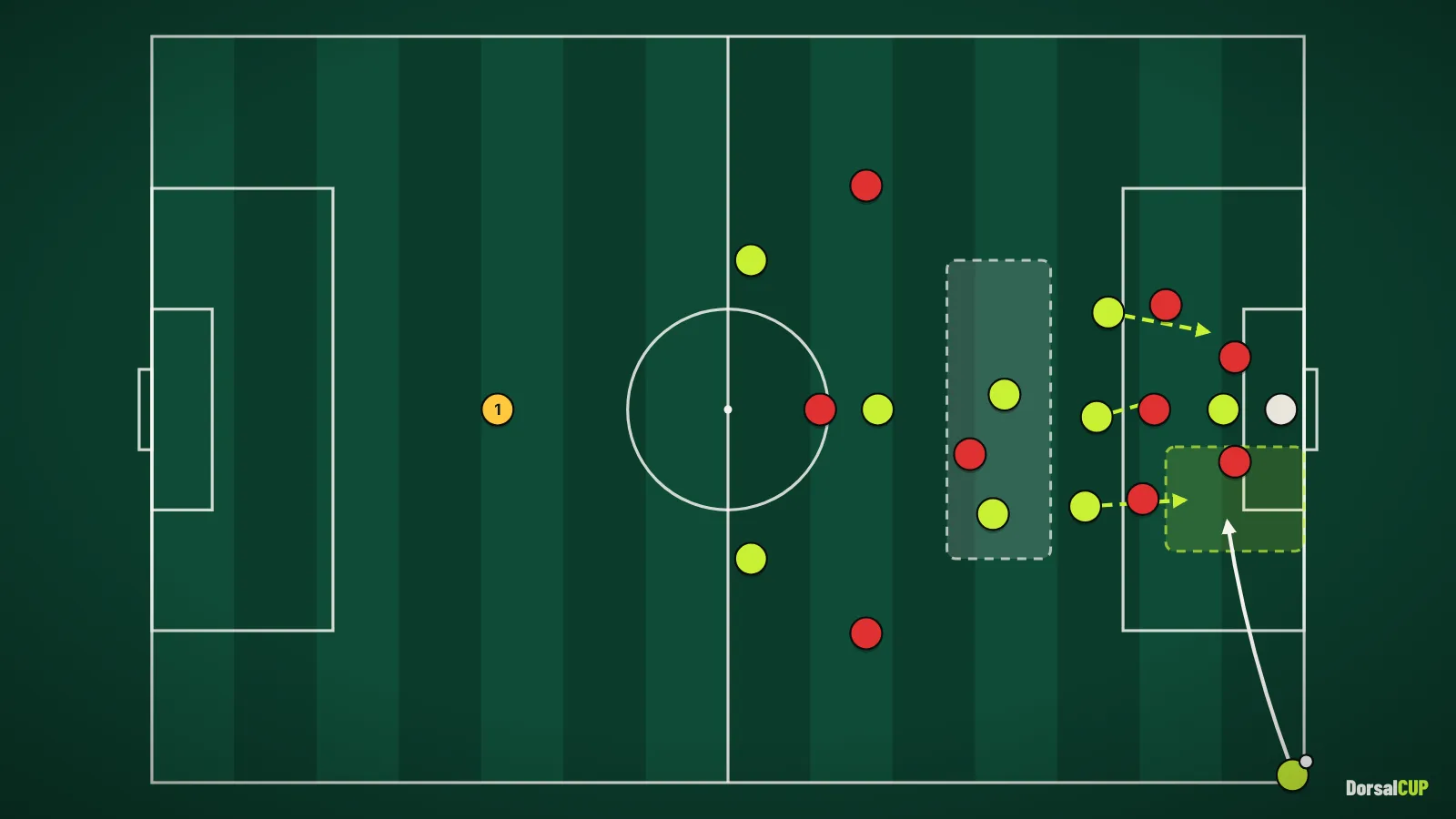
A corner routine is built around the delivery. Inswinging deliveries curl towards the goal and are attacked at the near post and in the six-yard box. Outswinging deliveries curl away and are attacked around the penalty spot and the back post. Driven low deliveries to the near post are hard to defend for zonal set-ups but need a precise taker. A short corner changes the angle and drags two defenders out of the box.
Five zones are usually occupied, with a clear owner for each:
- Near post: a runner attacks the space in front of the first zonal defender, to flick on or finish.
- Six-yard box, central: the goalkeeper's zone; one attacker occupies it to make the goalkeeper's movement harder, without impeding him.
- Back post: a late runner for overhit deliveries and flick-ons.
- Penalty spot: the best header arriving with momentum.
- Edge of the box: one or two players for second balls and cut-backs.
Behind them, the rest defence is usually two players around the halfway line plus one marker on the opponent's fastest forward, a 2+1. Against teams that leave three players up, it becomes a 3+1.
Screens and blocks within the Laws
Under Law 12, impeding an opponent means moving into his path to obstruct, block or slow him down when the ball is not within playing distance. Holding and impeding with contact are direct free-kick offences, which in the penalty area means a penalty. At the same time, every player has a right to his position: standing still in a place is not the same as moving into an opponent's way.
Routines should therefore create separation through starting positions, timing and crossing running lines, not through contact. Common tools are the stack, where several attackers start together and split on the taker's signal; decoy runs that drag a marker towards the near post while the main target attacks the space he leaves; and late runs from outside the box that zonal defenders find hard to attack. Referees apply holding offences at set pieces strictly in many competitions; train routines that do not depend on it.
Free kick routines from wide areas
A wide free kick 20 to 35 m from goal is similar to a cross, with one difference: offside applies. The attacking runners start on or just behind the opponent's defensive line and time their runs with the taker's approach, so that they are moving forward at full speed when the ball is struck.
- Target space: the area between the defensive line and the goalkeeper, typically 6 to 12 m from goal. A delivery that is too close lets the goalkeeper claim; too far lets the defenders head it away facing the ball.
- Staggered runners: four runners at different depths and angles, so the defenders cannot step up together to catch them offside.
- A player on the second ball: one player stays at the edge of the box for cleared headers.
- Variation: a short pass to a player who crosses from a different angle or the taker's dummy, with a second player delivering.
For central free kicks, the Laws of the Game require attackers to stay at least 1 m from a defensive wall of three or more players until the ball is in play. Routines that place attackers next to the wall must respect that distance. The opponents must be at least 9.15 m from the ball.
Throw-ins in the final third
Throw-ins are the most frequent restart and often the least trained. There is no offside from a throw-in, which allows players to stand behind the defensive line, and opponents must stand at least 2 m from the thrower.
- Short pattern: one player checks towards the thrower, a second runs into the space behind, and the thrower becomes a free player after the throw because markers rarely follow him.
- Long throw-in into the box: treated like a corner, with near-post flick-on, runners and second balls. It requires a thrower who can deliver it flat and fast.
- Speed: a quick throw-in before the opponent is organised is often worth more than a routine. Under the 2026/27 Laws, a referee can also start a visible five-second countdown when a throw-in is being delayed; if the ball is not in play in time, the throw-in goes to the opponents.
If you run tournaments at your club, DorsalCUP handles registrations, the draw, the multi-pitch schedule and live results for free. The guide how to organise a football tournament walks through every step, from the rules to matchday.
Defending set pieces
The defensive organisation for corners mirrors the attacking one. A typical mixed set-up uses three or four zonal players on the six-yard line, two or three markers on the most dangerous attackers, one player at the near post for short deliveries, one or two at the edge of the box and one or two outlets for the counter-attack.
- Zonal line: on or just in front of the six-yard line, attacking the ball forward.
- Markers: goal-side and with sight of the ball; contact early but no holding.
- Short corner: two players go out immediately, so that the 2v1 never happens.
- Counter-attack outlets: one or two players near halfway force the opponent to keep players back.
For wide free kicks, the defensive line usually holds around the edge of the penalty area, high enough to leave space for the goalkeeper and to catch late runners offside. The line holds until the ball is struck, then drops and attacks the ball.
How to train set-piece routines
1. Routine rehearsal against a passive, then active defence
Objective: timing and roles. Space: penalty area. Players: the attacking set-piece group against a defensive group that reproduces the opponent's organisation. Progression: walk-through, then passive defence, then full opposition. Load: 6 to 8 repetitions per routine with 30 to 45 s between repetitions, ideally on MD-1. Coaching points: the taker's signal, the start of each run, the delivery zone, the rest defence.
2. Set-piece game 9 v 9
Objective: set pieces under fatigue and game conditions. Space: 70 x 68 m. Rules: every time the ball goes out in the final third, the attacking team gets a corner or a wide free kick; a goal from a set piece counts double. Load: 3 x 8 min, 2 min rest. Coaching points: speed of organisation, communication, protection against the counter.
3. Delivery practice for takers
Objective: consistency. Organisation: the takers deliver into target zones marked with cones, 15 to 20 deliveries per session from each side, alternating inswinging and outswinging. Coaching points: height and pace of delivery, the same run-up for different deliveries so that the defence cannot read it.
Common errors and what to look for on video
- Runs too early. Attackers arrive in the zone before the ball and stand still. Check on video where each runner is when the taker strikes.
- No rest defence. Everybody goes forward. Count the players behind the ball at every corner.
- Routines that rely on holding. They work in training and concede free kicks in games. Review contact in every repetition.
- Poor delivery. The best routine fails with a delivery to the wrong zone. Record each delivery and its zone; track the percentage that reach the target.
- Same routine every time. Opponents analyse set pieces too. Alternate two or three variations from the same starting picture.
Frequently asked questions
What are the best corner kick routines?
There is no single best routine. Effective ones combine a reliable delivery with clear runs to the near post, the six-yard box, the back post and the penalty spot, one or two players at the edge of the box and a rest defence. A stack that splits on the delivery and a late run from outside the box are common variations.
Is blocking allowed at corners?
A player may stand in a position, but moving into an opponent's path to block him when the ball is not within playing distance is impeding, an indirect free kick offence. Holding or impeding with contact is a direct free kick, which inside the penalty area is a penalty. Routines should create separation through movement and timing.
Is there offside from a throw-in or a corner?
No. A player cannot be offside directly from a throw-in, a corner kick or a goal kick. Offside does apply to free kicks, so runners on a wide free kick must start onside.
How should a team defend corners?
Most teams use a mixed system: three or four zonal players on the six-yard line, markers on the most dangerous attackers, a player for the short delivery, one or two at the edge of the box and one or two outlets for the counter-attack.
Sources
Verified in October 2026. Rules and age groups vary by association and by season; check your local regulations.