
Attacking the Half-Spaces: Cut-Backs, Underlaps and Box Occupation
The half-space is the lane between the edge of the penalty area and the edge of the six-yard box, and in the final third it is the most effective area to attack. A player who receives there, or runs into the channel behind it, creates a dilemma for the defence: the full-back and centre-back cannot both go, and the ball from there can be a shot, a through ball or a cut-back. This article covers the entries between full-back and centre-back, underlaps, the cut-back, how to occupy the box, how defences respond, and how to train it.
Do you organise tournaments? Create yours for free on DorsalCUP.
In this article
Why attacking the half-spaces works
A back four defends the half-space with two players who each have another job: the full-back is responsible for the winger, the centre-back for the striker. When a player arrives in the half-space between them, someone has to decide, and decisions take time. The defender who steps out leaves a gap; the defender who waits gives the attacker time to face goal.
The geometry also helps. From the half-space, the angle to goal is good enough to shoot, the through ball into the channel behind the full-back is short, and the cut-back from the byline in that lane arrives at the penalty spot with the defence running towards its own goal. From the wide lane, the same actions are slower and less dangerous; from the central lane, the defence is usually most crowded.
For these reasons most structured attacking models aim to have a player in each half-space between the lines, often the two 8s or a 10 and an 8, while the wingers hold the width to keep the full-backs wide (see positional play).
Entries between full-back and centre-back
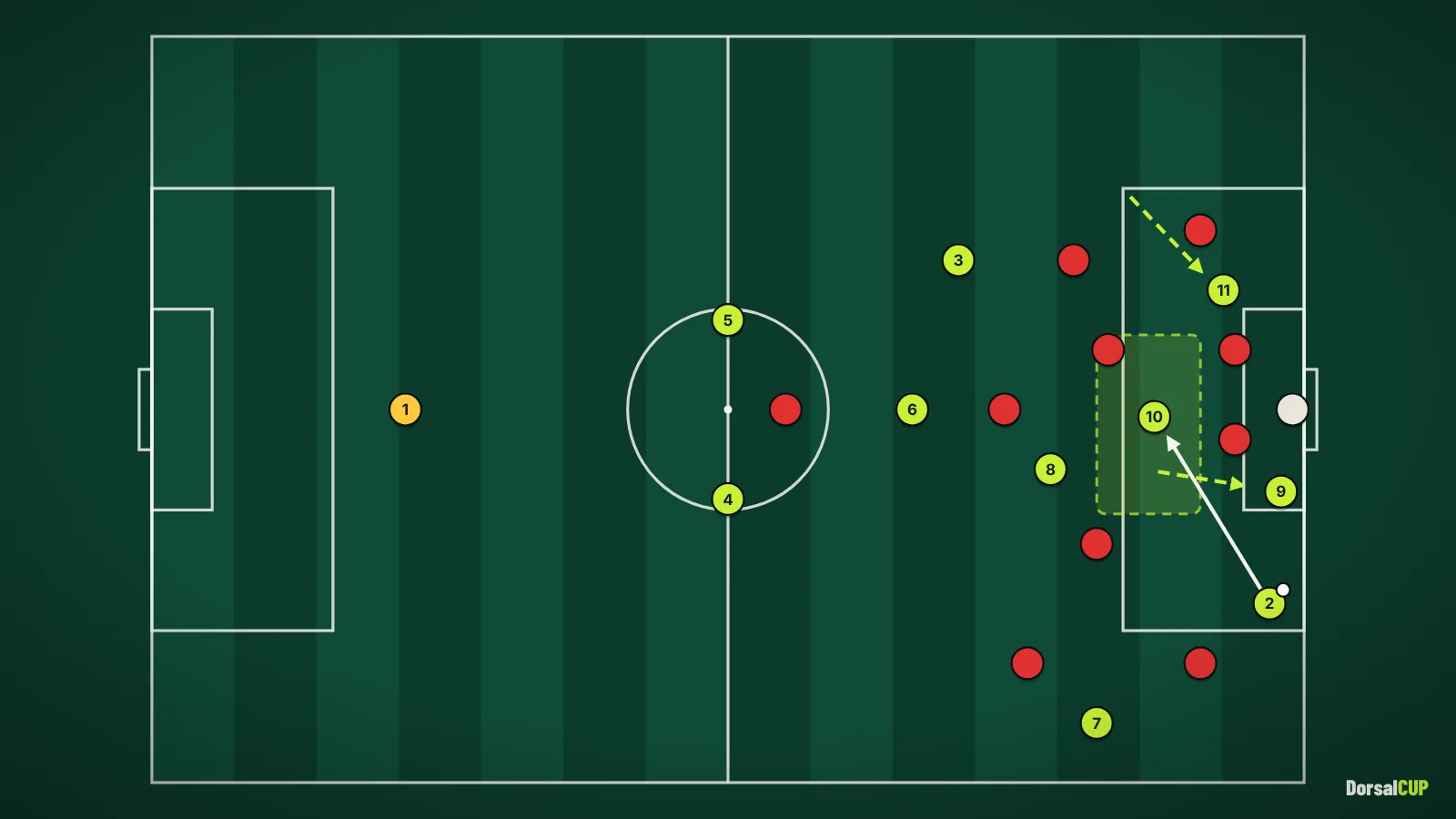
The most valuable entry is the run into the channel between the full-back and the centre-back, behind the defensive line. Three conditions make it work:
- The full-back is fixed wide. Our winger stays on the touchline, close enough to threaten the full-back's outside shoulder. If the full-back narrows to close the channel, the winger receives in 1v1.
- The centre-back is fixed centrally. Our 9 stays between the centre-backs or on the far centre-back's shoulder. If the near centre-back slides out, the 9 is free.
- The run starts from outside the defender's field of vision. The 8 or 10 starts behind the opposition midfielder's shoulder and runs diagonally into the channel, timing the run so that it begins as the passer opens his body.
Distances matter. If the 8 starts too close to the defensive line, the centre-back can follow him; if he starts too deep, the pass has to be too long. As a guide in 11v11: start 12–18 metres from the line, run at an angle of roughly 30–45 degrees, and receive 5–10 metres behind the line. The passer should be in the half-space or central lane, not wide, so that the pass travels away from the goalkeeper and into the runner's path.
Underlaps, overlaps and rotations
When the winger receives wide and the full-back joins, the classic option is the overlap outside him. Against modern defences, the underlap (the full-back or 8 running inside the winger, into the half-space channel) is often more effective: it attacks the space between full-back and centre-back, and the run is harder to track because the opposition winger tends to follow on the outside.
Rotations add a further layer. A typical right-side rotation: the 8 drifts wide into the winger's lane, the winger comes inside to the half-space, and the full-back holds a deeper position. Each movement drags a defender, and the player who arrives last into the half-space is often free. The rule for rotations is that the lanes stay occupied: if one player leaves the wide lane, another fills it.
The cut-back and box occupation
The cut-back is the pass from the byline (or close to it) back towards the penalty spot. It is effective because the defenders are running towards their own goal and must turn to see the ball, while the receivers arrive facing it. The ideal cut-back comes from the half-space channel, at the edge of the six-yard box or slightly wider.
A cut-back is only as good as the occupation of the box. A common reference, adapted by many coaches, is to fill four zones whenever the ball reaches the byline:
- Near post: usually the 9. His run drags the near centre-back and the goalkeeper towards the near post. He attacks the ball if it is driven low across the six-yard box.
- Far post: the far winger. He arrives late, on the defender's blind side, for the overhit ball or the deflection.
- Penalty spot zone (cut-back zone): the 10 or the far 8, arriving late into the space the near-post run has opened. This is the main target of the cut-back.
- Edge of the box: an 8 or the 6, for the second ball and the cut-back that is pulled further back. He also protects against the counter.
Timing beats speed. Runners who arrive in the box before the ball reaches the byline are already marked. The cue is the moment the wide player's touch takes him past the last defender: that is when the near-post run starts, and the cut-back runner should still be outside the box, arriving as the ball is played.
A pre-season tournament or a four-team round robin mid-season gives you several matches in one day to test these ideas against different opponents. The DorsalCUP tournament fixture generator builds the matches, pitches and kick-off times in minutes, free and with no sign-up.
How defences protect the half-spaces, and how to respond
- A back five. The extra centre-back closes the channel between full-back and centre-back. Response: attack the space in front of the five (the half-space between the lines) and use the wide centre-back's step-out: when he steps onto our 8, the channel behind him opens for the winger moving inside.
- Midfielders tracking runners. The opposition 8 follows our 8 into the channel. Response: use the run as a decoy and play into the space he has left, often for the 10 or the 6 arriving to shoot from the edge.
- A deep pivot protecting the cut-back zone. The opposition 6 drops into the penalty spot area as the ball goes wide. Response: cut back further, towards the edge of the box, or attack the near post with a low driven cross.
- Full-backs who stay narrow. Response: switch quickly to the winger in 1v1 on the far side (see overload to isolate).
How to train attacking the half-spaces
1. Channel-run pattern with live defenders: 4 v 2 + GK
- Space: final 30 m, width of the penalty area plus 10 m on one side.
- Players: winger, 8, 10 and 9 against full-back and centre-back, plus goalkeeper.
- Rules: the 10 starts with the ball; the attack must finish within 10 seconds. A goal after a channel run or a cut-back counts double.
- Progression: add a defending midfielder who can track the runner; then add a recovering opposition winger.
- Load: 3 sets of 8 repetitions, 20 seconds' rest between reps, 2 minutes between sets. Rotate roles.
- Coaching points: the winger keeps the width until the run starts; the run starts when the passer opens his body; the pass goes into the runner's path.
2. Final-third game with bonus lanes: 7 v 6 + GK
Final third plus 10 metres. Team A (two wingers, two 8s, a 10, a 9 and a 6) attacks against a back four, two midfielders and the goalkeeper. The half-spaces are marked with cones. A goal scored from a pass that originated in a half-space, or from a cut-back, counts triple. Team B counters through two gates on the halfway line. Play 4 × 6 minutes with 2 minutes' rest.
3. 11 v 11 against a low block
Full pitch, the second team defending in a 4-4-2 or 5-4-1 low block. The first team must reach the byline in a half-space channel at least once per attack before shooting from outside the box is allowed. Play 3 × 10 minutes, 3 minutes' rest. Review box occupation at each cut-back: were the four zones filled, and who arrived late?
Common mistakes and what to look for on video
- Winger and full-back both inside. Nobody holds the width, so the opposition full-back narrows and closes the channel. On video, check the touchline at the moment of the run.
- Running too early. The runner is in the channel before the passer can see him and is picked up. On video, compare the start of the run with the passer's touch.
- Everyone at the near post. Three players attack the same zone and the cut-back zone is empty. On video, freeze at the byline and count the players in each zone.
- Crossing instead of cutting back. The wide player reaches the byline in the half-space and lifts a cross into the goalkeeper. On video, list the decisions at the byline and what was available.
- No one at the edge of the box. Second balls go straight to the opponent's counter. On video, check the position of the 6 or 8 when the ball reaches the byline.
Frequently asked questions
What are the half-spaces in football?
The half-spaces are the two vertical lanes between the wide areas and the centre, roughly between the edge of the penalty area and the edge of the six-yard box. They are valuable because defenders there have unclear responsibilities and the angles to goal and to team-mates are good.
What is a cut-back in football?
A cut-back is a pass played from near the byline back towards the penalty spot or the edge of the box. It is effective because defenders are running towards their own goal while the receivers arrive facing the ball.
What is the difference between an overlap and an underlap?
In an overlap, the supporting player runs around the outside of the ball carrier, towards the touchline. In an underlap, he runs inside the ball carrier, into the half-space or the channel between full-back and centre-back.
Who should attack the near post and the far post?
A common distribution is the 9 at the near post, the far winger at the far post, the 10 or far-side 8 into the cut-back zone around the penalty spot, and an 8 or 6 at the edge of the box. Teams adapt it to their players' strengths, but the four zones should be filled.