
Positional Play in Football: Five Lanes, Staggering and the Third Man
Positional play is a way of organising possession so that, at any moment, the player on the ball has more than one good option and the opponent has to make a decision it cannot make well. It rests on rational occupation of the pitch (five lanes, several heights, staggered positions) and on three kinds of superiority: numerical, positional and qualitative. This article explains the principles in coaching terms, how opponents try to neutralise them, and how to train them without turning the team into a set of static markers.
Do you organise tournaments? Create yours for free on DorsalCUP.
In this article
- What positional play is trying to solve
- Positional play and rational occupation: five lanes, heights, staggering
- Numerical, positional and qualitative superiority
- Attract to release, and the third man
- How opponents defend positional play, and how to respond
- How to train positional play
- Common mistakes and what to look for on video
What positional play is trying to solve
Any organised defence tries to do three things: keep its lines close, protect the centre and press the ball when the pass is predictable. Positional play attacks each of these. It stretches the lines by occupying width and depth at the same time, it creates passing options between and behind the lines rather than in front of them, and it makes the next pass unpredictable because the player on the ball always has at least two options at different angles.
The idea is often associated with Cruyff's Ajax and Barcelona and later with Guardiola's teams, but the principles are not a style for elite players only. They are a set of rules about where to stand relative to the ball, the opponent and team-mates. A well-coached U15 side can apply them; a senior side that ignores them will struggle against any compact block, whatever the quality of its players.
The common misunderstanding is to treat positional play as a fixed formation. The structure changes with the ball. What stays constant is the logic: occupy the space rationally, create a superiority, attract the opponent and release the free player.
Positional play and rational occupation: five lanes, heights, staggering
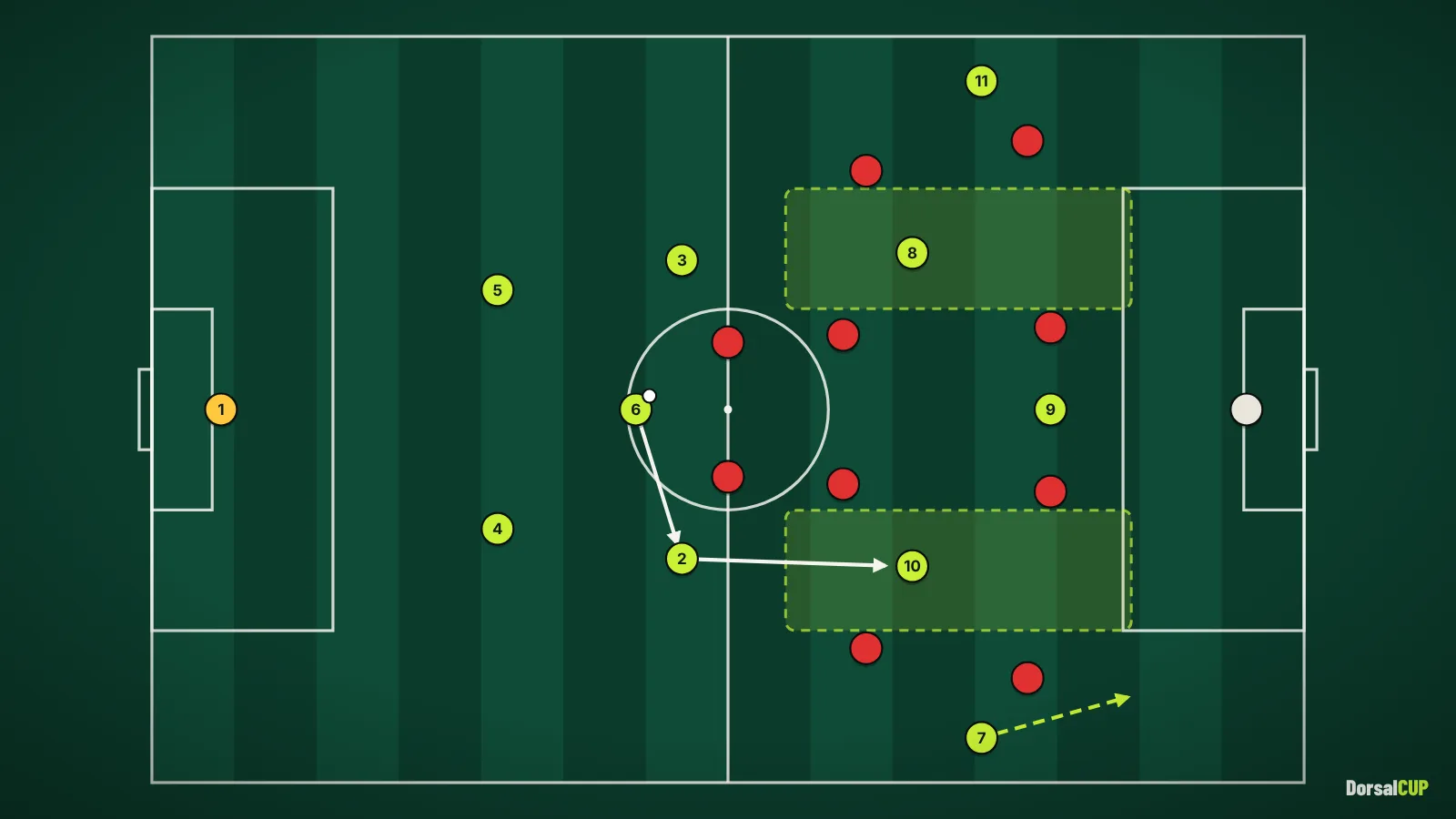
Divide the pitch into five vertical lanes: two wide lanes from the touchline to the edge of the penalty area, two half-spaces from the edge of the box to the edge of the six-yard box, and a central lane. Divide it horizontally into heights that correspond to the opponent's lines: in front of the first line, between first and second, between the lines, and the last line.
Three working rules follow, which the coach can state in a sentence each:
- Width is held by one player per side, on the touchline. Wingers or wing-backs keep their boots near the line until the ball enters the half-space on their side. Width stretches the opponent's back four and opens the half-spaces.
- No more than two players in the same lane, and never at the same height. Two players in the same lane on the same line can be covered by one defender. Different heights create a diagonal, and diagonals can be played into.
- No more than three players on the same horizontal line. A flat line of four makes every pass square and every interception a counter-attack. Staggering turns lines into triangles and diamonds.
Typical distances in an 11v11 structure: 12–18 metres between team-mates in the build-up, 8–12 metres in the final third, and a vertical gap of 6–10 metres between staggered players in neighbouring lanes. Body orientation matters as much as position: a player in the half-space should stand open to both the ball and the far post, so that he can receive and play forward with his first or second touch.
Numerical, positional and qualitative superiority
Numerical superiority is the simplest: more players than the opponent in a zone. Examples are 3v2 against two strikers in the build-up, or a full-back, winger and 8 against full-back and wide midfielder. It is also the most fragile, because the opponent can shift numbers across quickly.
Positional superiority is having a player in a position the opponent cannot reach in time: behind a line, in a defender's blind side, or between two defenders who are each unsure whose player he is. The classic example is the 8 or 10 who receives in the half-space between the opponent's midfield and back four. Even in equal numbers, the receiver is already beyond one line.
Qualitative superiority is a mismatch in quality: the best dribbler against the weakest defender, or a tall striker against a short full-back. Positional play uses it deliberately, for example by overloading one side to isolate a winger in 1v1 on the other (see overload to isolate).
Superiorities feed each other. A numerical superiority in the first line forces the opponent to commit a midfielder, which creates a positional superiority between the lines, which forces a defender to step out, which leaves a 1v1 somewhere else. The coach should teach players to see this chain, not just the first link.
Attract to release, and the third man
Positions alone do not move defenders. The ball has to be used to attract an opponent to one place so that another place is freed. Three actions do this:
- Carrying into a defender. A centre-back or 6 who drives at a presser forces him to engage. The moment he commits, the player he was screening is free. The carry stops 3–4 metres from the defender; closer and the pass is blocked.
- Playing to the player who attracts. A short pass to a midfielder with his back to goal draws his marker tight. That pass is not the objective; the lay-off is.
- The third man. Player A cannot pass to player C because C is marked or in a cover shadow. A plays to B, who lays it to C arriving facing forward. C's marker was watching C and the ball at once; when the ball moves to B, C runs out of his field of vision.
The timing rule for the third man is that C starts moving as the ball travels to B, not before. If C moves early, his marker follows; if he moves late, B has to hold the ball under pressure. In training, coach B to lay the ball into space in front of C, not to his feet, so that C can take it in stride.
A pre-season tournament or a four-team round robin mid-season gives you several matches in one day to test these ideas against different opponents. The DorsalCUP tournament fixture generator builds the matches, pitches and kick-off times in minutes, free and with no sign-up.
How opponents defend positional play, and how to respond
Man-oriented marking in midfield
If the opponent's midfielders follow ours, the spaces between the lines close but the structure of their block breaks: markers are dragged out of position. Use rotations (8 drops, 6 moves into the half-space, winger comes inside while the full-back overlaps) to drag markers into areas they do not want to defend, and attack the space they leave. Against man-marking, the third man becomes even more effective because each defender is looking at a man, not at the space.
A compact low block that refuses to step out
Against a deep 5-4-1 or 4-5-1, there is little space between the lines. The answer is to move the block from side to side quickly enough that the shift is late, to use the wide lanes to stretch it, and to attack the half-space at the moment the ball is switched. Patience is a principle here: the coach should define how many switches are normal before forcing a vertical pass.
A press that targets the first pass
If the opponent presses aggressively to prevent the team from settling into its structure, the structure has to be built faster and lower, with the goalkeeper involved. See the principles in build-up against a high press.
How to train positional play
1. Positional rondo 4 v 4 + 3
- Space: 40 × 30 m. One neutral at each end line and one central neutral.
- Players: two teams of four plus three neutrals (7 v 4 in possession).
- Rules: neutrals play with the team in possession, maximum two touches; a point for 8 consecutive passes, two points for a pass from end neutral to end neutral through the central neutral.
- Progression: central neutral is limited to one touch; then the pitch is divided into three vertical channels and no two team-mates may stand in the same channel.
- Load: 6 × 2 minutes 30 seconds, 1 minute rest. Short, intense, high density of decisions.
- Coaching points: open body before the ball arrives; receive on the back foot; move out of the cover shadow as soon as the ball moves.
2. 7 v 7 + 3 positional game with lane rules
Pitch 60 × 45 m, divided into five lanes with cones. Each team has 7 players plus a goalkeeper; three neutrals play for the team in possession (one in each half-space, one as a deep 6). Rule: the team in possession may not have two players in the same lane at the same height (coach judges). A goal after a third-man sequence counts double. Play 4 × 6 minutes with 2 minutes' rest. The aim is to make lane occupation automatic under fatigue.
3. 11 v 9 against a mid-block
Use two-thirds of the pitch. Team B defends in a 4-4-1 mid-block and counter-attacks two mini-goals on the halfway line. Team A attacks in its game-model structure; a pass received between the lines with the receiver facing forward earns a point even without a shot. Play 3 × 10 minutes, 3 minutes' rest. Stop play sparingly, mainly when the five lanes are not occupied or when two players stand at the same height in one lane.
Common mistakes and what to look for on video
- Static positions. Players reach the right zone and stop. Defenders adjust to a static picture easily. Correct by demanding small movements (2–3 metres) every time the ball moves. On video, freeze the image every second pass and check who moved.
- Both wide players inside. When the winger and full-back on the same side drift into the half-space together, the wide lane is empty and the opponent's full-back can narrow. On video, look at the touchline when the ball is on the far side.
- Possession without progression. Counting passes becomes the aim. Correct with rules that reward line-breaking passes and third-man sequences. On video, measure how many possessions reach the space between the lines.
- Rest-defence forgotten. Five players high and the full-backs inside means losses are dangerous. Positional play must be paired with a clear rest-defence structure.
- Wrong body shape. Receivers square to the passer cannot see the next option. On video, look at the hips at the moment of the pass.
Frequently asked questions
What is positional play in football?
Positional play is an approach to possession based on rational occupation of the pitch: players spread across five vertical lanes and several heights so that the ball carrier always has options at different angles. The aim is to create numerical, positional or qualitative superiority and then release the free player.
What are the five lanes in football?
Two wide lanes from touchline to the edge of the penalty area, two half-spaces between the edge of the box and the edge of the six-yard box, and a central lane. Coaches use them to organise width, avoid crowding and identify where the best passing lines are.
What is the difference between positional play and tiki-taka?
Tiki-taka is a media label for a style of short passing. Positional play is a set of principles about where players stand relative to the ball, opponents and team-mates. A positional team can play long or direct if the free player is far away; the principles decide the pass, not a preference for short passing.
Can youth teams play positional football?
Yes, in a simplified form. From U12 in 9v9, the basic rules of width, depth and staggering can be taught through small-sided games. The half-spaces, third-man sequences and deliberate superiorities are better introduced from U14 onwards.