
Rest-Defence in Football: 2+3, 3+2 and 3+1 Structures Explained
Rest-defence is the part of the team that stays behind the ball while the rest attack: the players whose job is to stop the counter-attack before it starts. A good rest-defence has the right number of players for the opponent's remaining forwards, protects the central lane, controls the depth behind it and is already positioned to win the ball back when possession is lost. This article explains the 2+3, 3+2 and 3+1 structures, how to choose between them, how to control depth, and how to train it.
Do you organise tournaments? Create yours for free on DorsalCUP.
In this article
Why rest-defence decides how you can attack
Most teams that attack with many players concede their most dangerous chances in transition, not against an organised attack. The problem is rarely the moment of the loss itself. It is what was already in place before the loss: how many players were behind the ball, where they were standing, and how much space there was behind them.
Rest-defence (sometimes called defensive balance in possession) is the answer to a simple question the coach must ask at every moment of the attack: if we lose the ball now, can the opponent play forward? If the answer is yes, the attack is being built on sand. If the rest-defence is good, the team can commit more players to the final third, because the cost of losing the ball is lower.
This is why rest-defence is not a defensive concept separate from attacking. It is a precondition for attacking with numbers. Teams associated with positional play and with intense counter-pressing tend to share this feature: their attacks are long and their opponents' counter-attacks are rare, because the structure behind the ball is planned as carefully as the structure in front of it.
Rest-defence structures: 2+3, 3+2 and 3+1
Structures are named by two numbers: the players in the last line, and the players in front of them screening the centre. The choice depends on how many forwards the opponent leaves high, how fast they are, and how the team builds its attack.
2+3
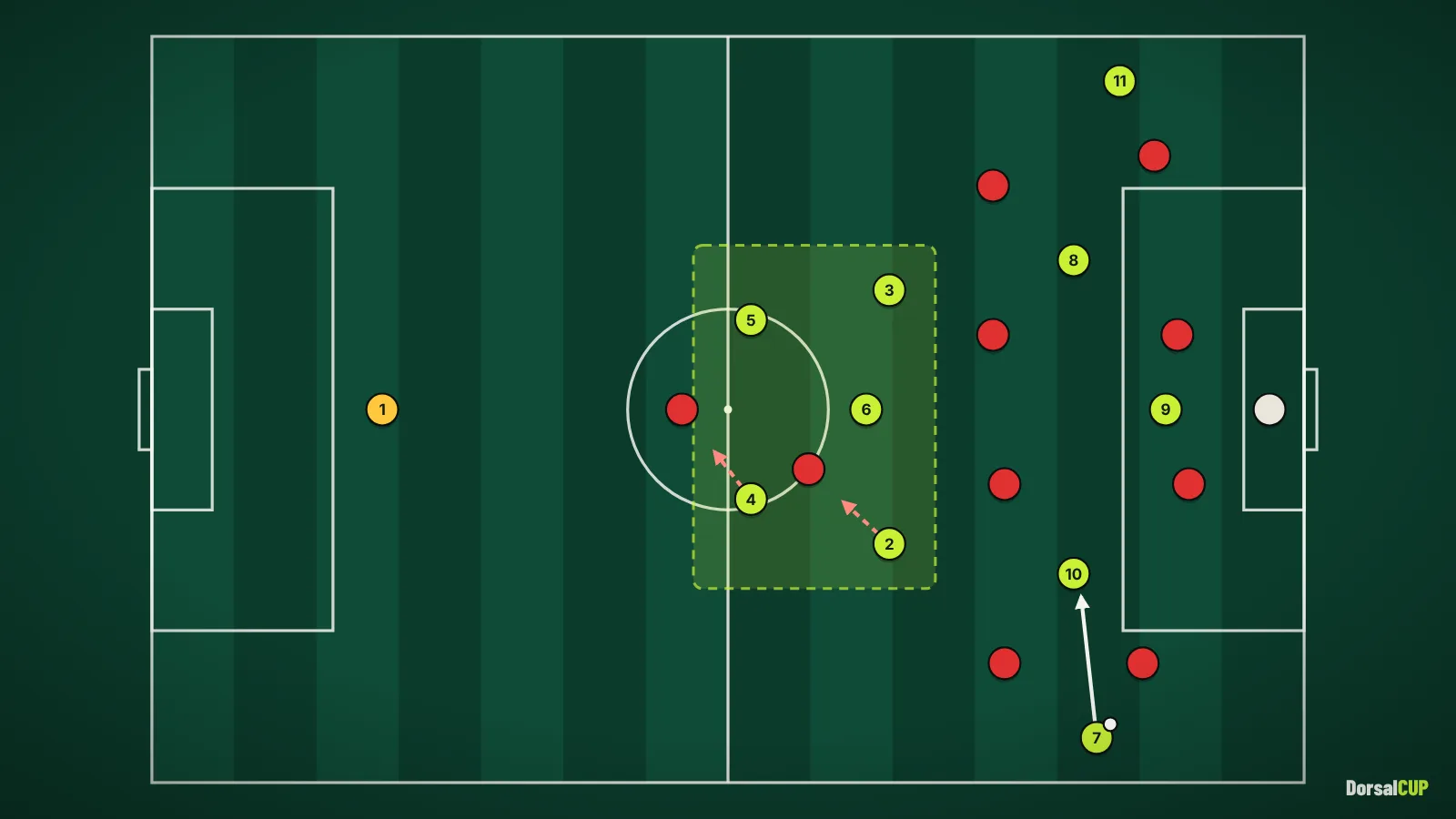
Two centre-backs in the last line, three players in front of them (typically the 6 plus two inverted full-backs, or the 6 plus two 8s). It suits teams that attack with five players across the last line (2-3-5) and opponents that leave one striker high. The three in front are the key: they block the first pass out of the opponent's block, especially into a 10 or a dropping winger, and they are the first counter-pressers.
3+2
Three in the last line (three centre-backs, or two centre-backs and a full-back who stays) and two in front (double pivot or 6 and 8). It is more secure against two forwards or one striker with a fast winger staying high. It costs one attacker in the final third, which is why it is common in teams that attack with wing-backs and two 10s (3-2-5).
3+1
Three in the last line and one 6. It frees an extra midfielder to attack but leaves the 6 with a large area to screen. It works when the opponent has few players high, when the back three are quick and comfortable defending space, and when the goalkeeper can cover depth. Against two strikers it creates the 3v2 the back line needs, with the goalkeeper as the extra cover.
| Structure | Typical in possession | Best against | Main risk |
|---|---|---|---|
| 2+3 | 2-3-5 with inverted full-backs | One striker, opponent's 10 dropping | Fast wide forward running behind a full-back |
| 3+2 | 3-2-5 with wing-backs | Two forwards or a striker plus a high winger | Fewer players in the final third |
| 3+1 | 3-1-6 with very high 8s | Two forwards, few players high | The 6 alone in a large central area |
A practical rule: rest-defence should have one more player than the opponent's forwards who are not defending, plus the screen of the central lane. Count the opposition players who stay above the ball, add one, and that is the minimum number in the last line plus screen.
Controlling depth behind the rest-defence
Numbers alone do not stop a counter. The space behind the last line does the damage: a single forward running into 40 metres of grass beats two centre-backs who are standing still. Depth control has three elements.
- Height of the last line relative to the ball. When the attack is in the final third, the rest-defence should be around 35–45 metres from the ball, not on the halfway line if the ball is on the edge of the opponent's box. Too deep and the opponent can play out comfortably into midfield; too high and one ball over the top is enough.
- Pressure on the ball. The rule is the same as in a defensive block: if the ball carrier is pressed and cannot play forward, the line steps up; if he has time and is facing forward, the line drops immediately. The trigger is the opponent's head coming up.
- The goalkeeper as sweeper. A goalkeeper positioned 20–25 metres from goal covers the space behind a high rest-defence. This is part of the structure, not an individual choice: the goalkeeper moves with the ball and the last line.
Preparing the reaction to the loss
A rest-defence that waits for the loss before choosing a man has already lost a second. The players behind the ball should pre-mark the opponent's outlets while the team is still attacking: the player who will receive the first pass out of the block (often a 10 or a winger dropping), and the forward who will run in behind.
- Position: goal-side and slightly ball-side of the outlet, at a distance from which he can intercept or press the receiver's first touch (3–6 metres in midfield, slightly more in the last line).
- Body orientation: half-turned, able to see the ball and the outlet without turning the head more than a few degrees.
- Connection with the counter-press: the players nearest the ball counter-press; the rest-defence makes sure that the first pass out of the counter-press can be intercepted. See counter-pressing for how the two parts work together.
A pre-season tournament or a four-team round robin mid-season gives you several matches in one day to test these ideas against different opponents. The DorsalCUP tournament fixture generator builds the matches, pitches and kick-off times in minutes, free and with no sign-up.
How opponents exploit rest-defence, and how to respond
- Leaving two or three forwards high. The opponent accepts defending with fewer players in exchange for a constant counter threat. Response: move from 2+3 to 3+2 or 3+1, and attack with fewer but better-timed runners. The opponent is also weaker in its own box, which favours patient circulation.
- A fast winger staying high on the far side. He waits behind our advanced full-back. Response: the far full-back stays as a third centre-back (asymmetric 3+2), or the far winger tracks back when the ball is on the opposite side.
- A target striker who holds the ball. The counter starts with a long ball to him and runners around him. Response: the centre-back nearest to him is touch-tight, the other covers, and the 6 drops to protect the knock-down zone.
- Runners from deep. Opposition midfielders who run past our screen as soon as they win the ball. Response: the screening players must track runners, not just stand in the lane; the counter-press must stop the forward pass.
How to train rest-defence
1. Attack 6 v 6 with rest-defence 3 v 2
- Space: two-thirds of the pitch, divided into an attack zone (final 35 m) and a rest zone (the next 25 m).
- Players: team A: 6 attackers in the attack zone plus 3 rest-defenders in the rest zone. Team B: goalkeeper + 6 defenders in the attack zone plus 2 forwards in the rest zone.
- Rules: team A attacks the big goal. When team B wins the ball, it plays forward to its two forwards and counters to a big goal at the other end, defended by team A's goalkeeper. Team A's rest-defenders score a point if they win the ball back or force a backward pass within 6 seconds.
- Progression: allow one team A attacker to recover into the rest zone after a loss; then add a third team B forward.
- Load: 5 × 5 minutes, 2 minutes' rest.
- Coaching points: pre-marking before the loss; drop when there is no pressure on the ball; the goalkeeper's position.
2. Positional game with a transition zone
Pitch 50 × 40 m with a 10-metre transition zone at each end. 7 v 7 + 2 neutrals in the middle area; each team keeps two players in the transition zone behind it when in possession. On a regain, the team may pass into the opposite transition zone and score by dribbling over the end line; the rest-defenders try to stop it. Play 6 × 3 minutes, 90 seconds' rest. Coach the distance between the rest-defenders and the ball.
3. 11 v 11 with loss scenarios
Play an attacking phase 11 v 11 with the second team in a low block. The coach calls 'lose' at random: the attacking player on the ball must leave it for the opponent, who counters immediately. Score the rest-defence: did the counter pass the halfway line within 8 seconds? Play 3 × 8 minutes, 3 minutes' rest.
Common mistakes and what to look for on video
- Rest-defence too far from the ball. The centre-backs stay near the halfway line while the attack is on the edge of the opponent's box, leaving 40 metres for the opponent's midfielders. On video, measure the distance from the last line to the ball during sustained attacks.
- Screening players in the same lane. The 6 and the inverted full-back stand in the central lane together and the half-space is empty. On video, check the horizontal spacing of the screen.
- No pre-marking. Rest-defenders watch the ball and not the outlet. On video, pause at the moment of the loss and check how far each rest-defender is from his outlet.
- Holding the line without pressure on the ball. The line stays high while the opponent's midfielder looks up. On video, look at the carrier's first touch after the regain and then at the movement of the line.
- Everyone joining the attack late in the game. When chasing a result, rest-defence disappears. Plan it: define who can join and who must stay, even when attacking for a late goal.
Frequently asked questions
What is rest-defence in football?
Rest-defence is the group of players who stay behind the ball while the team attacks, positioned to prevent or delay the opponent's counter-attack if possession is lost. It is usually described by two numbers, such as 2+3 or 3+2: players in the last line and players screening in front of them.
How many players should stay back when attacking?
A common guide is the number of opposition forwards who are not defending, plus one, with at least one player screening the centre. Against a single striker, 2+3 is common; against two forwards, 3+2 or 3+1.
What is the difference between rest-defence and counter-pressing?
Rest-defence is the structure behind the ball before possession is lost. Counter-pressing is the immediate pressure on the ball after the loss by the players nearest to it. They work together: the counter-press attacks the ball, the rest-defence intercepts the first pass out of it.
Should the goalkeeper be part of rest-defence?
Yes, when the team defends with a high line. A goalkeeper positioned 20–25 metres from goal covers the space behind the last line and allows the rest-defence to stay closer to the ball.