
Counter-Pressing in Football: Organising the First Five Seconds
Counter-pressing is the immediate, collective attempt to win the ball back in the seconds after losing it, close to where it was lost. It works because the opponent who has just regained possession is usually disorganised, facing the wrong way, and surrounded by players who were attacking a moment earlier. It fails when it is improvised. This article sets out the conditions that make counter-pressing possible, who does what in the first seconds, when to drop instead, what to do when it is beaten, and how to train it.
Do you organise tournaments? Create yours for free on DorsalCUP.
In this article
- Why counter-pressing works
- The preconditions: proximity and rest-defence
- Counter-pressing in the first seconds: who presses, who covers, who closes
- When to counter-press and when to drop
- When the counter-press fails
- How opponents beat the counter-press, and how to respond
- How to train counter-pressing, and what to look for on video
Why counter-pressing works
The moment a team loses the ball is, in theory, its most vulnerable: players are spread out to attack and the opponent can run into the space behind them. Counter-pressing reverses the logic. The moment an opponent wins the ball is also his most vulnerable: his team-mates are in defensive positions, often compact and deep, his body is usually oriented towards his own goal or the touchline, and the nearest players to him are our attackers.
The idea is widely associated with German coaching under the label gegenpressing, with Klopp's teams as the best-known reference, but it is also central to positional teams that keep the ball for long periods. In both cases the principle is identical: win the ball back near the opponent's goal before he can organise his first forward pass. A ball regained 35 metres from goal against a disorganised defence is one of the most valuable situations in the game.
Counter-pressing is not a separate defensive phase. It is the continuation of the attack. If the team does not attack in a way that makes it possible, no amount of effort after the loss will save it.
The preconditions: proximity and rest-defence
Two conditions must be in place before the ball is lost.
- Proximity around the ball. At least three or four players within 10–15 metres of the ball when it is in the final third. Teams that attack with long distances between players (one winger isolated, midfielders 25 metres behind) cannot counter-press; they can only chase. Positional play helps here: short distances and triangles mean that when a pass is intercepted, there are team-mates nearby.
- A rest-defence that covers the first long pass. The counter-press attacks the ball; the rest-defence intercepts the pass that escapes it. Without a 2+3 or 3+2 behind the attack, every failed counter-press becomes a counter-attack against two defenders.
A useful check during a match: when the ball is in the final third, count the players in a circle of 15 metres around it. If there are fewer than three, the attack may still produce a chance, but the loss will not be recoverable through counter-pressing. Adjust the attacking structure, not the effort.
Counter-pressing in the first seconds: who presses, who covers, who closes
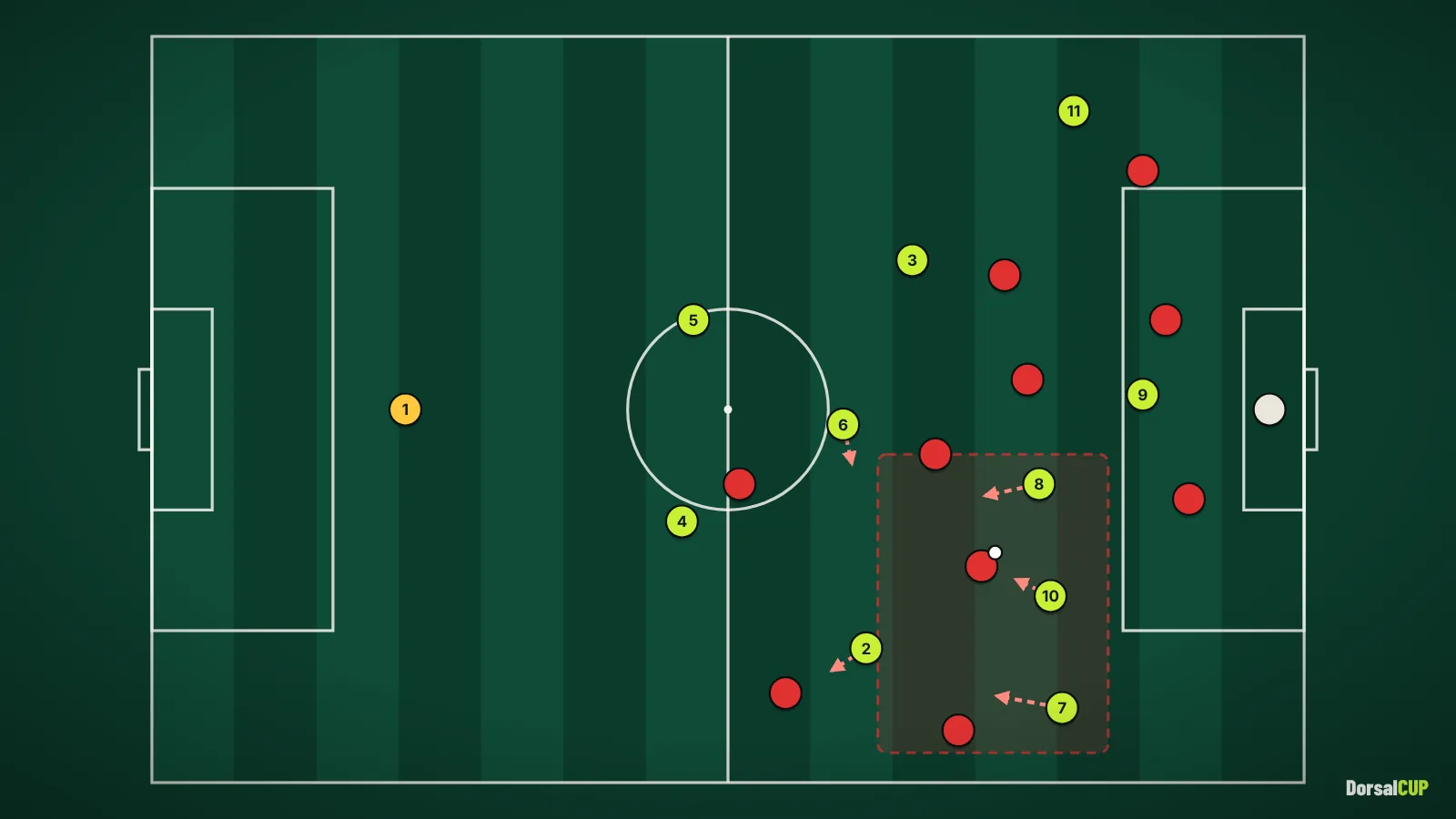
The counter-press has a limited window. Coaches often use a rule of thumb of around five seconds: if the ball has not been won back or forced backwards by then, the team switches to its defensive organisation. Within that window, there are three roles.
- The ball presser. The nearest player, usually the one who lost the ball or the one closest to the interception. He attacks the ball immediately, front-on, aiming to win it or force a backward or sideways pass. He does not need to win the duel; he needs to stop the forward pass and the forward carry.
- The cover and blocking players. Two or three team-mates close the passing lines nearest to the ball: the inside pass to the opponent's 6 or 8, and the pass down the line to the full-back or winger. They use cover shadows, standing on the line between the ball and the receiver, and step onto the receiver if the pass is played.
- The line closers. Players slightly further away (often the 6 and the nearest centre-back) close the vertical exit: the pass into the opponent's striker or the 10 who has dropped to receive. They hold their position rather than sprinting to the ball.
The order matters. The ball presser goes first, but the cover players must move at the same moment, not after. A ball presser alone is easily bypassed with one pass; a ball presser supported by two players closing the nearest lines leaves the receiver only a backward pass, a long ball under pressure, or a duel against two.
Using the touchline
When the ball is lost near the touchline, the counter-press is easier: the line removes half the receiver's options. The ball presser approaches from the inside to show the opponent down the line, the full-back and winger squeeze the receiver from in front and behind, and the nearest midfielder closes the pass back inside.
When to counter-press and when to drop
Counter-pressing every loss is not a plan; it is a recipe for being exposed several times a game. Players need clear criteria, rehearsed in training, for when to go and when to recover.
| Counter-press if… | Drop and recover if… |
|---|---|
| Three or more team-mates are within about 15 m of the ball | Only one team-mate is near the ball |
| The receiver is facing his own goal or the touchline | The receiver is facing forward with space in front |
| The ball is near the touchline | The opponent has won the ball with a clean first touch in the centre |
| The rest-defence is in place behind the ball | The rest-defence is broken or outnumbered |
| The ball was lost in the opponent's half | The ball was lost in our own third with players ahead of it |
Fatigue and game state also matter. Late in a match, or when protecting a lead, many teams counter-press only in the final third and drop into a mid-block after losses elsewhere. That is a legitimate choice if it is agreed and communicated, not a reaction to tiredness.
A pre-season tournament or a four-team round robin mid-season gives you several matches in one day to test these ideas against different opponents. The DorsalCUP tournament fixture generator builds the matches, pitches and kick-off times in minutes, free and with no sign-up.
When the counter-press fails
The counter-press will be beaten several times a match. What happens next decides whether that costs a goal. Three actions follow immediately:
- Delay the ball. The nearest player behind the ball carrier stops trying to win it and starts jockeying: goal-side, at a distance of 2–3 metres, showing the carrier away from the centre.
- Recover to the central lane. All players behind the ball sprint back towards the central lane, not to their original positions. The central lane in front of the box is the priority; wide areas can be recovered later.
- Drop the last line. The back line stops holding and drops towards the edge of the box, with the goalkeeper ready to come out. The line steps up again only when there is pressure on the ball.
Some teams also use a tactical foul to stop a counter that has broken through. The coach should be honest with players about the cost: it is a likely caution, and the Laws of the Game treat stopping a promising attack as a cautionable offence. A team that relies on it will spend matches with defenders on yellow cards. The structural answer, proximity and rest-defence, is better.
How opponents beat the counter-press, and how to respond
- An immediate long ball. The opponent clears first time towards a striker. Response: this is a success for the counter-press if the rest-defence wins the duel; prepare the centre-backs for aerial duels and the 6 for the second ball.
- A first pass to a target player in the half-space. Response: the line closers must pre-mark this outlet before the loss.
- A strong ball carrier who dribbles out. Response: two players press him, not one; the ball presser forces him towards the second presser and the touchline.
- Fast players left high to counter. Response: rest-defence numbers increase (3+2), and the counter-press becomes more selective.
How to train counter-pressing, and what to look for on video
1. Possession game with a five-second rule: 6 v 6 + 2
- Space: 40 × 30 m with an end target player at each short side.
- Players: two teams of six plus two target players who play for the team in possession.
- Rules: a point for a pass from one target player to the other. When a team loses the ball, it has five seconds to win it back: a regain within five seconds is worth 2 points.
- Progression: after the regain, the team must score in one of two mini-goals within 8 seconds.
- Load: 6 × 3 minutes, 90 seconds' rest. Very high intensity; monitor the work-to-rest ratio.
- Coaching points: ball presser goes immediately; the two nearest close lines; nobody watches.
2. Final-third attack with counter-press zone: 8 v 8 + GK
Half a pitch. Team A attacks the big goal; team B defends and, on a regain, attacks three mini-goals on the halfway line. Team A earns a point for every regain in the attacking half within five seconds of a loss. Play 4 × 6 minutes, 2 minutes' rest. Freeze the first few losses to check the roles: who pressed, who closed, who stayed behind.
3. 11 v 11 with forced losses
In an 11 v 11, the coach calls a loss at random and the player on the ball leaves it for the nearest opponent. The team reacts with its agreed rules: counter-press or drop. Play 3 × 8 minutes. This connects the counter-press to the rest-defence in a realistic context.
Common mistakes and video analysis
- One player presses, the others watch. On video, freeze one second after the loss and count how many players have moved towards the ball or a passing line.
- Everyone presses the ball. Four players run at the ball and no one closes lines. On video, look for the free receiver of the first pass.
- Counter-pressing without proximity. On video, measure distances between players in the second before the loss.
- Not stopping after five seconds. Players keep chasing as the opponent progresses. On video, check the time from the loss to the moment the team takes its block shape.
Frequently asked questions
What is counter-pressing in football?
Counter-pressing is the immediate, coordinated attempt to win the ball back in the few seconds after losing it, near the place where it was lost. The nearest player presses the ball while team-mates close the nearest passing lines, aiming to regain possession before the opponent can play forward.
Is counter-pressing the same as gegenpressing?
Yes. Gegenpressing is the German term and is commonly used in English. Both describe pressing immediately after losing the ball, as opposed to falling back into a defensive block.
How long should a team counter-press?
A common rule of thumb is around five seconds. If the ball has not been won back or forced backwards in that time, the team switches to its organised defensive block.
How do you train counter-pressing for youth players?
Use small-sided possession games where a regain within five seconds of losing the ball earns extra points. Keep the areas small so that players are close to the ball, and add roles gradually from U14 upwards.