
Pressing Traps and Triggers: Cover Shadows, Curved Runs, Jumps
Pressing traps turn pressing from a collective effort into a collective plan. The team decides in advance where it wants the opponent to play the ball, shows them that pass, and then closes the space around the receiver from several directions at once. Pressing triggers tell the players when to go. This article covers both: the triggers, how to direct the press with curved runs and cover shadows, how to set touchline and central traps, who jumps and who covers, and how to train it.
Do you organise tournaments? Create yours for free on DorsalCUP.
In this article
- Why pressing needs a trap, not just effort
- Pressing triggers: when to go
- Directing the press: outside-in, inside-out and cover shadows
- Pressing traps on the touchline and in the centre
- How opponents escape the trap, and how to respond
- How to train pressing traps
- Common mistakes and what to look for on video
Why pressing needs a trap, not just effort
A team that presses every ball with the nearest player wins a few balls through energy and loses many through disorganisation. Each player who leaves his position opens a passing line behind him, and a competent opponent will find it. The difference between pressing and chasing is that pressing restricts the opponent's options before it attacks the ball.
A pressing trap has three parts: an area where the team wants the ball to go (usually near the touchline, sometimes into a central player who receives with his back to goal), a way of guiding the ball there (curved runs, cover shadows, deliberately leaving one pass open), and a coordinated collapse when the ball arrives (the jump to the ball, the jumps to the nearest options and the cover behind).
The trap only works if the whole team agrees on it. The striker who curves his run to show the ball wide is useless if the winger is not ready to jump on the full-back, and the winger's jump is a risk if the full-back behind him does not step onto the opposition winger. Pressing is the clearest example in football of a principle that cannot be executed by individuals.
Pressing triggers: when to go
Triggers are cues that the opponent's next action has become predictable or slow. When a trigger appears, the press accelerates. Without one, the team holds its shape and keeps guiding. The most reliable triggers are:
- A backward or square pass. The whole team can step up while the ball travels, because the receiver is facing his own goal or receiving on a flat line.
- A pass to the full-back near the touchline. The touchline is an extra defender: the receiver's options are halved.
- A poor first touch or a receiver facing his own goal. The ball is not under control and the player cannot see forward.
- A slow or lofted pass. The time the ball spends in the air is time for the press to close.
- The ball reaching a weaker player, identified in the analysis (often a centre-back uncomfortable on his weak foot, or a goalkeeper who rarely plays forward).
- A pass that the team has deliberately left open. This is the trap trigger: the ball goes exactly where we wanted it.
Directing the press: outside-in, inside-out and cover shadows
The direction of the press decides where the trap will be. Outside-in pressing comes from the touchline side of the ball and forces play into the centre, where the team has more players. Inside-out pressing comes from the centre and forces play towards the touchline, where the space is smaller. Most teams press inside-out against the build-up because the central lane is the one that hurts most if broken.
The tool for directing the press is the curved run. The presser does not run straight at the ball. He bends his approach so that his body sits between the ball and the pass he wants to remove. The space behind him, invisible to the passer, is the cover shadow. A striker who curves onto the centre-back from the inside shuts the pass back to the goalkeeper or across to the other centre-back, and leaves only the pass to the full-back.
Coaching details for the curved run: start the curve early (from 12–15 metres away), slow down in the last 3–4 metres to avoid being beaten by a simple feint, and keep the body side-on so that the passer cannot see a gap. The curve is not a sprint; it is an angle. The sprint comes on the trigger.
Pressing traps on the touchline and in the centre
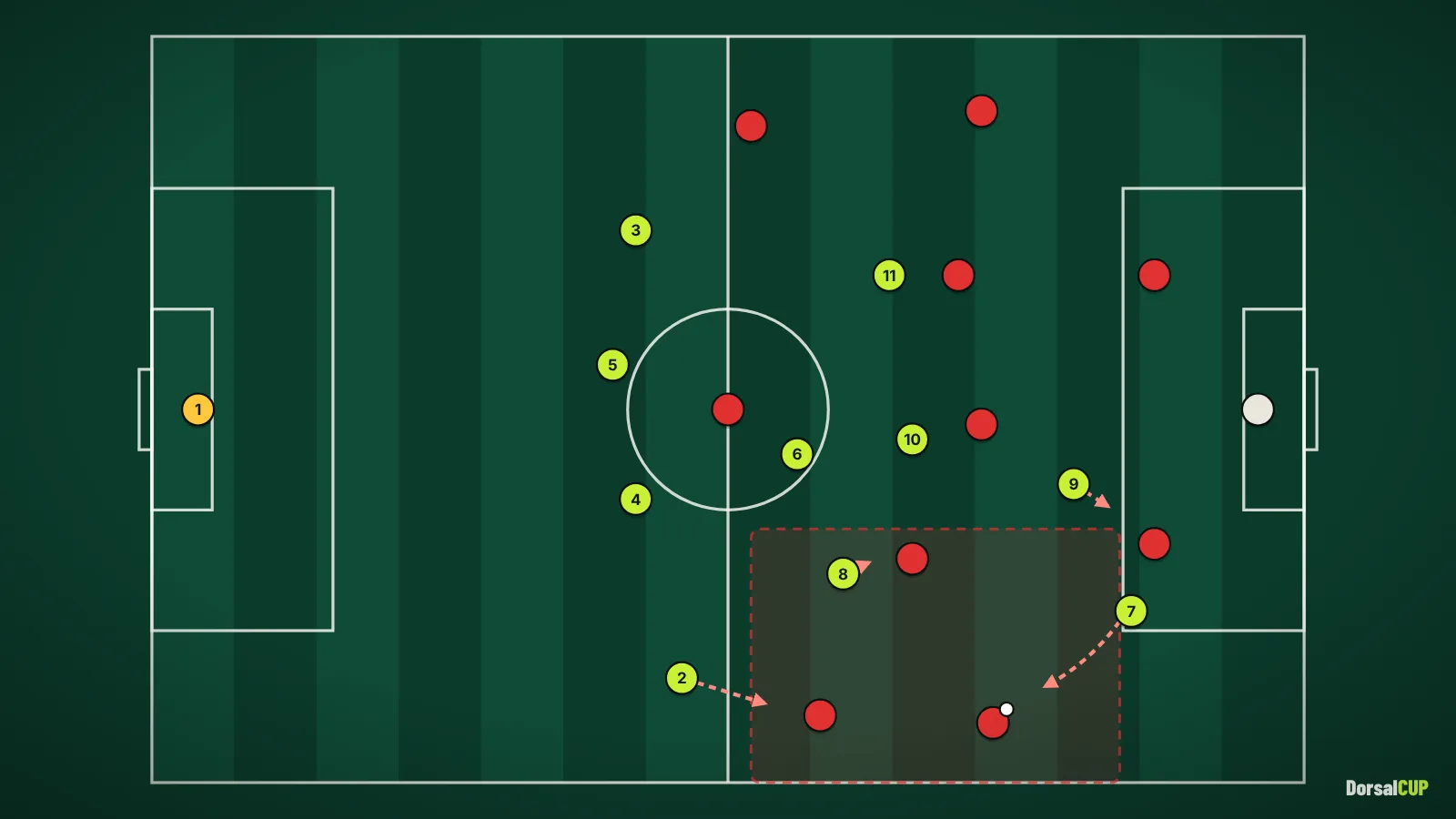
The touchline trap
Once the ball is played to the full-back, the trap closes. Each player has a specific job:
- The jump to the ball. The winger presses the full-back with a curved run from the inside, cutting the pass back into the centre. He arrives as the ball does, ideally while the full-back's first touch is still running.
- The jump to the nearest option. Our full-back steps onto the opposition winger, our 8 onto their 8, our 9 onto the passing line to the centre-back. Each player is now goal-side and touch-tight to his man.
- The cover. The centre-back on the ball side slides across behind the jumping full-back. The far-side winger tucks in to the half-space and the far-side full-back narrows so that the block remains compact. The far side is deliberately left open: if the opponent can switch play from inside the trap, the trap was badly set.
The central trap
Some teams prefer to invite the pass into the opponent's 6 and then collapse on him from three sides. The 10 stands slightly off the 6, on his blind side, making the pass look available. When the centre-back plays it, the 10 presses from behind, the 9 closes from the front and the near 8 shuts the lay-off. This trap wins the ball in the most dangerous area for the opponent, but it needs excellent timing: if the 6 can turn, the team has already been passed through its first line.
If you run tournaments at your club, DorsalCUP handles registrations, the draw, the multi-pitch schedule and live results for free. The guide how to organise a football tournament walks through every step, from the rules to matchday.
How opponents escape the trap, and how to respond
- They add a player to the first line (a 6 dropping between the centre-backs or a full-back staying deep). The 9 alone can no longer curve onto two players. Response: the 10 steps up beside the 9 and our 6 takes the opposition 10, or the team accepts a 3v2 and presses from the second pass.
- They use the goalkeeper to switch. If the curve is late, the goalkeeper becomes the free man. Response: the 9's curve starts earlier and the far winger positions himself on the line between goalkeeper and far full-back.
- They go long when the ball reaches the full-back. The trap is beaten over the top. Response: the back line must drop as the trap closes, not hold a high line. Pressing high and defending deep at the same time is a contradiction; the back line steps up only after the trap has removed the long option.
- They play through the third man. The full-back plays into the winger, who lays off to the 8 arriving. Response: the 8's jump must happen as the ball travels to the winger, not after.
- Their winger drops to receive short. Our full-back must decide whether to follow. The rule should be agreed: follow to the halfway line, then pass on.
How to train pressing traps
1. Curved-run pressing: 2 v 3 + GK
- Space: penalty area plus 15 metres (about 45 × 32 m). Two gates 6 metres wide at the far end.
- Players: goalkeeper + 2 centre-backs + 6 in possession against 2 pressers (9 and 10).
- Rules: the build-up team scores by dribbling through a gate. The pressers score by winning the ball and finishing within 6 seconds. The goalkeeper starts every rep with the ball.
- Progression: add a full-back on one side and a pressing winger; the trap is now set on the full-back.
- Load: 8 reps of 25–30 seconds per pair of pressers, 1:3 work-to-rest. Rotate pressers.
- Coaching points: curve early, slow down in the last metres, the 10 stays on the 6's blind side and jumps only on the trigger.
2. Touchline trap game: 7 v 7 + goalkeepers
Pitch 60 × 50 m with two 10-metre wide channels marked along the touchlines. Normal game, but the defending team earns 2 points for winning the ball inside a wide channel and 3 if they score within 8 seconds of that regain. The attacking team earns a point for every switch of play from one channel to the other. Play 4 × 6 minutes, 2 minutes' rest. Coach the jumps and covers: freeze when a player jumps without the cover behind him.
3. 11 v 11 pressing rehearsal against the opponent's build-up
Full pitch. The second team reproduces the next opponent's build-up structure (for example a back three with a dropping 6). The first team rehearses the agreed trap. Each restart comes from the opponent's goalkeeper. Play 3 × 8 minutes with 3 minutes' rest early in the week (higher load) or 2 × 6 minutes at lower intensity closer to the match.
Common mistakes and what to look for on video
- Straight runs. The presser runs directly at the ball and the passer simply plays around him. On video, draw the line of the run and check which passes it removed.
- Pressing without a trigger. The team goes after a sideways pass between composed centre-backs and gets played through. On video, check what the opponent did just before the team accelerated.
- Jumps without covers. The winger jumps, the full-back does not step, and the opposition winger is free. On video, freeze at the moment of the first jump and look at the next line.
- A trap with an open far side. The far winger and full-back stay wide and the opponent switches. On video, use a wide-angle view; count the metres between our far full-back and the nearest centre-back.
- The back line holding high while the ball carrier has time. If there is no pressure on the ball, the line should drop. On video, look at the ball carrier's head: if he is looking forward, the line must be moving back.
Frequently asked questions
What is a pressing trap in football?
A pressing trap is a planned area where the team wants the opponent to play the ball, usually to a full-back near the touchline or to a midfielder facing his own goal. The team guides the ball there with curved runs and cover shadows, then closes the receiver and his nearest options at the same moment.
What are the main pressing triggers?
Backward and square passes, passes to the full-back near the touchline, poor first touches, players receiving with their back to play, lofted or slow passes, and passes to a weaker player identified in analysis. The deliberate trap pass is also a trigger.
What is a cover shadow?
A cover shadow is the area behind a pressing player, from the ball carrier's point of view, where a pass cannot be played because the presser's body is in the way. Pressers use curved runs to put specific opponents in their cover shadow.
How do you train pressing for U12 and U14?
Use small-sided games with a reward for winning the ball in a specific area, such as a wide channel. At U12, focus on curved runs and showing the ball one way. At U14, add jumps and covers with two or three players working together.