
Playing Out from the Back Session Plan: U16 vs a High Press
This playing out from the back session plan is built for U16 and U17 squads and trains both sides of the same duel: building up against a high press, and pressing high as a coordinated unit. It runs for about 95 minutes with game-level intensity in short blocks, and closes with notes on monitoring load for players who combine school, club and often a second team.
Do you organise tournaments? Create yours for free on DorsalCUP.
In this article
Playing out from the back session plan: overview for U16–U17
Group: U16–U17 (players aged 15 and 16). Numbers: 18–22 players including two or three goalkeepers. Kit: size 5 balls, discs, six tall cones for gates, bibs in three colours, two full-size goals. Space: a full pitch. Duration: about 95 minutes. Place in the week: the most demanding session, three or four days before the match (MD-4 or MD-3).
Objective: in possession, the goalkeeper and back line create a numerical advantage against the first line of pressure and find the free midfielder or full-back; out of possession, the team presses high with clear roles: who curves the run, who screens the pivot, who jumps on the trigger, who covers behind.
At 15 and 16, most players have passed their peak growth rate, and the training age of the group allows tactical work with real 11v11 references. Physical differences remain large, though: some players are still maturing, and many play for school or a second team as well. Intensity in this session is high but delivered in blocks of 3–5 minutes with planned rest; volume is controlled across the week rather than through one long session.
| Part | Time | Activity | Objective |
|---|---|---|---|
| Activation | 0–12 min | Injury-prevention routine with ball | Readiness, prevention |
| Warm-up | 12–24 min | Positional rondo 4+2 v 3 | Play through the middle |
| Exercise 1 | 24–46 min | Build-up 7v5 to gates | Play out against a high press |
| Exercise 2 | 46–66 min | Coordinated high press 9v7 | Press with clear roles |
| Final game | 66–90 min | 11v11 with conditions | Both phases at match intensity |
| Cool-down | 90–95 min | Low-intensity jog, mobility, RPE | Recovery and load monitoring |
Activation and positional rondo
Start with an injury-prevention routine (for example the FIFA 11+ structure of running exercises, strength and balance, then faster running) adapted to include the ball. Ten to twelve minutes are enough. Then the rondo.
- Area of 20×18 m. Four lime players on the sides, two lime central players inside, three red pressers.
- Lime two touches, central players one or two. A point for each pass from one side to the opposite side through a central player.
- Red score by winning the ball and passing it out of the box; the player who lost the ball becomes a presser.
- Four blocks of 2 minutes, 1 minute's rest.
Coaching points: central players stay on different lines (one higher, one deeper) so the pressers cannot cover both. Side players fix a presser before passing: carry the ball one step towards them, then play. This is the logic of the build-up in miniature.
Exercise 1: playing out from the back against three pressers
The exercise reproduces the first phase of a build-up against an opponent that presses with three forwards and pushes two midfielders up behind them.
Organisation
- From the goal line to about 35 m, full width. Lime: goalkeeper, back four, two central midfielders. Red: three forwards and two midfielders.
- Each attack starts with the goalkeeper. Lime score by passing through one of three 4–5 m gates on the 35 m line to a team-mate, or by dribbling through. Red score in the big goal.
- Five blocks of 3 minutes, 2 minutes' rest. Swap the red group after the third block.
Principles in the build-up
- Numerical advantage at the back: goalkeeper plus two centre-backs against two or three forwards. Centre-backs split to the width of the penalty box so the forwards' runs become longer.
- Fix and release: the ball carrier steps forward to draw a presser, then passes to the free player. A pass to a player who is already marked only moves the problem.
- Third-man combinations: if the 6 is screened, the centre-back plays the full-back, who plays inside to the 8 facing forward. The free player is often the third one, not the second.
- Body shape: receive on the back foot, half-turned, so the next pass can go forward or across.
- Exit plan: if all short options are closed, the goalkeeper or centre-back plays long into a pre-agreed zone where the team is ready for the second ball. Playing out does not mean playing short at any cost.
Progressions
- Add a fourth red presser so lime can no longer rely on a simple overload; the goalkeeper must take part as an outfield player.
- Allow red to go man-to-man: lime need to use the goalkeeper's long pass or rotations (8 drops, full-back moves inside) to unbalance them.
Common mistakes: centre-backs too close together, so one forward presses both; the 6 hiding behind the forward's cover shadow; slow circulation that lets the press shift in time. On video, count the number of touches before each pass in the first phase and check how often the free player was found at the first opportunity. For a deeper tactical treatment, see build-up against a high press.
Exercise 2: coordinated high press
Organisation
- Two-thirds of the pitch. Red build up: goalkeeper, back four, two central midfielders (7 players) and score by passing into a target player at the halfway line or by dribbling over it.
- Lime press in a 4-4-2 shape with the front six plus the back line behind. A regain followed by a shot within 8 seconds earns two points; a goal counts three.
- Five blocks of 3 minutes, 2 minutes' rest.
Roles in the press
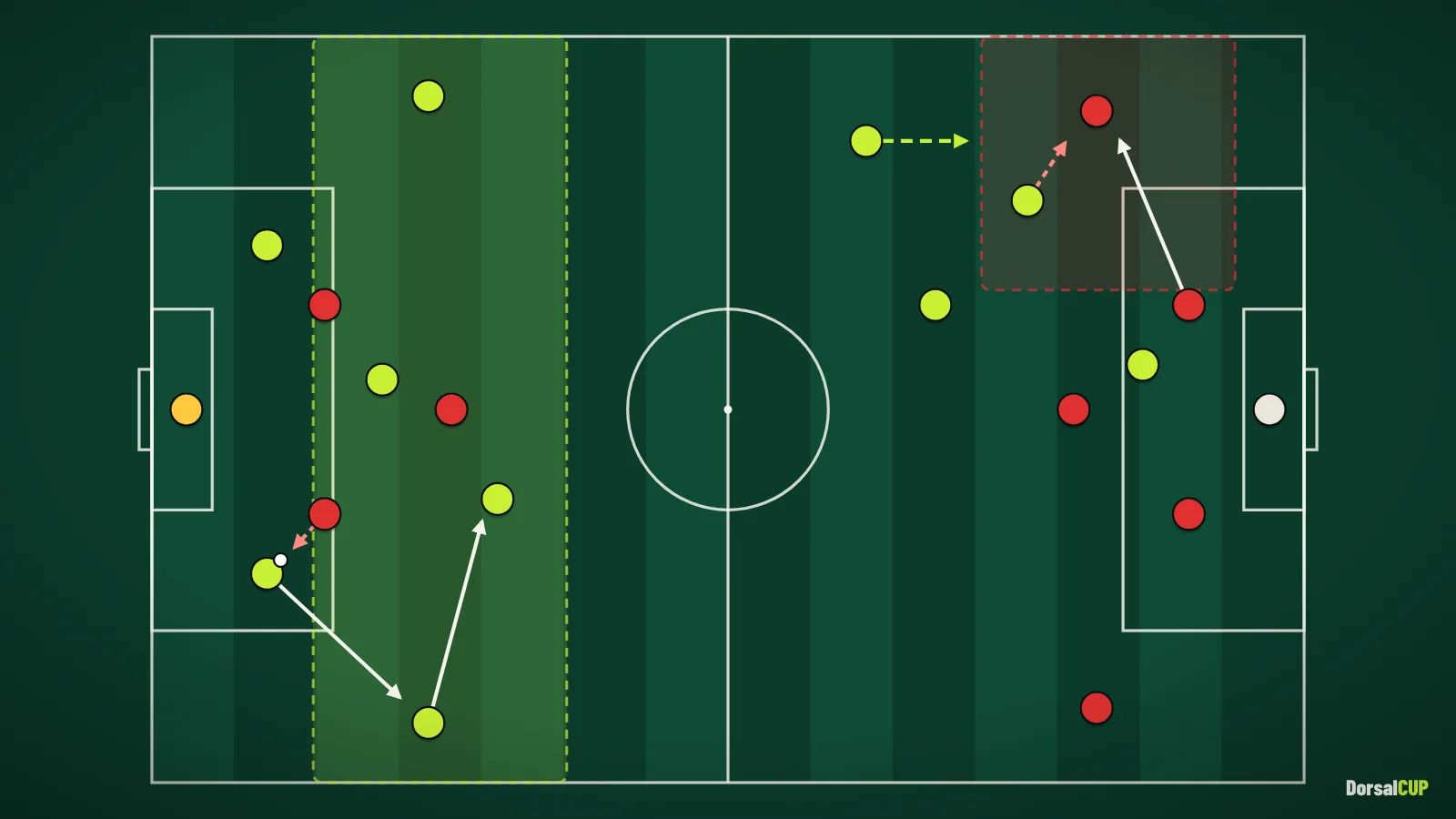
- First striker: curves the run towards the centre-back so play is shown to one side; never runs straight.
- Second striker: screens the red 6 so the inside pass is closed.
- Ball-side winger: waits on the line between the centre-back and full-back; on the pass to the full-back (the trigger), jumps out with a curved run that blocks the inside pass.
- Midfielders and full-back: push up behind the jump to win the second ball and close the pass down the line. The back line steps up to keep the team compact (about 30–35 m from striker to back line).
Contra-strategies to prepare for: the red goalkeeper joins as a third centre-back; the 6 drops between the centre-backs; red go long over the press. Agree in advance which of these the team will accept and how the back line reacts to a long ball (one player attacks it, one covers).
Common mistakes: the winger jumps too early, before the ball is played, which releases the full-back down the line; the back line stays deep, so the gap between units invites a pass into the midfielder. Related reading: pressing traps and triggers.
At tournaments and festivals, what you train during the week shows up in several games in a row. DorsalCUP runs the draw, the schedule and live results for free, and the tournament matchday checklist helps you forget nothing.
Final game: 11v11 and load control
- Full 11v11 (or 10v10 with available players) on the full pitch.
- Each half and each goal kick starts with a build-up from the goalkeeper. A goal after a ground build-up that crosses the halfway line counts double; regains in the opponent's third earn a point.
- Two halves of 10–12 minutes, 3 minutes' rest.
Monitoring load
For most clubs at this level, a simple and reliable tool is session RPE: each player rates the effort of the session on a 0–10 scale about 20–30 minutes after it ends, and the coach multiplies it by the minutes trained. Tracking the weekly total and its change from week to week helps to spot sudden spikes, which are more of a concern than high but stable loads. Add a short wellness question (sleep, soreness, mood) on the day after. If GPS is available, high-speed running and accelerations add detail, but the basic habit matters more than the technology.
Adapting the session
- Fewer players (14–16): Exercise 1 as 6v4 (goalkeeper, three at the back, two midfielders against three forwards and one midfielder); Exercise 2 as 7v6; final game 8v8 between the boxes.
- One coach: combine Exercises 1 and 2 into one game where the build-up team and the pressing team swap roles every 3 minutes.
- Less experienced group: start Exercise 1 with the pressers walking for the first block, and give the build-up team a fixed pattern before freeing it.
- U17 or stronger groups: add the man-to-man pressing progression and a 4-touch limit for the build-up team.
The previous session in this series covers transitions at U14–U15; the next one places the same ideas within a game model for U18.
Frequently asked questions
How do you coach playing out from the back?
Create an advantage at the back (goalkeeper plus centre-backs against the forwards), spread the centre-backs, give the 6 a position away from the forward's cover shadow, and use the fix-and-release principle. Train it against real pressure, and always agree an exit plan if the short options are closed.
What is a good playing out from the back session plan?
A rondo with central players, a build-up game from the goalkeeper against three or four pressers with gates as targets, and a final game in which every restart begins with the goalkeeper. Add progressions that remove the overload once the basics work.
How do you organise a high press in 11v11?
Define the shape (for example 4-4-2), the side you want to force play to, the trigger (a pass to the full-back, a back pass, a poor touch) and the roles: who curves the run, who screens the pivot, who jumps, who covers. The back line must step up so the team stays compact.
How do you control training load with U16 players?
Use session RPE multiplied by minutes, a weekly total, and a short wellness check. Avoid sudden week-to-week spikes, and consider school sport and second-team matches when planning.
Sources
Verified in October 2026. Rules and age groups vary by association and by season; check your local regulations.