
Transition Drills for U14–U15: Counter-Press and Counter-Attack
These transition drills build a 90-minute session for U14 and U15 players, the first age groups in England to play 11v11. The session trains what happens in the seconds after the ball changes hands: the counter-press when we lose it, the forward pass when we win it, and the rest defence that makes both possible.
Do you organise tournaments? Create yours for free on DorsalCUP.
In this article
Session overview: transitions at U14–U15
Group: U14–U15 (school Years 9 and 10, players aged 13 and 14). Numbers: 16–20 players including two goalkeepers. Kit: size 5 balls, 40 discs, 12 tall cones for gates, bibs in three colours, two full-size goals. Space: a full 11v11 pitch (in England, about 82×50 m at U14 and 91×55 m at U15). Duration: 90 minutes.
Objective: after losing the ball, the nearest players counter-press immediately while the rest of the team protects the centre; after winning it, the first look is forward. Transitions decide many games at this level because 11v11 is new: the pitch is bigger, distances between lines grow, and teams that react in the first three to five seconds create or prevent most chances.
At 13 and 14 most players are in or near their growth spurt. Coordination, sprint mechanics and tolerance of repeated high-intensity actions vary widely in the same squad. The session uses short, intense blocks with full recovery rather than long periods of continuous running. Watch for players who are growing quickly (knee or heel pain, loss of coordination) and reduce their sprint volume rather than pushing through.
| Part | Time | Activity | Objective |
|---|---|---|---|
| Warm-up | 0–15 min | Mobility + transition rondo | React to the change of possession |
| Exercise 1 | 15–33 min | 5v5+2 with counter-press bonus | Immediate pressure after loss |
| Exercise 2 | 33–55 min | Partial 11v11: attack, lose, counter-press | Rest defence and counter-press |
| Final game | 55–83 min | 8v8+GKs box to box | Both transitions in a game |
| Cool-down | 83–90 min | Low-intensity jog, mobility, review | Recovery and reflection |
Warm-up: transition rondo
Begin with 6 minutes of dynamic mobility with the ball: skipping, lunges with a pass, lateral movements, two short accelerations. Then the rondo.
- Box of 12×12 m with two 4 m gates 5 m outside two opposite sides. Groups of six: four keep the ball against two; with 18 players, run three boxes.
- Lime keep the ball with a two-touch limit. When red win it, they score a point by passing or dribbling through either gate.
- The lime player who lost the ball and the nearest team-mate counter-press immediately; if they win it back before red reach a gate, lime score a point.
- After each regain by red, the player who lost the ball swaps with a defender. Three blocks of 2 minutes, 1 minute's rest.
Coaching points: the reaction to the loss is instant; nobody stops to argue. Defenders who win the ball look up before passing: the first pass after a regain must be accurate, not hurried.
Exercise 1: 5v5 plus 2 with a counter-press bonus
Organisation
- Area of 35×36 m. Two teams of five plus two neutrals on the side lines who play with the team in possession.
- A team scores by dribbling over the opposite end line under control or by completing 10 consecutive passes.
- Bonus: a team that loses the ball and wins it back within 5 seconds scores a point.
- Four blocks of 3 minutes, 2 minutes' rest (work-to-rest 1:0.7, high intensity). Change the neutrals each block.
Coaching points
- Nearest player presses the ball at once, on a line that cuts the easiest forward pass.
- The next two players close the passing options around the ball; the others become compact. 'Hunt in packs, not alone.'
- If the 5 seconds pass without a regain, drop and regroup into a compact block rather than chasing.
- In possession: after a regain, the first pass goes away from the pressure, ideally forward.
Variants
- Easier: 6 seconds and three neutrals.
- Harder: 4 seconds, and the team that regains scores double if it dribbles over the line within 8 seconds.
Common mistakes: the player who loses the ball stops or turns away; the press is individual and the receiver escapes with one pass. Track the number of 5-second regains per team and announce it at the end of each block; it makes the behaviour visible.
Transition drills in a partial 11v11
The small-sided game builds the reflex. The partial 11v11 puts it into real positions and distances, and adds the element that makes counter-pressing safe: rest defence, the players who stay behind the ball while the team attacks.
Organisation
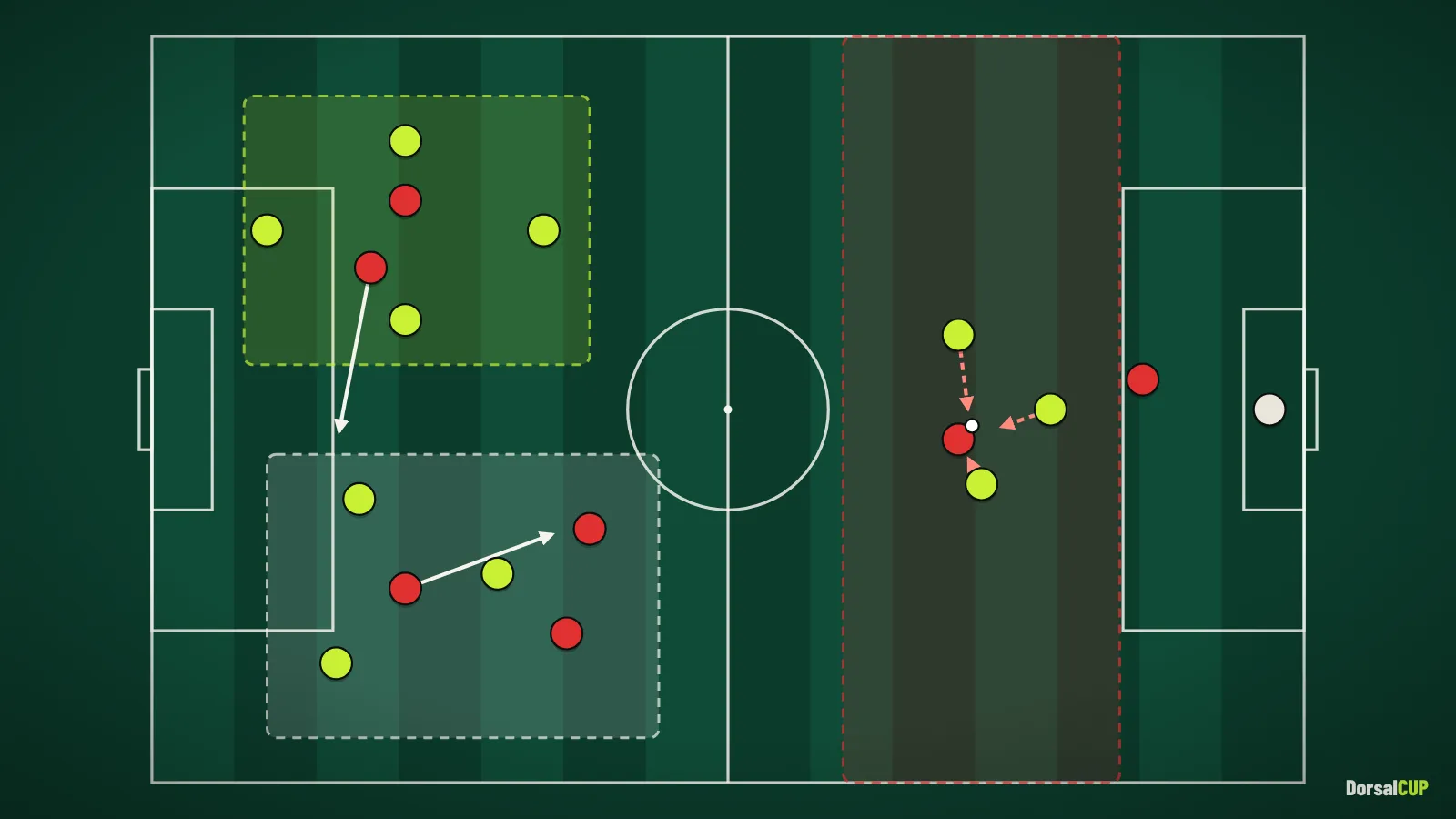
- Two-thirds of the pitch. Lime: two centre-backs, two central midfielders, two wingers, a number 10 and a striker (8 players). Red: goalkeeper, back four and two holding midfielders (7 players).
- Lime start each attack from the halfway line and try to score. The two lime centre-backs stay in the rest-defence zone between the halfway line and about 15 m behind it.
- When red win the ball, they counter into one of three 4 m gates on the halfway line by dribbling through. Lime counter-press; if they regain within 6 seconds and score, the goal counts double.
- Five blocks of 3 minutes, 2 minutes' active rest (passing in pairs). Rotate the lime front six with substitutes.
Coaching points
- Rest defence: the two centre-backs stay narrow and step forward as the attack progresses, so red's first forward pass can be intercepted.
- Counter-press: the three players nearest to the ball close it from different angles; the far winger and midfielder narrow to cut the switch.
- Positioning during the attack prepares the counter-press: if lime attack with everybody high and wide, nobody is near the ball when it is lost. Ask the midfielders: 'if we lose it now, who presses and who covers?'
- Red after the regain: first look forward to the gate, then decide between carrying the ball and passing.
Progressions
- Add a red forward who waits on the halfway line: the rest defence now has a 2v1 to manage.
- Remove the gates and let red counter into a full-size goal defended by a lime goalkeeper.
At tournaments and festivals, what you train during the week shows up in several games in a row. DorsalCUP runs the draw, the schedule and live results for free, and the tournament matchday checklist helps you forget nothing.
Final game: 8v8 transition game
- 8v8 plus goalkeepers on the area between the penalty boxes, full width.
- Goals scored within 10 seconds of winning the ball count double. Winning the ball back within 5 seconds of losing it earns a point.
- Three games of 6 minutes, 2 minutes' rest. Normal throw-ins and corners.
What to look for, live or on video
- Time to first pressure: how many seconds pass between the loss and the first player arriving at the ball. Over two seconds usually means the nearest player hesitated or was too far away.
- Number of players within 10 m of the ball at the moment of loss. Fewer than three makes a counter-press unlikely to succeed; the issue is the attacking shape, not the effort.
- The first pass after a regain: forward, sideways or back. A team that always plays back after winning the ball needs players who move forward early, not just a better passer.
- Rest defence at the moment of loss: are the centre-backs and holding midfielder in front of the opponent's most advanced player, or level with them?
Coaching points: let the game run. Note two or three clear examples of good and poor transitions and use them in a 2-minute review between games. Questions work better than statements: 'what did the four nearest players do when we lost it on the left?'
Adapting the session
- Fewer players (12–14): Exercise 2 becomes 6 attackers against 4 defenders plus goalkeeper; the final game is 6v6 plus goalkeepers on a half pitch.
- Half pitch only: Exercise 2 in the half with gates 30 m from goal; final game 7v7 across the half.
- One coach: keep the same scoring rules in all three exercises so the coach can referee and count in one go.
- Mixed physical maturity: in the small-sided games, match players by size where possible, or limit tackling in the rondo. Early maturers dominate transitions physically; reward the decision (who pressed first, who played forward) as well as the outcome.
- U14 groups new to 11v11: reduce Exercise 2 to six against five, so players can see the shape without being overwhelmed.
For the tactical background, see counter-pressing and rest defence. The next session in this series moves to build-up against a high press at U16.
Frequently asked questions
What are transition drills in football?
Exercises in which the ball changes hands often and both teams must react straight away: the team that loses it tries to win it back or delay the opponent, the team that wins it tries to attack quickly. Scoring rules such as bonus points for regains within 5 seconds make the reaction the focus.
How do you train counter-pressing with U14 players?
Start in small-sided games with a time rule (win the ball back within 5 seconds for a bonus), then move to larger games with real positions. Teach that the nearest players press and the others cover the centre. Keep blocks short so the press stays intense.
When does 11v11 start in England?
From the 2026/27 season, 11v11 starts at U14. U12 and U13 play 9v9. Pitch sizes for U14 and U15 are smaller than adult pitches; check your league's handbook.
What is rest defence?
The players who stay behind the ball while the team attacks, positioned to stop the opponent's counter-attack. At U14–U15, two centre-backs and a holding midfielder are a common rest-defence structure.
How much high-intensity work is right for a U15 session?
It depends on the week, but blocks of 2–4 minutes with at least as much rest work well. Around 30–45 minutes of high-intensity work in a 90-minute session is a demanding day; follow it with a lighter session.
Sources
Verified in October 2026. Rules and age groups vary by association and by season; check your local regulations.