
Football Drills for Adults: An Amateur Team's Training Week
Football drills for adults in amateur teams have to do a lot with little time: two or three sessions a week, players who arrive from work, and a match at the weekend. This article sets out a weekly plan for a Saturday or Sunday league side and details the main session of the week, a 90-minute plan that combines the tactical work and the physical load in the same exercises.
Do you organise tournaments? Create yours for free on DorsalCUP.
In this article
Context: amateur seniors with two or three sessions
Group: senior amateur team (Saturday non-league, Sunday league or reserve sides), players aged 18 to mid-30s. Numbers: 14–20 at training, often fewer than expected. Kit: balls, discs, bibs, two full-size goals, two mini-goals. Space: often half a pitch or a full artificial pitch shared with other teams, under floodlights. Time: 75–90 minutes per session.
The constraints define the plan. Players work during the day and arrive with very different levels of fatigue. Attendance varies. There is no time for separate running sessions, and many players do none on their own. The most efficient approach is to make every exercise carry both the tactical objective and the physical load: small-sided games for intensity, larger games for match-like running, and short finishing blocks for quality.
The objective of the main session below is to defend as a compact unit and attack quickly after winning the ball. For most amateur teams, those two ideas decide more matches than elaborate build-up patterns.
The weekly plan (microcycle)
With a match on Saturday, the two-session week places the main session early and the lighter, sharper session close to the game. With a Sunday match, shift everything by a day.
| Day | Two sessions a week | Three sessions a week |
|---|---|---|
| Sunday (MD+1) | Rest; optional walk or bike | Rest; optional walk or bike |
| Monday (MD+2) | Rest | Optional 45-min recovery and technique for those who played; full session for those who did not |
| Tuesday (MD-4) | Main session (90 min): intensity in small spaces, defending unit, finishing | Main session (90 min) |
| Wednesday (MD-3) | Rest | Rest |
| Thursday (MD-2) | 75 min: larger games, team shape, set pieces, speed | 75 min: larger games, team shape, set pieces |
| Friday (MD-1) | Rest | Rest (or 30 min activation for teams that can meet) |
| Saturday (MD) | Match | Match |
- Tuesday: the hardest session. Small and medium spaces, many duels and accelerations, about 35–40 minutes of high-intensity work in total.
- Thursday: shorter blocks at high speed with full rest, team shape in 11v11 or 9v9, 15 minutes of set pieces. Less volume, so players arrive fresh on Saturday.
- Injury prevention: a structured routine such as the FIFA 11+ at the start of both sessions. It takes about 20 minutes in its full form and can be shortened by mixing in the ball; done regularly, it is one of the most useful habits an amateur team can build.
- Players who miss Tuesday: do not make them run alone on Thursday. Give them more minutes in the small-sided parts of Thursday's session instead.
Thursday at a glance
- Activation and injury prevention with the ball (15 min).
- Speed: short sprints of 10–20 m reacting to a visual cue, with a ball at the finish, 6–8 repetitions with full recovery (8 min).
- Team shape: 9v9 or 11v11 on a large pitch, starting from Saturday's expected scenario: how the opponent builds up, where we press, where we defend (25 min, blocks of 6 minutes).
- Set pieces: two attacking and two defending routines, walked through then run at speed (15 min).
- Short game or finishing competition and cool-down (12 min).
The Thursday session should leave players feeling sharp rather than tired. If attendance is low, keep the speed and set-piece parts and replace the team-shape block with a 6v6 on half a pitch.
Football drills for adults: the main session
| Part | Time | Activity | Objective |
|---|---|---|---|
| Activation | 0–15 min | Injury-prevention routine with ball | Readiness, prevention |
| Exercise 1 | 15–33 min | 4v4+3 possession | Intensity, pressing, short passing |
| Exercise 2 | 33–55 min | Back six defending against six | Compact block, counter after regain |
| Exercise 3 | 55–67 min | Finishing after a combination | Quality in front of goal |
| Final game | 67–87 min | 9v9 on two-thirds of the pitch | Match intensity, transitions |
| Cool-down | 87–90 min | Walk, mobility, notes for Saturday | Recovery |
Exercise 1: 4v4 plus 3 possession
- Area of 30×26 m. Two teams of four plus three neutrals (one inside, two on the end lines) who play with the team in possession.
- Eight consecutive passes score a point. A team that wins the ball scores a point if it finds an end-line neutral within three passes.
- Four blocks of 3 minutes, 90 seconds' rest. Two touches for the neutrals.
Coaching points: pressing as a group of three around the ball, not as individuals; in possession, constant movement to create triangles. This is also the main conditioning block of the week: at this size and duration, players work at high intensity without a separate running session. Easier: 40×30 m. Harder: 25×20 m and two touches for everyone.
Defending as a unit and finishing
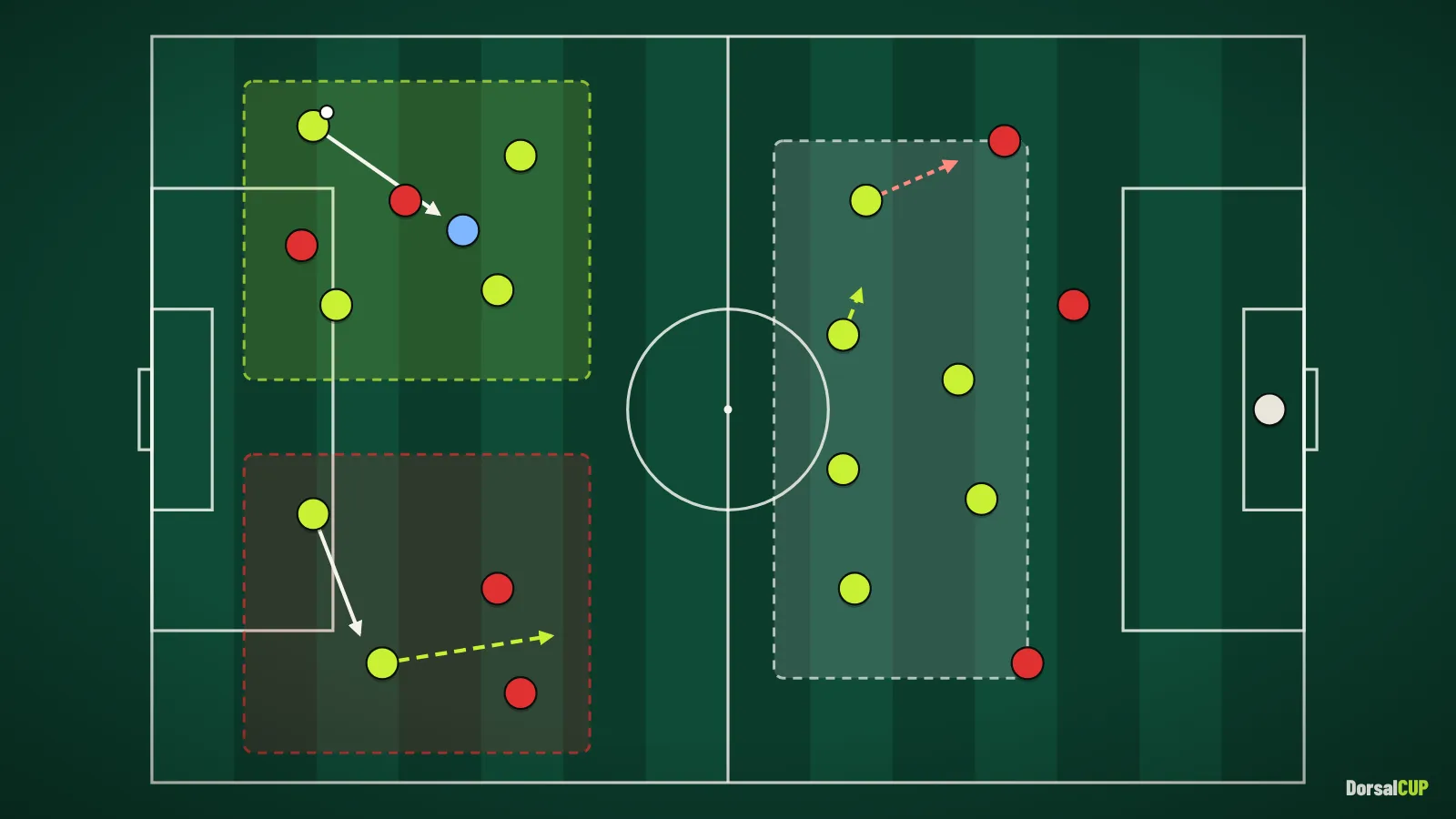
Exercise 2: back six against six
- From the goal line to about 40 m, full width. Lime: goalkeeper, back four, two central midfielders. Red: six attackers (two wide players, two forwards, two midfielders).
- Red attack from 40 m; the coach serves a new ball as soon as one attack ends. Lime defend and, after a regain, counter into either mini-goal on the 40 m line within 8 seconds.
- Five blocks of 3 minutes, 2 minutes' rest. Swap the attacking group with the substitutes every second block.
Coaching points: the back four moves together, shifting towards the ball; the far full-back tucks in level with the centre-backs; one player presses the ball, the nearest covers. The two midfielders protect the space in front of the centre-backs and stay within 10–12 m of them. When the ball goes back, the whole line steps up. Common mistakes: a centre-back following a forward into midfield and leaving a gap; the far full-back staying wide and marking nobody; midfielders chasing the ball and leaving the space behind them open.
For the principles behind this, see mid-block defending in a 4-4-2.
Exercise 3: finishing after a combination
- Two groups of four to six at the edge of the final third, a goalkeeper, one striker (B) who changes every five repetitions.
- The first player passes into the striker, receives the lay-off and plays a through ball for the striker's run. Shots first time or after one touch.
- Twelve minutes, alternating sides. Count goals per group.
Coaching points: the pass into the striker is firm and to the foot away from the imagined defender; the lay-off is soft; the striker's run starts as the lay-off is played, on a curve to stay onside. Finishing: low and across the goalkeeper. The exercise is short on purpose; adults enjoy it and it gives quality touches before the final game.
Ending a training block with an in-house tournament or a festival with nearby clubs gives players a goal and plenty of minutes. The tournament fixture generator builds the matches and times in minutes, no sign-up, and the formats for 8, 12 and 16 teams help you choose the structure.
Final game: 9v9 on two-thirds of the pitch
- 9v9 plus goalkeepers on two-thirds of the pitch, full width. With 16 players, 7v7 plus goalkeepers on half a pitch.
- Normal rules. A goal within 10 seconds of a regain counts double.
- Two blocks of 8 minutes, 2 minutes' rest.
Coaching points: let it run. The coach observes the defending shape from Exercise 2 and the speed of the first pass after a regain, and stops the game only once or twice. End with three minutes of walking and mobility, and two sentences for Saturday: what went well, what to focus on.
Adapting the session
- Only 10–12 players: Exercise 1 as 4v4+2; Exercise 2 as back four plus one against four; final game 5v5 plus goalkeepers.
- One coach, no assistant: use the goalkeepers or an injured player to serve balls in Exercises 2 and 3. Keep the same scoring rules across exercises so explanations are short.
- Half a pitch only: Exercise 2 from 30 m, final game 7v7 across the half.
- Late arrivals: start Exercise 1 with whoever is there and add players to the neutrals as they arrive; latecomers do the prevention routine on the side first.
- Older squad (veterans' players mixed in): longer rest between blocks and smaller pitch for Exercise 1 to reduce long sprints.
This session completes the first half of the series; for younger players see the U18 acquisition-day session. For more small-sided formats, see small-sided games.
Frequently asked questions
What are good football drills for adults?
Small-sided possession games (4v4 to 6v6), defending exercises for the back line and midfield, finishing after combinations, and a final game on a large pitch. Exercises that combine the tactical idea with intensity are more efficient than separate running and drills.
How often should an amateur football team train?
Twice a week is common and enough for most Saturday and Sunday league teams: a harder session early in the week and a lighter, sharper one two days before the match. A third session can be added for recovery and technique.
Do amateur players need separate fitness running?
Usually not. Small-sided games in short blocks produce high-intensity work, and larger games produce match-like running. Strength and injury-prevention exercises are the most useful additions.
What should a Sunday league training session include?
An injury-prevention warm-up, one possession or pressing game, one exercise on the team's main tactical problem (often defending as a unit), some finishing, and a game. Keep explanations short and the ball moving.
Sources
Verified in October 2026. Rules and age groups vary by association and by season; check your local regulations.