
Football Training for Large Groups: 24 Kids, One Coach, No Queues
Football training for large groups works when the coach stops trying to run one exercise for everyone. With 20–30 children and one adult, the answer is a set of stations that run themselves, teams of five or six fixed from the start, rotations on a whistle, and the coach standing at the one station that needs teaching. This 60-minute plan for 24 children aged 7–10 shows the layout, each station, the final games and how to scale it for 20 or 30 players.
Do you organise tournaments? Create yours for free on DorsalCUP.
In this article
The problem with large groups, and the principles that solve it
Twenty-four children and one coach is a common Saturday morning at a grassroots club: an U9 squad that has grown, a holiday course, a school club. The usual result is one drill, two long queues and a coach shouting across the pitch. Children of 7–10 learn football by touching the ball hundreds of times, making decisions and playing; a session where each child waits four minutes for a 20-second turn gives them almost none of that.
Four principles make a large group manageable:
- Set up everything before the children arrive. All stations marked out, balls at each one, bibs in piles. Nothing is moved during the session.
- Fixed groups of six. Four teams of six in four colours, given out at the gate. The groups rotate together, which removes the "who goes where" chaos at every change.
- Self-running stations. Three of the four stations are games or exercises the children already know and can run without an adult. The coach stays at the fourth station, where something new is taught.
- One demonstration, then play. Explain each station once, with the whole group, at the start. Then children learn by doing, and the coach corrects at the station.
- Players: 24 children aged 7–10 (U8–U10), ideally of similar age; see the adaptation section for mixed groups.
- Space: half a full-size pitch, about 60×45 m.
- Equipment: 24 balls, 50 cones, 6 mini-goals or 12 poles, 24 bibs in four colours, one small goal with a net.
- Duration: 60 minutes; about 45 of them with a ball at the feet or in a game.
| Part | Time | Activity | Objective |
|---|---|---|---|
| 1 | 0–8 min | Gate dribbling, everyone with a ball | Arrive and play straight away; ball mastery |
| 2 | 8–12 min | Briefing and teams to stations | One explanation for all four stations |
| 3 | 12–44 min | Four stations × 7 min, 1 min rotation | Small games, 1v1, finishing, passing |
| 4 | 44–58 min | Two simultaneous 6v6 games | Apply everything in the game |
| 5 | 58–60 min | Together: one question, one praise | Close the session calmly |
Arrival: gate dribbling for everyone (8 min)
Organisation: a 30×30 m square with 10 gates made of two cones 1.5 m apart, scattered inside. Every child has a ball and starts dribbling as soon as they arrive; no waiting for the last child.
Rules: dribble through as many different gates as possible in 60 seconds; count them aloud. Then: only with the left foot; stop the ball in each gate with the sole; turn back in a gate with an inside or outside hook. Final round: the coach takes a ball and tries to knock players' balls out of the square, and those players do a skill (five toe taps) to return.
Coaching points: small touches, head up between gates, change of pace after the gate. With 24 children in one square the coach can see everyone and spot who needs which station.
The station circuit (32 min)
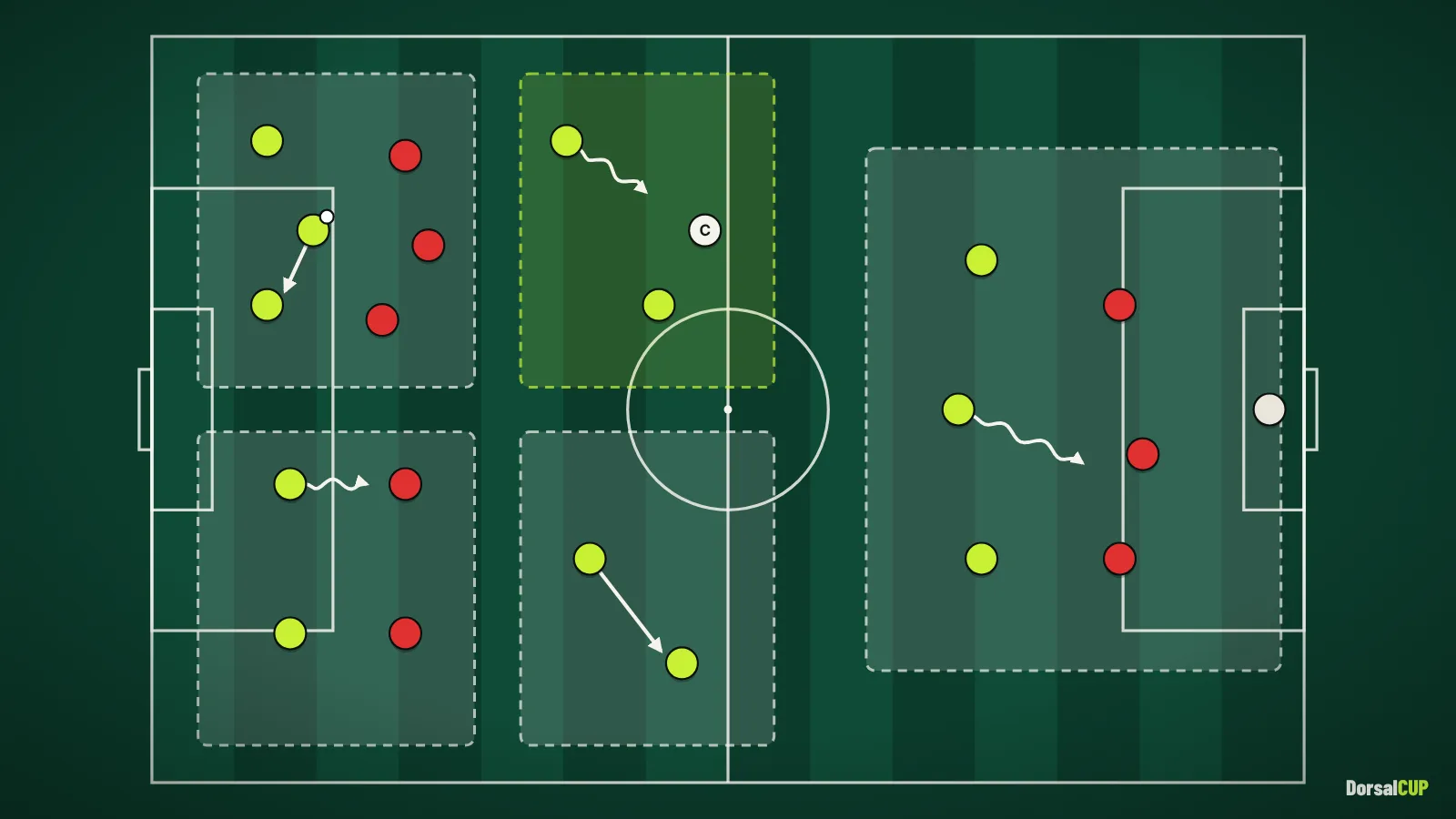
The four stations sit in four quarters of the half pitch. Each group of six spends 7 minutes at a station, then rotates clockwise on the whistle, with one minute to drink and move. The coach stays at Station C, where the teaching happens. Stations A, B and D run on simple rules that the children already know.
Station A: 3v3 to mini-goals (self-running)
A 20×15 m pitch with a mini-goal at each end. Normal 3v3, kick-in or dribble-in restarts, no goalkeepers. Rule for self-refereeing: after a goal, the team that conceded restarts from their own goal line; if there is a dispute, the ball goes to the team that did not touch it last. It is the station with the most touches and decisions per minute.
Station B: 1v1 channels (self-running)
Three channels 15×8 m, side by side, with a pair in each. One player dribbles from one end and tries to stop the ball on the opposite line; the defender starts on that line and comes out to defend. Then the roles swap. Six players, three channels, nobody queues.
Coaching points (when the coach passes by): attack the defender at speed, change direction when the defender commits; defenders slow the attacker down and stay on their feet.
Station C: dribble and shoot (coach station)
A small goal with a net and a keeper who rotates every minute. Players start 20 m out with a ball each, three cones as passive defenders in front of the goal. Each child dribbles past a cone with a feint and shoots before a line 10 m from goal. Two lines of two, one ball each, the next player goes as soon as the shot is taken. This is where the coach teaches the feint of the week and gives individual feedback.
Questions to ask: "Which way did the defender go when you feinted?" "Where in the goal is the keeper weakest?"
Station D: passing gates (self-running)
Pairs with one ball pass to each other through a gate 1 m wide, from 8 m apart. Count the passes in 1 minute; then only the weaker foot; then one touch. Final challenge: after each pass, the passer runs to another gate and the pair continues there. Competition between the three pairs keeps the station going without an adult.
Final games: two 6v6 games side by side (14 min)
Organisation: two pitches of 35×25 m, side by side, with mini-goals or small goals. The four teams of six play two games of 7 minutes, then swap opponents. Use 5v5 with a goalkeeper (the 5v5 format is the U8–U9 game in England) or 6v6 to mini-goals without keepers for maximum touches.
Rules: kick-ins or dribble-ins; a goal scored after a 1v1 dribble past an opponent counts double, linking the game to the session. Children referee their own throw-ins and goals, the coach steps in only for safety. Coaching points: praise effort and good decisions by name, and freeze one game only once, briefly, to show a good dribble.
At tournaments and festivals, what you train during the week shows up in several games in a row. DorsalCUP runs the draw, the schedule and live results for free, and the tournament matchday checklist helps you forget nothing.
Managing the group: rotations, rules and one coach
- The whistle rule: one whistle means stop and put a foot on the ball; two whistles mean rotate. Practise it in the first 5 minutes of the season.
- Clockwise rotation: A → B → C → D → A. A cone of each team's colour at each station shows where each group starts.
- Drinks at rotation, not during stations. Bottles at the station corners of each group, not in one pile.
- Station cards: a laminated card at each station with three rules and a picture of the setup. Older children read it to the group.
- Captain per group: a different child each week is in charge of the balls and the restart at self-running stations.
- Coach position: at Station C, facing the other three stations, so every child is in view.
Common mistakes: changing a station mid-session (the setup becomes the activity); rotating too often, so groups spend more time walking than playing; leaving the youngest or least confident children at the end of every queue. In large groups those children are easy to miss; give them a role (keeper for one minute, captain) and make sure they are seen.
How to adapt the session
- 20 players: four groups of five; Station A becomes 2v2+1 neutral, the final games 5v5.
- 30 players: five groups of six; add Station E, a 2v2 to two gates each, self-running. Rotations shorten to 6 minutes.
- Mixed ages (7–12): group by age, not friendship, and set rules by group: older groups play two-touch at Station A, younger groups use bigger gates at Station D.
- A parent helper: give them Station A to referee or Station D to count; never a teaching station without a brief beforehand.
- Less space: reduce Station A to 15×12 m and Station B to two channels with three players each, rotating attacker, defender, waiting.
- Bad weather: in a sports hall, the same four stations work with futsal balls; replace the goal with mini-goals or cones.
Frequently asked questions
How do you coach 25 kids on your own?
Use stations instead of one drill: four or five areas set up in advance, fixed groups of five or six, and three self-running activities the children already know. The coach stays at one station to teach and rotates the groups on the whistle.
What are good football drills for large groups?
Small-sided games of 2v2 or 3v3 to mini-goals, 1v1 channels, everyone-with-a-ball dribbling games and passing in pairs through gates. They involve every child at once and need almost no explanation.
How long should each station last?
For children of 7–10, 6–8 minutes per station with one minute to rotate works well. Shorter rotations waste time on walking; longer ones make the self-running stations lose focus.
How many children per coach in grassroots football?
There is no single number that applies everywhere. Check the safeguarding guidance of your club and county FA, and make sure a second responsible adult is present even when one coach runs the football.
Sources
Verified in October 2026. Rules and age groups vary by association and by season; check your local regulations.