
U10 Football Drills: Passing, Receiving and Support Session
These U10 football drills form one 75-minute session on passing, receiving and supporting the player on the ball. It suits U10 and U11 squads of 10–14 players aged nine and ten, moves from unopposed technique to rondos and an end-zone game, and finishes with 7v7, the match format of these age groups in England.
Do you organise tournaments? Create yours for free on DorsalCUP.
In this article
Session overview: passing and support at U10
Group: U10–U11 (school Years 5 and 6, players aged nine and ten). Numbers: 10–14 players including one or two goalkeepers. Kit: one size 3 ball per player, 40 discs, bibs in three colours, two 7v7 goals (12×6 ft). Space: half of a full-size pitch or a full 7v7 pitch of about 55×37 m. Duration: 75 minutes.
Objective: pass with the right weight to the correct foot, receive with an open body and a directional first touch, and give the ball carrier two options at sensible angles and distances. Nine and ten-year-olds are entering a good period for technical learning: coordination is more stable, they can hold attention for longer, and they start to see team-mates as part of the solution rather than as competition for the ball. They can now understand simple 'why' questions about space and angles.
The progression is deliberate: unopposed technique with decisions (gates), a fixed pattern that isolates the receiving skill (diamond), minimal opposition with a support problem to solve (3v1), a directional game with numerical superiority (4v4+2) and the full match format. Each step adds opposition and decisions while keeping the same coaching vocabulary.
| Part | Time | Activity | Objective |
|---|---|---|---|
| Warm-up | 0–10 min | Passing through gates in pairs | Pass weight, first touch away |
| Exercise 1 | 10–22 min | Receiving diamond | Open body, back-foot receive |
| Exercise 2 | 22–36 min | 3v1 support rondo | Angles and distances of support |
| Exercise 3 | 36–52 min | 4v4+2 to end zones | Support and penetration |
| Final game | 52–72 min | 7v7 with scoring rules | Apply it in the match format |
| Close | 72–75 min | Review questions | Recall the key ideas |
Warm-up: passing through gates
- Area of 25×25 m with eight gates of 2 m. Players in pairs with one ball.
- The pair scores a point each time a pass goes through a gate and the receiver's first touch takes the ball away from the gate, in the direction of the next one.
- The same gate cannot be used twice in a row. Rounds of 90 seconds, pairs count their points.
- Progression: two players without a ball become 'gatekeepers' who stand in a gate to close it.
Coaching points: look for the next gate before the ball arrives; receive with the foot furthest from the ball when possible. The passer moves after the pass, so the pair keeps moving instead of standing still at a gate.
Exercise 1: receiving diamond
A fixed pattern with no opponents isolates one skill: receiving across the body. The pattern is simple enough that players can focus on body shape rather than on where to go.
Organisation and rules
- Four cones in a diamond, 15 m between opposite cones. Five or six players: one at each cone, the extra player behind the start.
- Pass from the bottom to the side cone; the receiver opens the body (hips facing the inside of the diamond), receives with the back foot and passes to the top cone. The top player passes to the other side and the pattern continues.
- Each player follows their pass to the next cone.
- Three blocks of 3 minutes, changing direction (clockwise and anti-clockwise) so both feet work. Thirty seconds' rest between blocks.
Variants
- Easier: reduce the diamond to 10 m; allow two touches plus the pass.
- Harder: a passive defender behind the receiver calls 'man on' or 'turn'; the receiver must decide between receiving across the body or setting the ball back first time.
Coaching points
- Body open before the ball arrives: 'can you see where the ball comes from and where it goes next?'
- Receive with the back foot to move the ball towards the next target in one touch.
- Pass to the receiver's back foot, firm and on the ground.
- A quick look over the shoulder before receiving; ask the receiver what they saw.
Common mistake: receiving with the front foot and the body closed, which forces a second touch to turn. Stand behind the receiver and ask them to show you the sole of the receiving boot as the ball arrives: if they can, they are open.
U10 football drills for support: 3v1 rondo
Passing is only useful if the ball carrier has somewhere to pass. The 3v1 rondo teaches the support player's job: arrive at an angle where the pass cannot be cut out, at a distance the passer can reach.
Organisation and rules
- Boxes of 10×10 m, four players per box (three attackers, one defender). With 12 outfield players, run three boxes.
- The attackers keep the ball, moving along the sides of the square. The defender changes after six consecutive passes or after winning the ball.
- Rule: the two players without the ball must stand on the sides adjacent to the ball carrier, never on the opposite side.
- Four blocks of 2 minutes, 1 minute's rest. Each player defends at least twice.
Variants
- Easier: a 12×12 m box, or two touches minimum to give time to look.
- Harder: 4v2 in 12×12 m; one-touch passes count double.
Coaching points
- Support at an angle: 'can the defender cut the pass to you with one step? Then move.'
- Move after every pass. The player who has just passed is often the one who has to find a new line.
- Receive on the foot furthest from the defender.
Common mistake: support players standing on the line behind the defender, hidden in the cover shadow. Freeze play and ask the ball carrier which team-mate they can pass to. Players soon learn that a team-mate they cannot see is no help.
Ending a training block with an in-house tournament or a festival with nearby clubs gives players a goal and plenty of minutes. The tournament fixture generator builds the matches and times in minutes, no sign-up, and the formats for 8, 12 and 16 teams help you choose the structure.
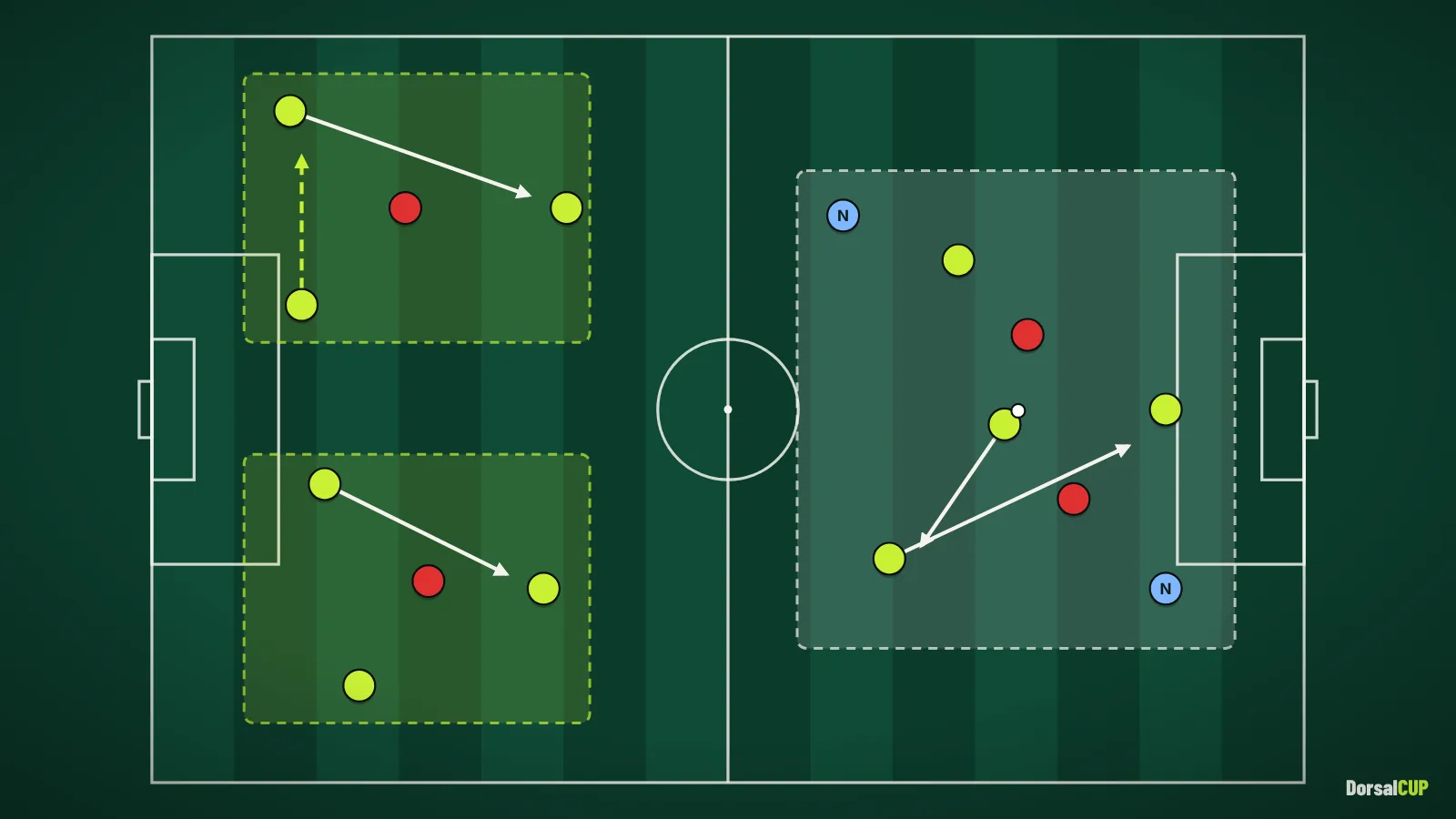
Exercise 3: 4v4+2 to end zones
- Pitch of 30×36 m including two 5 m end zones. Two teams of four plus two neutrals (one inside the pitch, one floating) who play with the team in possession.
- A team scores by passing to a team-mate who runs into the end zone and receives there under control. A pass must not be received standing in the zone; the receiver has to arrive with a run.
- After a point, the team that scored keeps the ball and attacks the other end zone.
- Three games of 4 minutes, 90 seconds' rest. Change the neutrals each game.
Easier: three neutrals. Harder: the end zone is reduced to two 10 m gates within it; neutrals play one touch.
Coaching points: width first so the defence spreads; then one player times a run into the end zone as the ball carrier looks up. Ask: 'when is the right moment to run, before or after your team-mate is ready to pass?'. Common mistake: all four players run forward at once and the ball carrier has no short option. The neutral should always offer a safe pass back.
Final game: 7v7 with scoring rules
U10 and U11 teams in England play 7v7 on pitches of about 55×37 m. The game uses that format with team A in a 2-3-1 (more on shapes in 7v7 formations).
- Normal rules for the format, including pass or dribble restarts from the touchline and the retreat line if your league uses one.
- A goal counts double if it comes after a one-two or a switch of play from one side to the other.
- Two halves of 8–10 minutes with a 2-minute break; rotate substitutes every 4 minutes so everyone plays at least three-quarters of the time.
Coaching points: keep the shape wide in possession so the central midfielder has angles; full-backs and wingers offer the switch. Stop the game at most twice per half, when a pattern from the session appears (good or bad), and let the players explain it.
Adapting the session
- One coach: combine Exercise 1 and Exercise 2 into one area (diamond next to the rondo boxes) and rotate groups every 6 minutes; you coach the rondo, the diamond runs itself.
- Odd numbers: in the rondo, 4v1 or 3v2; in Exercise 3, use three neutrals.
- Less space: the diamond at 10 m, rondo boxes at 8×8 m, end-zone game at 25×30 m.
- Mixed abilities: group the rondo boxes by level so each box has a fair challenge; in the end-zone game, mix levels and use the neutral role for the strongest player with a one-touch limit.
- Fewer players (8): skip the end-zone game and play 4v4 with a goalkeeper at each end.
For further ideas for the same age group, see football drills for 8 to 10 year olds. The next step in the series covers space and passing lines in 9v9 at U12.
Frequently asked questions
What should U10 football training focus on?
Technique under light pressure (passing, receiving, dribbling, shooting), 1v1 situations, and simple team ideas such as support angles and width. Most of the session should be games and game-like exercises with a ball for every player or pair.
How do you teach receiving with an open body?
Use a fixed pattern such as a diamond or triangle, so players know where the ball comes from and where it goes next. Ask them to receive with the back foot and to look before the ball arrives. Then add a passive defender.
Is U10 football 7v7?
In England, U10 and U11 play 7v7 (six outfield players and a goalkeeper) on pitches of about 55×37 m with 12×6 ft goals. Some leagues add a retreat line on goal kicks; check your league handbook.
How long should a U10 training session last?
About 75 to 90 minutes, with drinks breaks every 20 minutes. Keep explanations short and give every player time on the ball in each exercise.