
Football Drills for 12 Year Olds: 9v9 Space and Pressing Session
These football drills for 12 year olds turn one idea into a 90-minute session: make the pitch big when you have the ball, find the player between the lines, and press together when the opponent plays into a trap. The plan suits U12 and U13 squads of 12–18 players and is built around 9v9, the match format these age groups play in England in 2026/27.
Do you organise tournaments? Create yours for free on DorsalCUP.
In this article
Session overview: U12–U13 in 9v9
Group: U12–U13 (school Years 7 and 8, players aged 11 and 12). Numbers: 14–18 players including two goalkeepers. Kit: size 4 balls, 40 discs, bibs in three colours, two 9v9 goals (16×7 ft) and two mini-goals. Space: a 9v9 pitch, about 73×46 m. Duration: 90 minutes.
Objective: occupy the space in possession (width, depth, players between the opponent's lines) and give the ball carrier passing lines; out of possession, take the first steps of collective pressing: one player presses, the nearest team-mates cover and the team shifts across.
Why now: around 11 and 12 players can hold more than one reference at a time (ball, team-mate, opponent, space), which makes positional ideas teachable. 9v9 is the bridge to 11v11: lines become clearer (defence, midfield, attack) and the spaces between them start to matter. Growth spurts begin for some players at this age, so coordination may dip temporarily and physical differences widen; keep intensity in short blocks and avoid judging players on size.
| Part | Time | Activity | Objective |
|---|---|---|---|
| Warm-up | 0–15 min | Mobility, then 4v4+4 rondo | Width and depth in possession |
| Exercise 1 | 15–35 min | Three-zone build-up game | Passing lines, player between the lines |
| Exercise 2 | 35–55 min | 6v6 pressing on a trigger | Press, cover, shift |
| Final game | 55–85 min | 9v9 with conditions | Apply both ideas in the match format |
| Close | 85–90 min | Review and cool-down | Players explain the key ideas |
Warm-up: 4v4 plus 4 for width and depth
Start with 5 minutes of mobility and coordination with the ball (skipping, side steps, short accelerations, passing in pairs). Then move into the rondo.
- Area of 30×28 m. Two teams of four inside, four outside players (one on each side) who play with the team in possession.
- Inside players have two touches; outside players one or two. A point for eight consecutive passes.
- Three blocks of 2 minutes 30 seconds, 1 minute's rest; outside players swap with one team each block.
Coaching points: two players stay wide, one deep, one high, like a diamond. When the ball moves, the diamond moves with it. Ask: 'how many passing lines does the ball carrier have right now?'. Three is the target. Common mistake: all four inside players come towards the ball. The outside players then have to play long, risky passes.
Football drills for 12 year olds: the three-zone build-up game
This is the central exercise of the session. It isolates the moment that decides most 9v9 build-ups: the pass that breaks the first line of pressure and finds a midfielder facing forward.
Organisation
- Area 45 m wide divided into three zones across the pitch: back zone (about 20 m deep), middle zone (about 25 m), front zone (about 18 m).
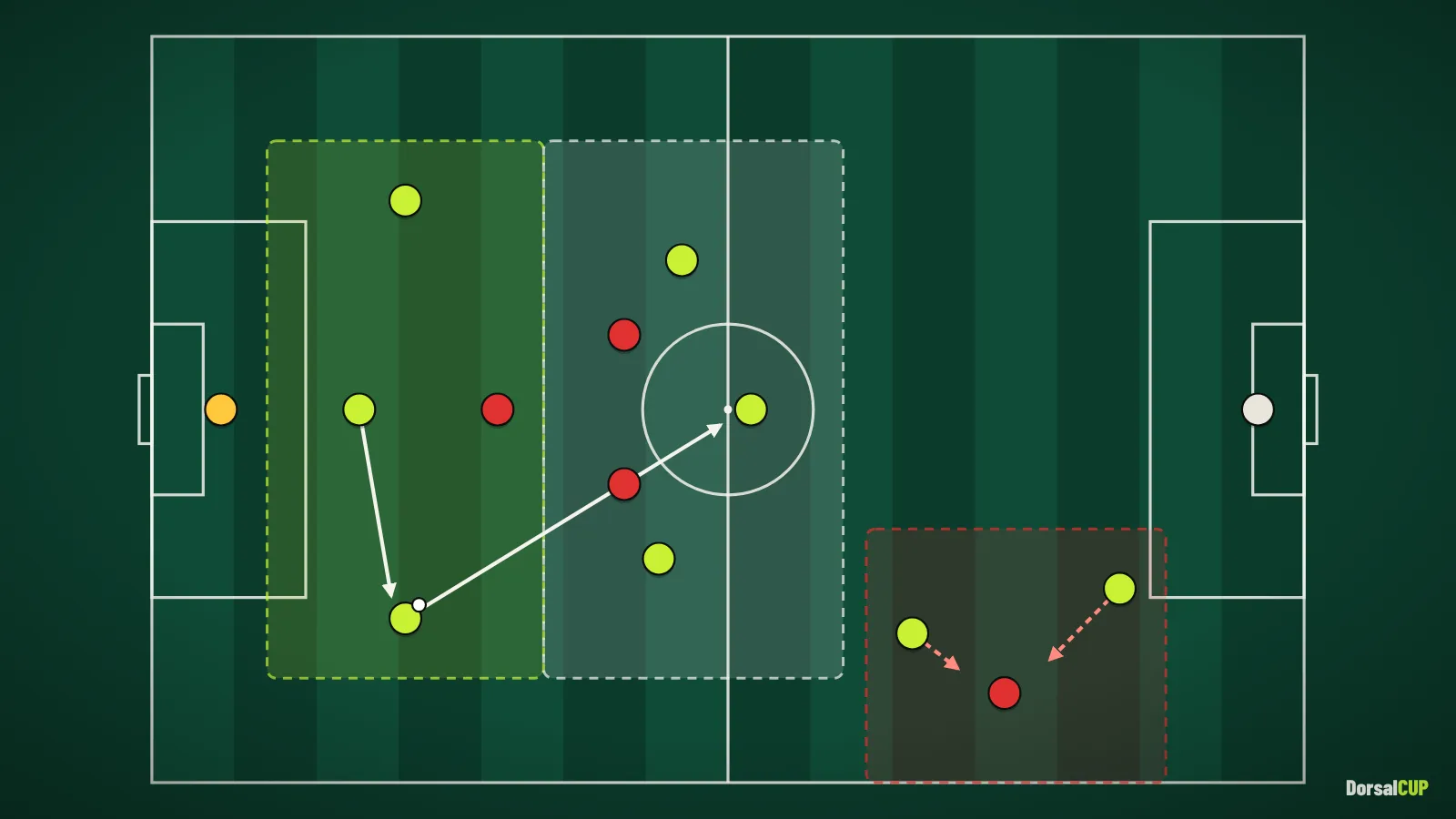
- Zone 1: goalkeeper and three defenders (A) against one forward (B). Zone 2: three A midfielders against two B midfielders. Zone 3: one A target player against one B defender.
- Players stay in their zones. A score one point when the ball reaches the target player under control. B win the ball and score in either of two mini-goals placed on the back line of zone 1 (or by passing to the goalkeeper's hands, depending on your set-up).
- Four blocks of 4 minutes, 90 seconds' rest. Rotate players through zones and roles after each block.
Progressions
- Easier: the B forward in zone 1 can only shadow, not tackle.
- Harder: one B midfielder may drop into zone 1 to press, making it 3v2; the A midfielders must react by offering a short option.
- Further: allow one A defender to carry the ball into zone 2, creating a 4v2 there.
Coaching points
- Defenders: wide and deep enough that the forward cannot press two of them. Take the first touch forward to fix the forward before passing.
- Midfielders: get into the gaps between the two B midfielders, not in front of them. Scan before receiving: 'where is your nearest opponent?'
- Receive on the half-turn and play forward when possible. If the line is closed, recycle and switch.
- Ask the passer: 'which line did that pass break?'
Common mistakes: midfielders standing level with or behind the B midfielders (the pass cannot break any line); defenders passing sideways too quickly, which lets the forward shift without effort. Stop play when a midfielder is hidden behind an opponent and ask them to find a position where the passer can see their face.
Exercise 2: first pressing on a trigger
Pressing at this age is not about intensity first. It is about understanding that one player presses and the others cover. The exercise uses one simple trigger: the pass to the wide player.
Organisation
- Half of the 9v9 pitch. Red (five players plus goalkeeper) build from the goalkeeper towards two mini-goals on the halfway line. Lime (five players) defend and, when they win the ball, attack the big goal.
- Lime start in a compact shape around the ball. When the ball is passed to a red wide player, the nearest lime player presses on a curved run that blocks the pass inside; the next player covers; the far side shifts towards the ball.
- Points: red score in a mini-goal (1 point); lime win the ball and score in the big goal within 8 seconds (2 points).
- Four blocks of 3 minutes, 2 minutes' rest. Switch roles at half time.
Coaching points
- The presser curves the run so the touchline becomes an extra defender. 'Show them the line.'
- The cover player stands at an angle behind the presser, 5–8 m away, ready to win the second ball.
- Far-side players move towards the ball side; the team becomes narrow and short.
- One call: the presser says 'go' as they start, so the others know to move.
Common mistakes: two players press the same opponent while the inside pass is free; the presser runs straight and lets the ball carrier play inside. Use the freeze: 'which pass did we want to stop?'
At tournaments and festivals, what you train during the week shows up in several games in a row. DorsalCUP runs the draw, the schedule and live results for free, and the tournament matchday checklist helps you forget nothing.
Final game: 9v9 with conditions
9v9 is the match format for U12 and U13 in England (one season longer than before, since 11v11 now starts at U14). The final game brings both ideas together. For shapes, see 9v9 formations.
- 9v9 on the full pitch, 3-2-3 against 3-3-2 (or your usual shapes). Normal rules for the format, including any retreat line your league uses.
- A goal counts double if the move included a pass received between the opponent's midfield and defence.
- The defending team scores a bonus point for winning the ball in the opponent's half within 6 seconds of a pass to their wide player.
- Two halves of 12 minutes with a 3-minute break; substitutes rotate every 6 minutes.
Coaching points: watch the distances between lines (no more than 10–15 m within the team when defending) and the number of passing lines available to the centre-backs. Use half-time to ask players to explain one moment where they found the space between the lines and one moment where they pressed together.
Adapting the session
- Fewer players (10–12): in Exercise 1 remove the target player (score by dribbling into zone 3); play the final game 7v7.
- One coach: run Exercise 1 and Exercise 2 one after the other rather than as stations; the goalkeepers can keep score.
- Less space: zone widths of 35 m and a 60×40 m final game; keep the pressing exercise on half that pitch.
- Mixed levels: in Exercise 1 the more advanced players take the middle zone, where decisions are hardest; rotate everyone through it at least once.
- Goalkeepers: they are part of the build-up in Exercise 1 and the first passer in Exercise 2. Give them the same scanning cues as outfield players.
Heading is not part of this session. Follow the FA's current heading guidance for youth age groups when planning sessions with crosses or set pieces. For more pressing ideas suited to youth teams, see pressing drills for youth football.
Frequently asked questions
What should 12 year olds work on in football training?
Technique under pressure, receiving on the half-turn, scanning, and the first collective ideas: width and depth in possession, finding players between the lines, and pressing with a cover player. Sessions should still be built mainly on games and game-like exercises.
Is U12 football 9v9 in England?
Yes. U12 and U13 play 9v9 in England from 2026/27, with 11v11 starting at U14. Pitches are about 73×46 m with 16×7 ft goals and a size 4 ball. Check your league handbook for local rules.
How do you teach pressing to U12 players?
Start with one clear trigger, such as a pass to the wide player, and three roles: presser, cover and shift. Keep blocks short and reward winning the ball in a specific zone. Intensity follows understanding.
How long should a U12 training session be?
About 75 to 90 minutes, with two or three main exercises and a game. Keep high-intensity blocks to 3–4 minutes with adequate rest.
Sources
Verified in October 2026. Rules and age groups vary by association and by season; check your local regulations.