
Day-Before-Match Training (MD-1) and the Recovery Day After (MD+1)
Day-before-match training should leave players sharper than when they arrived, not more tired. The session the day after the match has two different jobs: help the starters recover and give the players who did not play enough the load they missed. This article sets out both sessions in detail, a 50-minute MD-1 activation and a split MD+1 with recovery and compensation groups, for U17 to senior teams, with notes for amateur weeks where the days do not fit the textbook.
Do you organise tournaments? Create yours for free on DorsalCUP.
In this article
Where MD-1 and MD+1 sit in the week
In a week with one match, sessions are often named by their distance from match day (MD). MD-1 is the day before the match, MD+1 the day after. A full-time team with a Saturday game trains Friday (MD-1) and has a recovery session on Sunday or Monday (MD+1). Many amateur and youth teams train Tuesday and Thursday for a Saturday or Sunday game: their last session is MD-2 or MD-3, and there is no MD+1 at all.
The principles still apply in a shorter week. The last session before a match should be short, sharp and low in volume; the first after a match should separate those who played most from those who played little. The sessions below are written for a U17 to senior squad of 18–20 players with two goalkeepers. For teams with only two sessions a week, the final section shows how to fold the content in.
| Session | Duration | Main content | Feeling at the end |
|---|---|---|---|
| MD-1 activation | 45–55 min | Rondo, short reaction speed, unopposed patterns, set pieces, finishing | Fresh, quick, confident |
| MD+1 recovery (starters) | 30–35 min | Easy aerobic work, mobility, light rondo | Loose, not tired |
| MD+1 compensation (others) | 45–55 min | Small-sided game, high-speed running, finishing | Worked, close to a match load |
MD-1: the day-before-match training session (50 min)
Objective: activate the nervous system, rehearse the key game-plan patterns and set pieces, and build confidence. What to avoid: long high-intensity bouts, large running volumes, new tactical ideas and heavy contact. Players should be able to train again the next morning without feeling it.
| Part | Time | Exercise | Notes |
|---|---|---|---|
| 1 | 0–12 min | Mobility and 5v2 rondo | Two-touch, short bouts |
| 2 | 12–18 min | Reaction races over 5–10 m | 6 reps, full rest |
| 3 | 18–30 min | Unopposed build-up and pressing patterns | Walk-through to match speed |
| 4 | 30–40 min | Set pieces: attacking and defending corners and free kicks | Real positions |
| 5 | 40–50 min | Finishing and strides | Quality, then 3 × 20 m strides |
Part 1: mobility and 5v2 rondo (12 min)
Five minutes of dynamic mobility (hips, groin, hamstrings, ankles), then 5v2 rondos in 12×12 m. Rules: two touches; the defender who wins the ball swaps with the player who lost it; 5 × 60 s with 30 s rest. The rondo raises the temperature with the ball, sharpens first touch and creates a lively mood.
Part 2: reaction races over 5–10 m (6 min)
Pairs 2 m apart, a ball 8 m in front. On the coach's clap (later on a visual signal) both race to the ball; the winner shoots into a mini-goal 10 m beyond, the loser defends. Six repetitions with at least 45 seconds between them. This keeps players in touch with maximal speed without adding fatigue; the efforts are short and the rest is complete.
Part 3: unopposed build-up and pressing patterns (12 min)
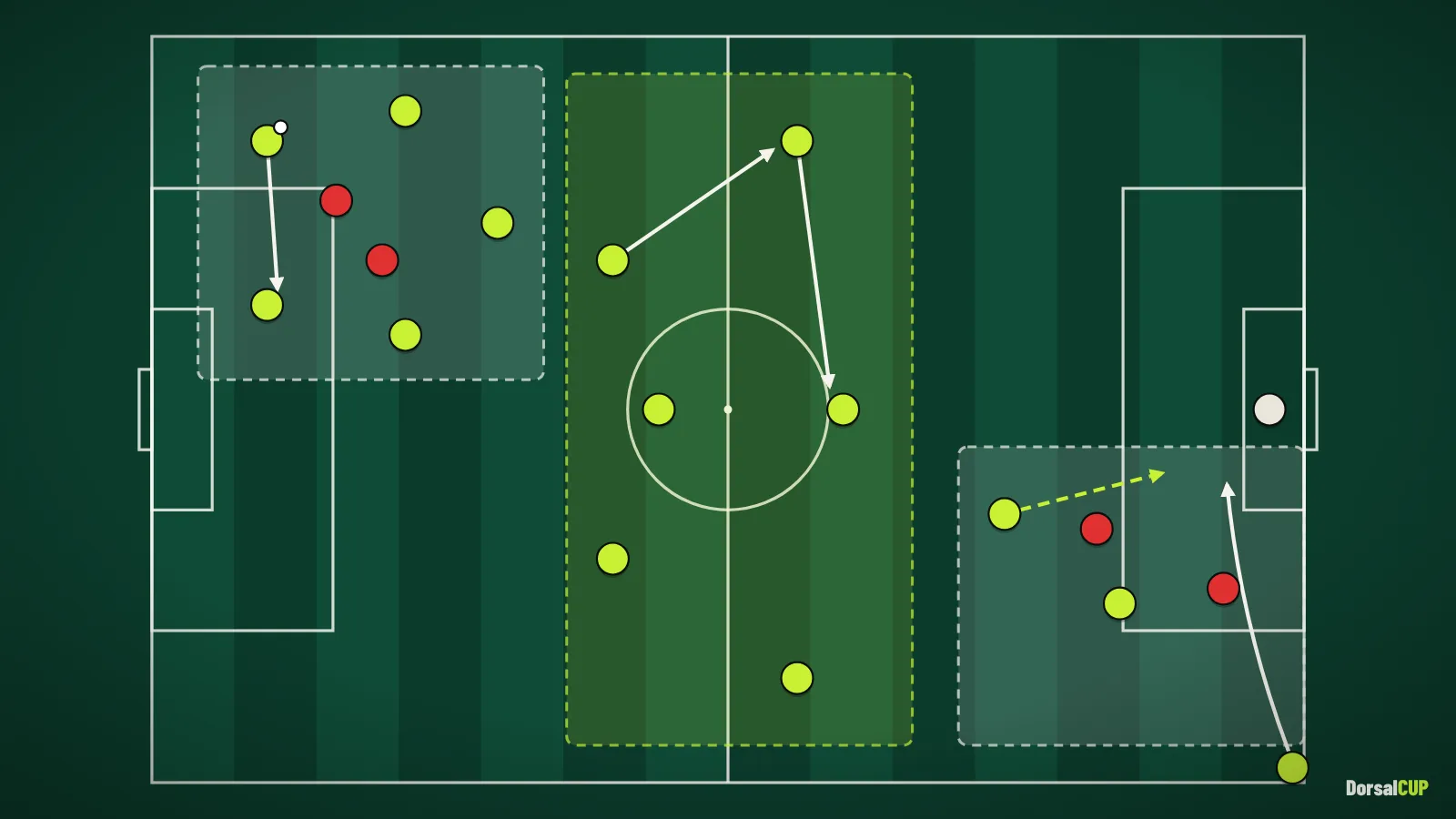
The starting eleven (or the probable one) walks through the two or three patterns from the match plan: how the team builds up against the opponent's expected press and how it presses their build-up. Start at walking pace, then at three-quarter speed with the ball, finishing each pattern with a shot or a cross. Substitutes play as the opponent's shape, without contact.
Coaching points: correct only the details that matter for tomorrow: distances, timing of the inside pass, who starts the press. Keep the tone positive. Ask the key players to explain the pattern to the group: it shows understanding and builds confidence.
Part 4: set pieces (10 min)
Two attacking corners, one defensive corner, one attacking free kick, one defensive free kick, each rehearsed three or four times in real positions. Keep it short and specific. Players should know their job and their marker, not learn a new routine. Defensive positions should be checked against the opponent's likely set-piece threats.
Part 5: finishing and strides (10 min)
Two lines, combination with a wall pass and a finish with one or two touches. Goalkeepers make saves, not long dives in the mud. End with three strides of 20 m at about 85–90% of maximum speed, walking back. The last action of the session should be a goal, a good save or a sharp stride, not a long talk.
MD+1: recovery for the starters
Players who played more than about 60 minutes the day before have fatigue in the muscles, a lower energy store and often poor sleep after a late game. The session should help them feel better, not add load. Duration: 30–35 minutes.
- Easy aerobic work (12–15 min): stationary bike, easy jog on grass or a pool session at a conversational pace.
- Mobility (10 min): hip flexors, groin, hamstrings, calves, thoracic spine. Slow, controlled, no forcing.
- Light rondo (8 min): 6v2 or 7v2, big area, free touches, no pressing at speed. It keeps contact with the ball and the group.
Talk to each starter briefly: any knock, any soreness, how they slept. That information shapes the next session more than any test. Sleep, food and fluid intake in the 24–48 hours after the match matter more for recovery than ice baths, compression or massage guns, whose effects are variable and depend on the individual.
Ending a training block with an in-house tournament or a festival with nearby clubs gives players a goal and plenty of minutes. The tournament fixture generator builds the matches and times in minutes, no sign-up, and the formats for 8, 12 and 16 teams help you choose the structure.
MD+1: compensation for the players who did not play
Substitutes and unused players lose the stimulus of the match. Over a few weeks, they fall behind in match-specific fitness and are more vulnerable when they suddenly play 90 minutes. The compensation session gives them a load close to a match in a short time. Duration: 45–55 minutes. Group: players who played less than about 45 minutes, plus the third goalkeeper or one of the keepers.
Compensation game: 5v5 with goalkeepers (16 min)
Organisation: 40×30 m pitch, two goals with goalkeepers. With fewer than ten players, play 4v4 or 3v3 + 2 neutrals on a smaller pitch. Load: 4 × 3 min, 1 min 30 s rest. Rule: after a goal, the goalkeeper of the team that conceded restarts immediately to keep the pace high.
High-speed running with the ball (12 min)
Exposure to high speeds that the starters got in the match. Pairs: a 1-2 with the coach, a run of 25–30 m onto a through pass and a finish, then a walk back. Six to eight repetitions per player with 60–90 seconds of rest. Wide players and full-backs can finish with a cross for a central player.
Position-specific finishing or defending (10 min)
Strikers finish from crosses and cut-backs; defenders defend 1v1 and crosses; goalkeepers do a full session block with their coach. End with a short cool-down. This is also a good moment for the coach to give substitutes individual attention, which they often miss in a match week.
Adapting MD-1 and MD+1 to youth and amateur weeks
- Amateur team, Tuesday and Thursday, Saturday match: Thursday is MD-2. Keep the first 40 minutes as a normal session with a high-intensity small-sided game, then finish with Part 3 and Part 4 of the MD-1 plan. Tuesday starts with a 15-minute recovery block for the starters while the others do the compensation game, then the groups join.
- U17–U19: the plan works as written. Players who also play for school or another team need their total weekly load checked before compensation work.
- U15 and younger: an MD-1 activation is not needed. The last session of the week is a normal session with games; recovery is a day off and a good night's sleep.
- Two matches in a week: MD+1 and MD-1 merge into one session: recovery for the starters, short compensation for the others, then the set pieces for the next match.
- Bad weather or a heavy pitch: move the MD-1 rehearsal indoors or to a small area, and keep the session to 40 minutes. Freshness matters more than full content.
Frequently asked questions
What should a football team do the day before a match?
A short session of 45–55 minutes: a rondo, a few short maximal efforts with full rest, rehearsal of the game plan patterns and set pieces, and some finishing. Volume and contact are low so players arrive fresh.
Should players train the day after a match?
Starters benefit from a light recovery session or a day off with good sleep and food. Players who played little benefit from a compensation session that gives them a load close to a match.
What is a compensation session in football?
A session for substitutes and unused players, usually the day after the match, with small-sided games, high-speed running and position-specific work. It keeps their match fitness close to that of the starters.
How long should a recovery session be after a football match?
About 30–35 minutes: easy aerobic work, mobility and a light rondo. It should leave players feeling better than when they arrived, not tired.