
Pre-Season Football Training: The First Week, With the Ball
The first week of pre-season football training decides how the next six weeks go. Players come back from several weeks off with different fitness levels, and the most common mistake is to test them with long runs on day one and spend the next fortnight managing sore hamstrings. This plan uses the ball from the first session, increases load step by step across the week, includes simple tests that do not wreck the group, and details the main session of the week for U15 to senior teams.
Do you organise tournaments? Create yours for free on DorsalCUP.
In this article
What the first week of pre-season has to achieve
After the summer break, most players have lost part of their high-intensity running capacity and their tolerance to accelerations, decelerations and changes of direction. Some have trained on their own, others have done nothing for six weeks. The first week has three jobs: reintroduce load without spikes, collect a baseline for every player, and start rebuilding the game model (see tactical periodisation and the game model). It is not the week to find out who is fittest.
The plan below is for a team training four times in week one and playing a short friendly at the weekend: typical for U15–U18 academy or county-level teams and for ambitious senior amateur clubs. A section at the end shows how to compress it into two or three sessions.
| Day | Session | Main content | Intensity |
|---|---|---|---|
| Day 1 | 75 min | Rondos, technical circuit, extensive small-sided game, wellness questionnaire | Low–moderate |
| Day 2 | 80 min | Positional games in large spaces, aerobic test at the end (U17+) | Moderate |
| Day 3 | Off | Rest, or 20–30 min easy bike or swim and mobility | — |
| Day 4 | 90 min | Main session (detailed below): rondo, 4v4, 3v2 waves, 9v9 | Moderate–high |
| Day 5 | 60 min | Team shape, set pieces, low-intensity game | Low |
| Day 6 | Friendly | 2 × 30 min, everyone plays 30–45 min | High, short |
| Day 7 | Off | Rest | — |
The load rises from Day 1 to Day 4, drops on Day 5 and returns with a short friendly. Volume and intensity are not both pushed at once: in Day 2 the space is large and the intensity moderate; in Day 4 the spaces are smaller and the intensity is higher, with longer rest.
Monitoring and simple baseline tests
The baseline does not need a sports science department. Three tools cover most needs at grassroots and academy level.
- Session RPE: after each session, every player rates how hard it was on a 0–10 scale. Multiply by the session minutes for a load number. Watch the trend for each player and the team; a sudden jump from one week to the next is the pattern to avoid.
- A short wellness questionnaire before Day 1, Day 4 and the friendly: sleep, muscle soreness, mood and energy on a 1–5 scale. A player with low scores trains, but the coach adjusts the volume.
- Aerobic test at the end of Day 2 (U17 to seniors): an intermittent shuttle test such as the 30-15 Intermittent Fitness Test or the Yo-Yo Intermittent Recovery Test level 1. It gives a baseline to individualise running later in pre-season. Do it after a full warm-up and with the group well fed and hydrated.
For U15 and U16: skip maximal running tests in week one. Players are often in or around their growth spurt; aches in the knee or heel at this age are frequent and maximal efforts in the first days add risk with little benefit. A 10 m and 30 m sprint with timing gates or a stopwatch on Day 4, after the warm-up, and the questionnaire are enough.
Day 4 main session: plan and warm-up
Group: 18 outfield players plus 2 goalkeepers, U15 to senior. Space: a full-size pitch. Equipment: 20 balls, 2 portable goals, 40 cones, bibs in three colours. Duration: 90 minutes. Objective: higher intensity with the ball in short, controlled bouts; finishing and transition; the first tactical references in the game.
| Part | Time | Exercise | Objective |
|---|---|---|---|
| 1 | 0–18 min | Movement prep (FIFA 11+ based) and passing pattern | Prepare tissues; quality of passing |
| 2 | 18–36 min | Positional rondo 3v3+3 | Possession, support, counter-press |
| 3 | 36–56 min | 4v4 with goalkeepers in 30×20 m | High-intensity intermittent work with the ball |
| 4 | 56–70 min | 3v2 transition waves | Attack quickly, defend outnumbered |
| 5 | 70–86 min | 9v9 on 70×50 m | Game model references |
| 6 | 86–90 min | Cool-down and RPE | Recovery and monitoring |
Warm-up (18 min): 8 minutes of running exercises (hip out, hip in, circling partner, shoulder contact, forwards and backwards), 6 minutes of strength and balance (plank, side plank, single-leg balance, Nordic hamstring lowers, 3–5 slow reps), then a passing pattern in groups of five with accelerations at about 80% at the end. The structure follows the FIFA 11+, which was designed for players aged 14 and over.
Main exercises: rondo, 4v4 and transition waves
Positional rondo 3v3+3 (18 min)
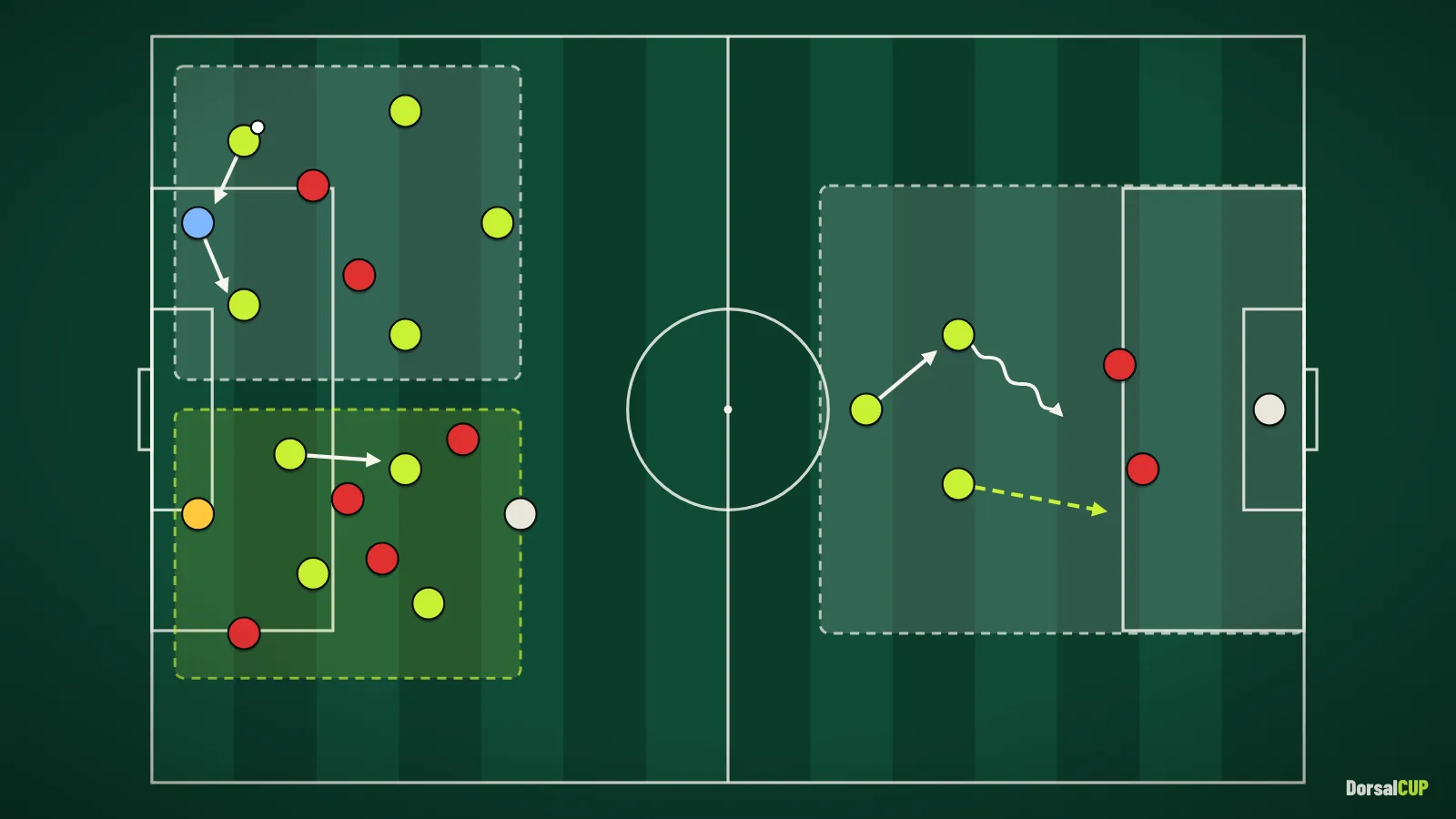
Organisation: two areas of 30×25 m. In each, two teams of three plus three neutrals: one at each end and one in the middle. The team in possession plays with the neutrals, a 6v3 in possession. Nine players per area uses all 18 outfield players.
Rules: a point for 10 consecutive passes or for a pass from one end neutral to the other through the middle neutral. When the ball is lost, the team that lost it has 5 seconds to win it back; if it does, double point. Load: 4 × 3 min 30 s, 1 min 30 s rest.
Coaching points: width and depth so the neutrals always have two options; play to the free player, not to the nearest; immediate reaction when the ball is lost. In video review, watch the first two seconds after a loss: does the closest player press, and does the second cut the pass?
4v4 with goalkeepers (20 min)
Organisation: one pitch of 30×20 m with two portable goals and the two goalkeepers. Four teams of four: two play while the other two serve balls from the sides, then they swap. The two remaining outfield players act as feeders and replace a player in each team in turn.
Load: 4 bouts of 2 min 30 s per team, 2 min 30 s rest while the other two teams play (work-to-rest 1:1). For U15, 3 bouts of 2 min. This is the most intense block of the week; do not extend it.
Coaching points: shoot early; defend the ball, not the player; transition in both directions in under 2 seconds. Keep the balls coming so the bouts are continuous.
3v2 transition waves (14 min)
Organisation: half a pitch, a goalkeeper in the main goal. Three attackers start from the halfway line against two defenders. When the attack ends (goal, save or ball out), the two defenders become attackers against a new single defender who enters from the side, to a mini-goal or a line at halfway. Then the next three attackers go.
Load: each player does 6–8 actions of 8–12 s with long natural rest. Coaching points: attackers finish within 10 seconds; the ball carrier drives at a defender; defenders stay compact, delay, and force the attack wide.
Final game and how to adjust by age and level
9v9 on 70×50 m (16 min)
Two halves of 7 minutes with a 2-minute break. First references of the game model: the shape in build-up, who presses first, where the team regains the ball. Rule: a goal scored within 8 seconds of winning the ball counts double, linking to the transition work. With 18 outfield players plus two goalkeepers, two teams of nine including goalkeepers leave two outfield players to rotate in every 4 minutes.
Cool-down (4 min): easy jog, mobility, fluids and RPE collected before players leave.
By age and level
- U15: total session 75 min, shorten 4v4 to 3 × 2 min, no aerobic test in week one, strength work with body weight and technique only.
- U17–U19: the plan as written. Add a short gym or body-weight strength session on Day 2 or Day 5 if players already have the technique.
- Senior amateurs with three sessions: combine Day 1 and Day 2 into one session (rondos, extensive game, test optional), keep Day 4 as written, drop Day 5 and play the friendly.
- Senior amateurs with two sessions: Day 1 content plus a shorter 4v4 block in session one; Day 4 without the aerobic test in session two. Ask players to do two easy 30-minute runs or rides on their own during the week.
- Players back from injury or with no summer activity: work in the rondo and waves, act as a feeder in the 4v4, and play half of the final game.
Ending a training block with an in-house tournament or a festival with nearby clubs gives players a goal and plenty of minutes. The tournament fixture generator builds the matches and times in minutes, no sign-up, and the formats for 8, 12 and 16 teams help you choose the structure.
Common mistakes in the first week of pre-season
- Long runs and maximal tests on day one. They tell the coach who did their summer homework, and cause soreness that lowers the quality of the next three sessions.
- Pushing volume and intensity together. Large spaces with moderate intensity, or small spaces with high intensity and long rest; not both in the same session in week one.
- No rest day. Tissues adapt between sessions, not during them. A rest day in the middle of the week keeps quality high on Day 4.
- Everyone plays 90 minutes in the first friendly. 30–45 minutes per player is enough in week one.
- No record of load. Without RPE or minutes, the coach cannot see who is doing too much in week two, which is when soft-tissue injuries often appear.
A good first week ends with players feeling they have trained with the ball, a little tired but not sore, and eager for week two. That is the base on which the higher loads of weeks two to four can be built.
Frequently asked questions
How long should pre-season be for an amateur football team?
Most amateur and youth teams use four to six weeks before the first competitive match. The first week builds the base gradually, and the load usually peaks in weeks two to four.
Should pre-season start with running or with the ball?
With the ball. Small-sided games and positional games in different spaces can deliver most of the running load, while rebuilding technique and the game model. Specific running can be added for individual players based on the baseline test.
What fitness test should we do in pre-season?
For U17 to seniors, an intermittent shuttle test such as the 30-15 Intermittent Fitness Test or the Yo-Yo Intermittent Recovery Test is practical, done after a full warm-up and not on the first day. For younger players, short sprint times and a questionnaire are enough in week one.
How many sessions in the first week of pre-season?
Three or four sessions plus a short friendly suits most academy and ambitious amateur teams. With two sessions a week, compress the content and keep at least one rest day between sessions.
Sources
Verified in October 2026. Rules and age groups vary by association and by season; check your local regulations.