
Small-Space Football Training: Quarter-Pitch and Indoor Session
A small-space football training session can be one of the most productive of the week. When a team only has a quarter of a 3G pitch, or is moved into a sports hall by the weather, the coach has to swap long passes and sprints for what small areas do well: many touches, quick decisions, constant pressure and plenty of finishing. This 75-minute plan for 16 players aged 11–14 is built for a 50×34 m quarter pitch, with an indoor version of every exercise for a 30×18 m hall.
Do you organise tournaments? Create yours for free on DorsalCUP.
In this article
What a small space does well, and what it takes away
Shared pitches are the norm in grassroots football. Many clubs give a team a quarter of a full-size 3G pitch, about 50×34 m, for an hour on a weeknight; in winter the session may move to a sports hall of roughly 30×18 m. Coaches often treat this as a lost session. It is not, if the plan fits the space.
A small area increases the number of touches, receptions under pressure and decisions per player per minute. It also reduces the distance covered at high speed, removes long passing and limits work on depth and team shape. A small-space session should therefore focus on receiving and passing under pressure, 1v1 and 2v2 duels, and finishing, and leave long-ball, crossing and sprint work for another day of the week. More formats are in the guide to small-sided games.
- Players: 16 outfield players aged 11–14 (U12–U14) plus two goalkeepers if available.
- Space: a quarter of a full-size pitch, 50×34 m; indoors, a sports hall of about 30×18 m.
- Equipment: 16 balls (futsal balls size 4 indoors), 40 cones, two portable goals, four mini-goals, 16 bibs.
- Duration: 75 minutes.
Three rules make the space work harder:
- Match the area to the number of players. As a rough guide for this age, allow roughly 30–60 m² per outfield player in possession games and more in games with goals. A quarter pitch is about 1,700 m², so 16 players in one game is a crowded match, but four groups of four in separate grids is an efficient warm-up.
- Use rules, not shouting, to set the difficulty. Touch limits, neutrals and scoring rules change the problem the players face. The coach then only needs to ask questions.
- Set up all areas before the start. In a shared space there is no time to move goals around; every exercise uses the same cones or a simple variation of them.
The biggest risk in a small space is queues and standing. Every exercise below involves every player at once, with rest built in through rotations rather than waiting in line.
| Part | Time | Activity | Objective |
|---|---|---|---|
| 1 | 0–15 min | 3v1 rondos in four grids | Body shape, first touch, support angles |
| 2 | 15–33 min | 3v3+2 possession box | Receive under pressure, play forward |
| 3 | 33–51 min | 2v2 finishing between two goals | Duels, quick shots, transitions |
| 4 | 51–71 min | 7v7 with goalkeepers on the quarter pitch | Apply the session in the game |
| 5 | 71–75 min | Cool-down and questions | Review and close |
Warm-up: 3v1 rondos in four grids (15 min)
Objective: a warm-up with the ball from the first minute, working body shape and first touch in tight space.
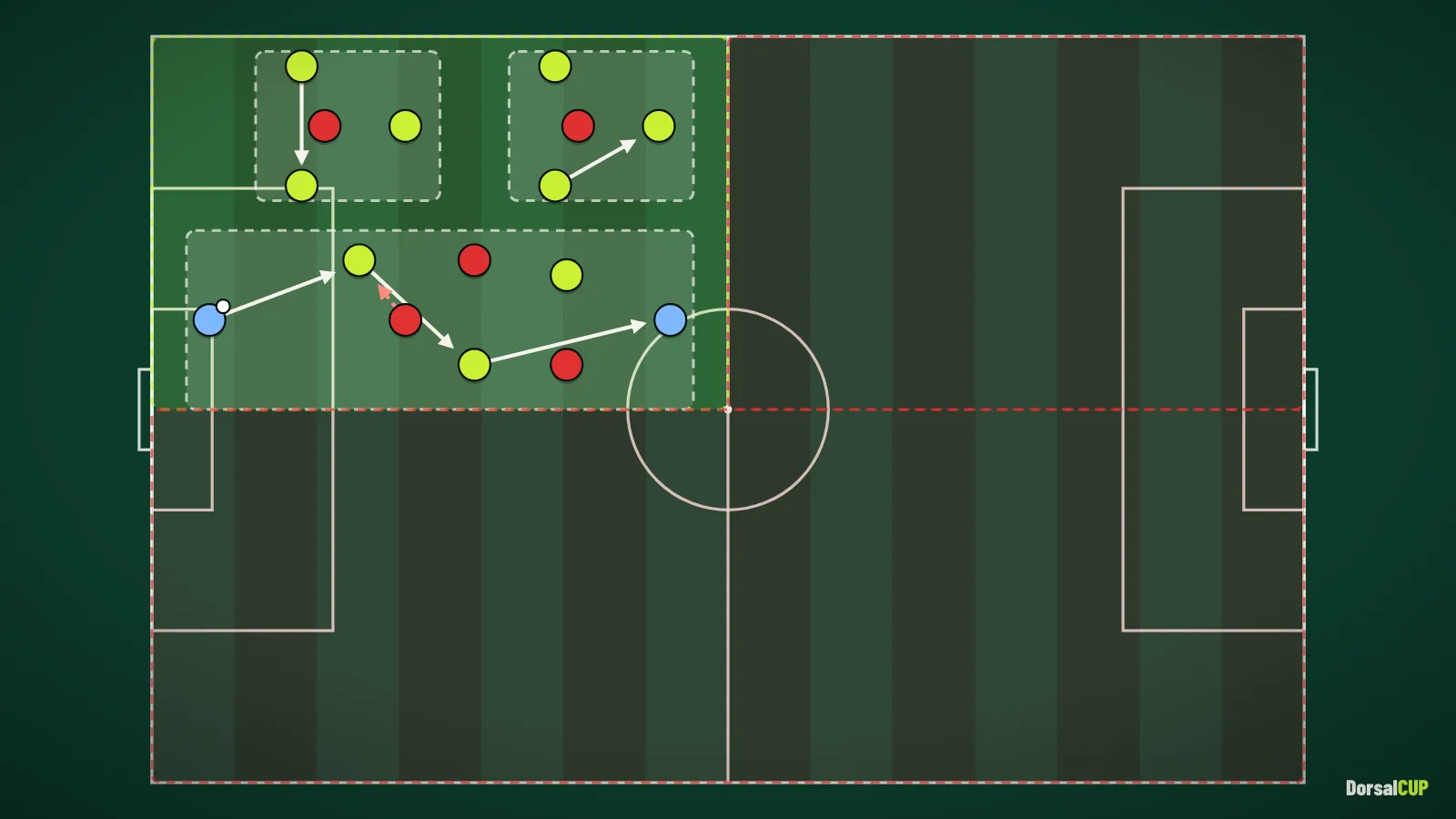
Organisation: four grids of 8×8 m along one side of the quarter, four players per grid: three on the outside, one defender inside. Indoors, the same grids fit across the width of a hall.
Progression: 3 min free touches; 3 min two-touch; 3 min two-touch and the receiver must open the body to play the next pass to the opposite player; then 2 × 2 min competitive (the defender counts interceptions). Mobility and short accelerations in between, about 3 minutes in all.
Coaching points: receive on the back foot, half-turned; move along the line to make the angle before the pass, not after; pass to the far foot. Ask: "Where can the defender not reach?"
Common mistake: the attackers stand still in the corners. The fix is a rule: the player who just passed must move to a new spot on the line.
Exercise 1: 3v3+2 possession box (18 min)
Objective: receive under pressure and play forward through a crowded area, the central skill of a small-space session.
Organisation: two boxes of 20×15 m, each with 3v3 inside and two neutral end players who play for the team in possession. With 16 players, that is exactly two boxes. Indoors, one box across each half of the hall.
Rules: the team in possession scores a point by playing from one end neutral to the other, through at least one team player. End neutrals have two touches; inside players free. Restart from the neutral of the team that won the ball.
Load: 4 × 3 min, 1 min 30 s rest. Rotate the neutrals every round so every player spends time in the middle.
Coaching points: the inside players create a triangle with the ball; the free player shows on the side away from the defender; the team that loses the ball presses immediately for 5 seconds. Ask: "Could you have played forward first time?"
Make it easier: add a third neutral inside the box. Make it harder: end neutrals one touch only; the point only counts if the middle receiver plays forward with the first touch.
Exercise 2: 2v2 finishing between two goals (18 min)
Objective: win duels, shoot early and react quickly in both directions. Small spaces are ideal for finishing, because every action ends near a goal.
Organisation: a 25×20 m area with a portable goal and goalkeeper at each end. 2v2 inside; the remaining players wait in pairs at the side of each goal, two pairs per team. Each game lasts 45 seconds or until a goal, then the next pairs come on and the coach plays a new ball in. Indoors, use the handball goals or two mini-goals without keepers.
Load: each pair plays about 8 actions of 30–45 s with 1–2 min rest between them. The intensity is high and the rest is natural.
Coaching points: shoot when you can see the goal, not when the space is perfect; after a shot, follow it for the rebound; when the ball is lost, the nearest player presses the ball and the other drops to protect the goal. Ask: "How long did it take you to shoot after you won the ball?"
Variations: 2v2 + one neutral who plays for the team in possession; 3v2 where the third attacker joins from the side; goals scored with one touch count double.
Ending a training block with an in-house tournament or a festival with nearby clubs gives players a goal and plenty of minutes. The tournament fixture generator builds the matches and times in minutes, no sign-up, and the formats for 8, 12 and 16 teams help you choose the structure.
Final game on the quarter pitch, and the indoor version
7v7 with goalkeepers on 50×34 m (20 min)
Two halves of 9 minutes with a 2-minute break; the two spare outfield players rotate in every 3 minutes. The pitch length is the 50 m of the quarter. Rules: normal throw-ins or kick-ins; a goal that follows a pass played forward by a player who received in the middle third counts double, linking back to the 3v3+2. No long balls over head height.
Indoor version: 5v5 futsal-style in a 30×18 m hall
In a sports hall, run two teams of five with rolling substitutions (the other six players rotate in every 2 minutes) or two games of 4v4 across the hall with mini-goals. Use a futsal ball: it bounces less and keeps the ball on the floor. Rules: kick-ins instead of throw-ins, no slide tackles, no playing off the walls unless the hall has rebound boards.
Cool-down (4 min): easy passing in pairs, mobility, and two questions: "Where did we find space in the 3v3+2?" and "What did you do in the first two seconds after losing the ball?"
How to adapt the session
- Fewer players (10–12): one 3v3+2 box, 2v2 finishing with fewer waiting pairs, 5v5 final game.
- More players (20–24): add a fifth rondo grid, run three possession boxes with neutrals rotating, two final games across the quarter at 5v5.
- Sharing a half with another team: agree the line between the two areas before the session and place goals so shots go away from the other group.
- One coach: stay with the possession boxes in Part 2 and the finishing in Part 3; rondos run with a simple rule card.
- Younger players (U9–U11): 4v1 instead of 3v1, 2v2 to mini-goals without keepers, 5v5 final game.
- Balancing the week: if most sessions are in a small space, use the weekend game and one session a month on a larger area for long passing, crossing and sprint work.
Frequently asked questions
What football drills work in a small space?
Rondos, small possession games with neutrals, 1v1 and 2v2 duels to goal and small-sided games. They give many touches and decisions without needing much room.
How do you run an indoor football training session?
Use a low-bounce futsal ball, keep groups of four to six per area, replace throw-ins with kick-ins and remove anything dangerous from the edges of the hall. The same structure works: rondos, a possession game, a finishing game and a small-sided match.
Is training in a small space bad for players?
No. It gives more touches and decisions per player. What is missing is long passing, crossing, depth and sprinting at full speed, so these need to be covered in other sessions or matches.
What size area for a 3v3 or 4v4 game?
As a guide, 20×15 m for 3v3 and 25×20 m for 4v4 for players aged 11–14. Make the area smaller to increase pressure and larger to give more time on the ball.