
Goalkeeper Training Session Plan for U11, U15 and Senior Keepers
A goalkeeper training session plan has to match the keeper's age and still fit inside the team's evening. This plan gives one 40-minute goalkeeper block in three versions, for a U11 keeper in 7v7, a U15 keeper in 11v11 and a senior keeper, followed by 30 minutes integrated with the outfield players. Each exercise comes with the space, number of repetitions, rest and what the coach should watch, so a club without a specialist goalkeeper coach can still run it.
Do you organise tournaments? Create yours for free on DorsalCUP.
In this article
- How this goalkeeper training session plan works
- Warm-up: handling and footwork (10 min, all ages)
- U11 goalkeeper drills for kids: gate game and low dives
- U15 block: shot-stopping and distribution under pressure
- Senior block: shot-stopping, crosses and high balls
- Integrating the goalkeeper with the team (30 min)
- How to adapt it
How this goalkeeper training session plan works
Most grassroots clubs do not have a goalkeeper coach at every session. The keeper either stands in goal during finishing drills for an hour or plays outfield and never trains the position. Neither develops a goalkeeper. A better pattern is a split session: for the first 40 minutes the keepers work on their own block, with one coach, a parent helper or a rotating pair of outfield players as servers; for the last 30 minutes they join the team in exercises where the goalkeeper has a real role.
In England the youngest format, 3v3 at U7, is played without goalkeepers, and keepers appear from 5v5 at U8. Specific goalkeeper work therefore starts gently around U8–U9 and becomes structured from U10–U11, in 7v7. Many young players should still try the position and play outfield too; early specialisation in goal is not needed, but early technical habits are. For a broader view of the position by age, see goalkeeper training in youth football.
| Part | Time | U11 (7v7) | U15 (11v11) | Senior |
|---|---|---|---|---|
| Warm-up with ball | 10 min | Footwork ladders, catching games | Footwork, handling, low dives from kneeling | Handling, footwork, progressive dives |
| Main block 1 | 15 min | Gate game | Shot-stopping from three angles | Shot-stopping from three angles |
| Main block 2 | 15 min | Low dives from kneeling and squat | Distribution under pressure | Crosses and high balls |
| Integration | 30 min | 7v7 game, sweeper rule | Build-up game and 11v11 phase | Crossing and finishing with the team |
Equipment: one ball per server (ideally 6–8), 20 cones, 4 poles or flat markers, gloves, and a goal. Dive on grass, a soft 3G surface or crash mats indoors, never on hard or frozen ground.
Warm-up: handling and footwork (10 min, all ages)
The warm-up prepares the hands, the ankles and the hips for diving. Keep it continuous and ball-based; one server per keeper is ideal.
- Handling in pairs (3 min): server 5 m away throws at chest, then at stomach, then at head height. Basket catch for balls at the stomach, "W" or contour catch above the chest. Twenty balls each.
- Footwork (3 min): side steps along a line of 5 cones 1 m apart, set position at the end, catch a throw. Then the same with forward and diagonal steps.
- Progressive diving (4 min): from kneeling, collapse to each side onto a ball placed at the side (U11 starts and stays here). From a squat, low dives to a rolled ball. Senior and U15: from the set position, 3–4 dives each side to a ball played at half pace.
Coaching points: the set position is balanced on the balls of the feet, knees bent, hands relaxed in front of the body, head still when the ball is struck. In dives, the first contact with the ground is the side of the body, not the elbow; the ball is held with the top hand behind it and the bottom hand on top.
U11 goalkeeper drills for kids: gate game and low dives
Gate game (15 min)
Objective: set position, quick footwork and catching in a competitive form that children enjoy.
Organisation: two keepers face each other 10 m apart, each defending a gate 5 m wide made of cones. They score by rolling, throwing or kicking the ball (from the hands or the ground) through the opponent's gate below knee height, then above knee height in the second round. With four keepers, run two games or rotate every 2 minutes. A coach or parent stands at the side with spare balls.
Load: 6 rounds of 90 s, 30 s rest. The game is intense in short bursts, which suits children of this age.
Coaching points: back to the set position before every opponent's attempt; move the feet first, then the hands; get the body behind the ball when there is time. Ask: "Where were your feet when you saved that one?"
Make it easier: wider gates are harder to defend, so narrow the gate to 4 m for less confident keepers. Make it harder: only one-handed saves count, or a ball must be caught and released within 3 seconds.
Low dives from kneeling and squat (15 min)
Three stations in a line: kneeling collapse dive to a stationary ball, squat dive to a rolled ball, and from standing to a ball rolled 1.5 m to the side. Six repetitions each side at each station, walking back between reps. Do not progress to full-height dives until the technique from kneeling is consistent. Common mistake: landing on the elbow or stomach. Correct it by asking the keeper to show where the ball should be held, at the front of the body with the eyes on it.
U15 block: shot-stopping and distribution under pressure
Shot-stopping from three angles (15 min)
Objective: adjust the position to the angle of the ball, set before the shot and save with the correct technique.
Organisation: a full-size goal, three servers with balls 14–18 m from goal: one central, one on each side in line with the edge of the six-yard box. The coach calls a number; that server shoots after a touch. The keeper must reposition on the line between the ball and the centre of the goal and be set when the ball is struck.
Load: 4 sets of 6 shots, about 10 s between shots and 90 s between sets. Diving is high impact; above about 24–30 quality dives per session the technique usually drops.
Coaching points: small adjusting steps, not a jump, during the server's touch; weight forward; dive forwards to the ball, not backwards. In video or live feedback, look at the keeper's feet at the moment of the strike.
Distribution under pressure (15 min)
Objective: receive a back pass, scan and play out to a free teammate, a skill the U15 keeper uses in every 11v11 build-up.
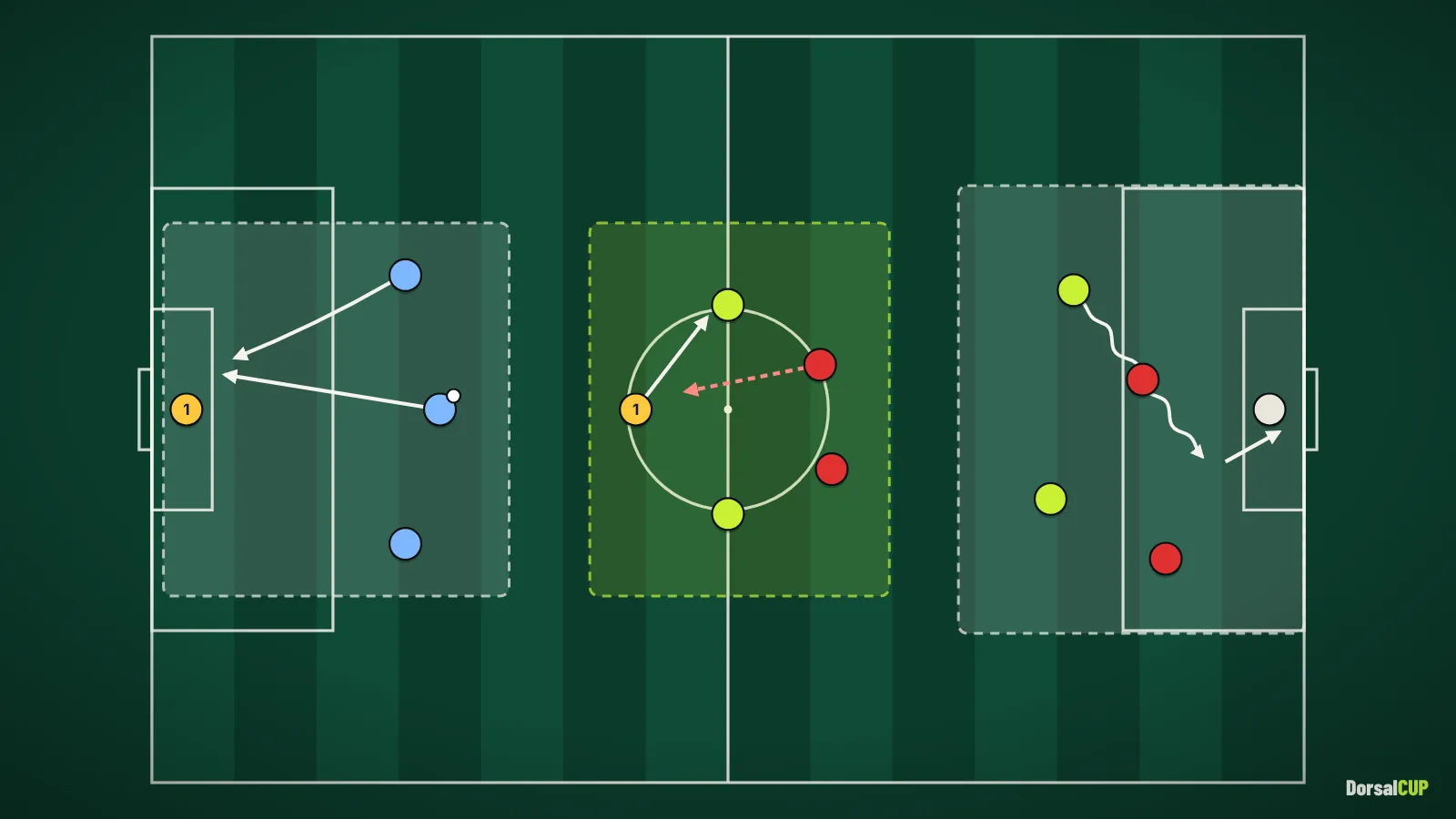
Organisation: the penalty area and the zone up to 30 m. Keeper plus two centre-backs against two forwards. Two gates 4 m wide at the sides 25 m from goal. A server passes back to the keeper; the defending side scores by passing through a gate or dribbling through it; the forwards score in the full-size goal if they win the ball.
Load: 8 attempts per keeper, a minute of rest every 4. Progression: add a third forward and a defending midfielder as an option; then allow the keeper to go long only into a 15 m zone near the halfway line.
Coaching points: open body shape to see both sides; first touch away from the nearest forward; pass to the far foot of the receiver. Common mistake: the keeper receives square-on and has only one option. Correct with a simple cue: "Look before the ball arrives."
Ending a training block with an in-house tournament or a festival with nearby clubs gives players a goal and plenty of minutes. The tournament fixture generator builds the matches and times in minutes, no sign-up, and the formats for 8, 12 and 16 teams help you choose the structure.
Senior block: shot-stopping, crosses and high balls
Senior keepers run the shot-stopping exercise above at higher speed and with deflections (a pole or a player in front), then move to crosses.
Crosses and high balls (15 min)
Organisation: a winger on each side crosses from about 30 m out, wide of the penalty area. Two attackers attack the near and far post; one defender marks. The keeper decides: claim, punch or stay. Alternate sides each repetition.
Load: 3 sets of 8 crosses, 2 min rest. Mix outswinging and inswinging deliveries, and low driven crosses where the keeper must stay or parry.
Coaching points: start position slightly behind the middle of the goal, body open to the field; call early and loudly ("Keeper!"); take off from one leg with the knee up for protection; catch at the highest point. Ask after each cross: "When did you know you were coming?"
Integrating the goalkeeper with the team (30 min)
The second half of the session is where the keeper learns to play football: positioning off the line, communication and decisions when the ball is not coming straight at them.
- U11: a 7v7 game with a sweeper-keeper rule. When the team is attacking, the keeper stands at the edge of the penalty area; a goal scored after the keeper played a pass in the build-up counts double.
- U15: a build-up game, keeper plus back four plus two midfielders against four pressers, with three target gates on the halfway line; then 15 minutes of 11v11 phase play.
- Senior: the team's crossing and finishing practice, with the keeper's decisions on crosses coached as part of the defensive unit.
Coaching points: talk to the defenders before every phase; adjust position each time the ball moves; after a save or catch, look to restart quickly. The goalkeeper should finish the session having touched the ball with the feet as often as with the hands.
How to adapt it
- No goalkeeper coach: two outfield players act as servers for 10 minutes each, rotating. Give them the cue card: shoot after one touch, aim inside the posts, wait until the keeper is set.
- One keeper only: the coach serves in the warm-up and first block; in the second block, use two outfield players as forwards.
- Keepers of different ages together: run the same exercises with different distances. Younger keepers stay at kneeling dives while older keepers dive from standing.
- Small space or indoors: the gate game, handling and kneeling dives work on mats in a sports hall; save crosses for outdoor sessions.
- Two sessions a week: do the shot-stopping block in one and the distribution or crosses block in the other, rather than both every time.
Frequently asked questions
At what age should a child start goalkeeper training?
Goalkeeping begins in 5v5 from U8 in England, so simple handling, footwork and kneeling dives can start then. Structured goalkeeper sessions become more useful in 7v7 from around U10–U11, while children should still play outfield regularly.
How long should a goalkeeper training session be?
A focused block of 30–45 minutes of goalkeeper-specific work is enough in most sessions, followed by time with the team. Quality of repetitions matters more than total time.
How many dives should a keeper do in a session?
There is no official number. As a practical guide, work in sets of 6–8 repetitions with full recovery and stop when technique drops; for young keepers, keep most dives from kneeling or a low squat.
What is a good goalkeeper warm-up before a match?
Handling at different heights, footwork, a few low dives each side, then shots from different angles and some crosses or long balls. It should take 15–20 minutes and finish shortly before kick-off.
Sources
Verified in October 2026. Rules and age groups vary by association and by season; check your local regulations.