
Set-Piece Training in Youth Football: Corners, Free Kicks, Throw-Ins
Set-piece training in youth football often means twenty players standing in the box while one child takes corner after corner. It does not need to. Set pieces can be trained in short waves where every player has a role, inside games through simple scoring rules, and within the heading limits that apply to young players. This 80-minute session for U13 to U17 teams covers throw-ins, attacking and defending corners and wide free kicks, and ends with a game where every restart counts.
Do you organise tournaments? Create yours for free on DorsalCUP.
In this article
Why set pieces deserve a place in youth training
A large share of goals in youth football come from restarts: corners, free kicks near the box, long throw-ins and quick throw-ins that catch a team unprepared. Teams that never practise them concede goals that have nothing to do with how well they play. Yet the opposite mistake is common too: long set-piece sessions with most players standing, and complex routines that 13-year-olds forget by the weekend.
The approach here follows four principles:
- Short blocks, many repetitions. 10–15 minutes per set-piece type, organised in waves so that every player is involved every minute.
- Simple routines, real roles. Two or three corner routines a season are enough; the set-piece routines guide covers how to design them. Every player knows a role: near post, far post, edge of the box, short option, rest defence.
- Set pieces inside games. Scoring rules in small-sided and final games make restarts happen often and matter, without separate drills.
- Within the heading guidance. Deliveries in training are mostly low and driven or played to feet, with heading practice limited as The FA's youth heading guidance requires.
Formats in England: 9v9 at U12–U13 and 11v11 from U14. The session is written for 16 outfield players plus two goalkeepers on a full-size pitch; for U13, use the 9v9 pitch and reduce the numbers in each wave.
| Part | Time | Exercise | Objective |
|---|---|---|---|
| 1 | 0–15 min | Throw-in game 3v2 by the touchline | Quick, safe throw-ins; movement to receive |
| 2 | 15–35 min | Corner waves: attack 6 v defend 5 + GK | Roles, timing of runs, defending the zone |
| 3 | 35–50 min | Wide free kicks and the defensive line | Delivery and line height |
| 4 | 50–75 min | 9v9 / 8v8 game with set-piece rules | Restarts under match pressure |
| 5 | 75–80 min | Cool-down and questions | Review roles |
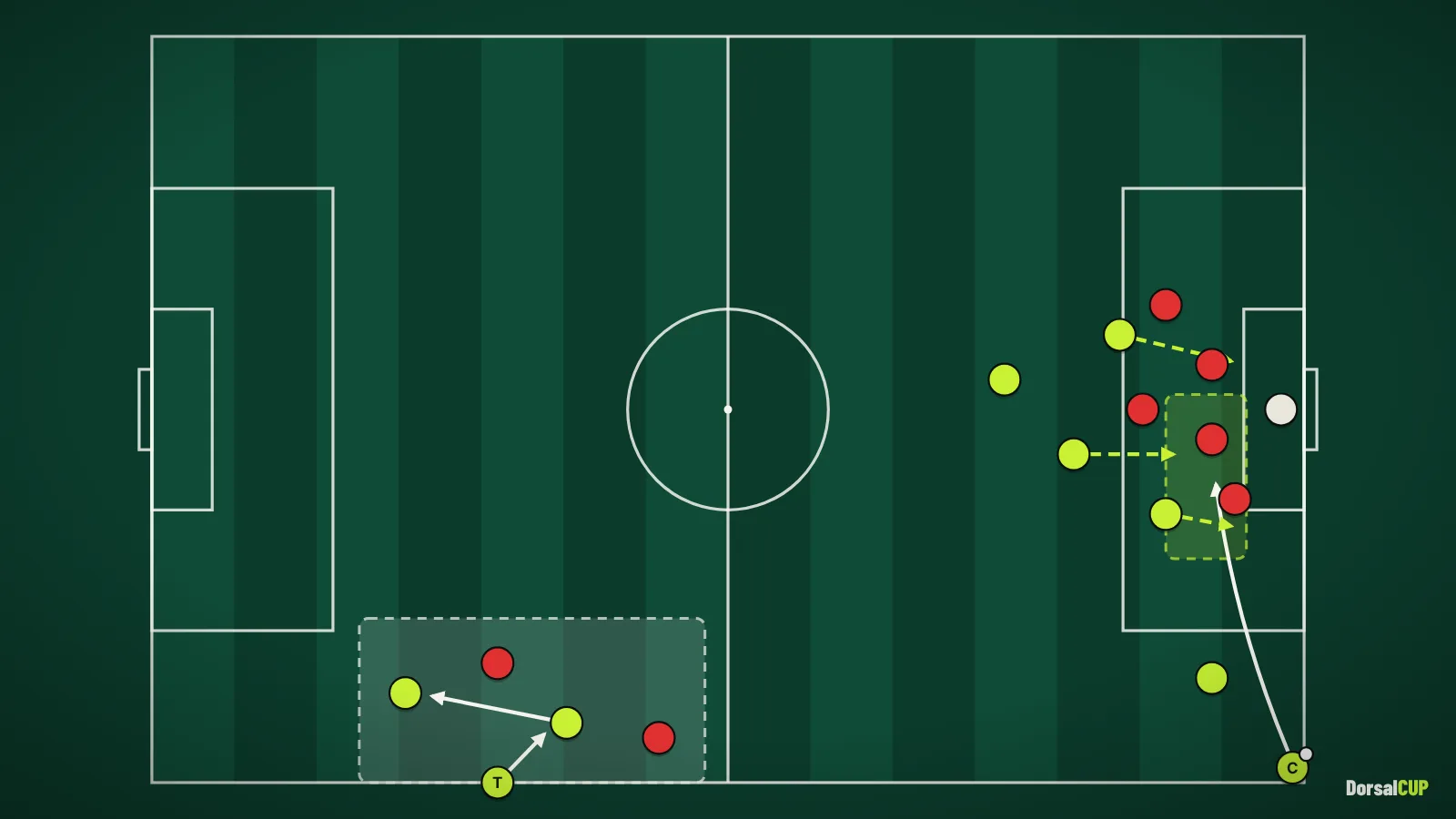
Part 1: throw-in drills, the 3v2 throw-in game (15 min)
Objective: keep the ball after a throw-in. Young teams lose possession from most of their throw-ins because the receivers stand still and the thrower aims at a marked player.
Organisation: two channels along the touchline, 20×15 m each. In each channel, a thrower plus two receivers against two defenders. The attacking team scores by dribbling over the end line or passing to a target player standing on it. After the attack, roles rotate: thrower becomes defender, defenders become receivers.
Load: 6 throws per player as thrower; about 10 minutes of continuous play in two channels, then 5 minutes of competition between channels.
Coaching points: take the throw quickly, before the defence is organised; receivers move away then check back, or the other way round; throw to the feet or the chest of the free receiver, not to the head; the thrower steps back onto the pitch as a passing option. Ask: "Who was free three seconds before the throw?"
Variation for U15–U17: add a long throw option into the box if a player has one, with two attackers and two defenders plus a goalkeeper.
Part 2: corner kick drills in waves (20 min)
Objective: every player learns a role on attacking and defending corners and repeats it often enough to remember it on Saturday.
Organisation: penalty area, a goalkeeper in goal. Attacking unit of six (taker, near post, far post, edge of the box, short option, central runner) against five defenders and the goalkeeper. The other four outfield players wait at the edge of the box as the next group and as rest defence for counter-attacks.
Organisation of the waves: five corners in a row, alternating sides. After each corner, if the defence clears the ball, the attackers have 6 seconds to win it back and shoot; if the defence clears it to the halfway line, they score a point. Then the next attacking group comes on. Each player attacks 10 corners and defends 10.
Deliveries by age: U13 and U14: mostly driven corners at about waist height to the near post or the central zone, and short corners. U15–U17: add inswinging and outswinging deliveries in the air, within the heading limits for the age group.
Defending corners: for U13–U14, a simple mixed system: two or three players in zones (near post, front of the six-yard box) and the rest marking the attackers. For U15–U17, the coach can teach a full zonal or mixed system. In both cases, the first job is to attack the ball, the second to block runs, the third to clear wide and high.
Part 3: free kick training, wide deliveries and the defensive line (15 min)
Objective: deliver wide free kicks into the space between the defensive line and the goalkeeper, and, when defending, hold a line high enough to protect that space.
Organisation: a free kick from 30 m out, wide on the right, then on the left. Five attackers against four defenders plus a goalkeeper. The defenders set their line about 4–6 m in front of the penalty spot; the attackers start in a line and break on the delivery.
Load: 8 free kicks per side, rotating the taker and the attackers. Each delivery is followed by 6 seconds of play.
Coaching points for attackers: start in a line, then stagger the runs so not everyone arrives at once; attack the ball on the move. For defenders: hold the line until the ball is struck, then turn and run with the attackers; the goalkeeper decides early whether to come. Central free kicks: for direct shots, practise wall positioning in 2 minutes at the end: the goalkeeper sets the wall to cover one side of the goal and stands to see the ball.
At tournaments and festivals, what you train during the week shows up in several games in a row. DorsalCUP runs the draw, the schedule and live results for free, and the tournament matchday checklist helps you forget nothing.
Final game with set-piece rules (25 min)
Organisation: 8v8 plus goalkeepers on a 9v9 pitch (about 70×50 m), three periods of 7 minutes. For U13, it is their match format. Rules that make restarts count:
- Every time the ball goes out over the touchline, the throw-in must be taken within 5 seconds. A team that keeps the ball for 5 passes after a throw-in scores a bonus point.
- Every ball out over the goal line becomes a corner for the attacking team, whoever touched it last. More corners, more practice.
- After each goal, the team that conceded takes a corner, then play continues.
- A goal from a corner or a wide free kick counts double.
Coaching points: players take their roles from Part 2 without being told; the defending team organises before the kick, with one voice (usually the goalkeeper or a centre-back). Between periods, ask two questions: "Who was your marker on the last corner?" and "Where was the space on our throw-ins?"
Cool-down (5 min): easy jog, mobility, and a quick check that every player knows their role on attacking and defending corners.
Common mistakes and how to adapt
- Twenty players watching one taker. Organise waves, give the waiting players a job (next group, rest defence, collecting balls), and rotate takers.
- Too many routines. Two attacking corners, one short option, one wide free kick. Repeat them until they are automatic.
- Only the tallest players attack the ball. In youth football, timing and desire matter more than height. Everyone learns every role.
- Ignoring rest defence. Leave two players outside the box on attacking corners; it is where counter-attacks begin.
- Too much heading. Keep within the guidance, use low deliveries, and do heading practice with soft, correctly inflated balls.
By age: U13 on 9v9: shorter deliveries, more short corners, three attackers in the box. U14–U15: introduce one zonal player and one blocker. U16–U17: full routines, opposition-specific adjustments the week before a match.
Short of time: use only Part 4, the game with set-piece rules, once a week. It covers most of the learning in a format players enjoy.
Frequently asked questions
How do you train set pieces in youth football without wasting time?
Use short blocks of 10–15 minutes organised in waves, so every player attacks and defends many times. Add set-piece scoring rules to the final game so restarts happen often and matter.
How many corner routines should a youth team have?
Two or three are enough for a season: one to the near post, one to the central zone and one short option. Players should know their role in each one.
Can youth players practise heading at set pieces?
Only within The FA's youth heading guidance, which limits heading practice in training for U12 to U18 and excludes it for younger players. Most set-piece work can be done with low or driven deliveries.
How should a 9v9 team defend corners?
A simple mixed system works well: one or two players defending zones at the near post and in front of the six-yard box, the rest marking the attackers, and one player outside the box for clearances.
Sources
Verified in October 2026. Rules and age groups vary by association and by season; check your local regulations.