
Football Drills for 7 Year Olds: U8–U9 Dribbling and 1v1 Session
These football drills for 7 year olds and 8 year olds build one session around the 1v1: beating a defender, protecting the ball and finishing the move with a shot. The plan lasts 70 minutes, suits a U8 or U9 squad of 8–12 players, and finishes with a 5v5 game in the match format these age groups play in England.
Do you organise tournaments? Create yours for free on DorsalCUP.
In this article
Football drills for 7 year olds: session overview
Group: U8–U9 (school Years 3 and 4, players aged seven and eight). Numbers: 8–12 players, one or two coaches. Kit: one size 3 ball per player, 30 discs, one full-size 5v5 goal (12×6 ft), two to four mini-goals, bibs. Space: a 5v5 pitch of about 37×27 m plus a strip beside it. Duration: 70 minutes.
Objective: dribbling to beat an opponent, protecting the ball, and finishing with a shot after a 1v1. The 1v1 is the base unit of the game. At seven and eight, children's coordination improves quickly and they can start to combine speed with control, but most still see the game from the ball outwards. Training the 1v1 matches where they are: it rewards bravery with the ball and teaches the timing that later makes passing work (a pass is most useful after a defender has been drawn in).
Volumes stay short. Each 1v1 lasts a few seconds and needs a short recovery; work-to-rest of roughly 1:2 keeps quality high. Long, flat lines in front of a goal are the main enemy at this age: every exercise below runs in parallel so children play rather than wait.
| Part | Time | Activity | Objective |
|---|---|---|---|
| Warm-up | 0–10 min | Copy the leader | Ball control, change of direction |
| Exercise 1 | 10–25 min | 1v1 channels | Beat a defender, protect the ball |
| Exercise 2 | 25–42 min | 1v1 to goal with finishing | Finish after a 1v1 |
| Final game | 42–66 min | 5v5 with a dribble bonus | Use the 1v1 in the game |
| Close | 66–70 min | Questions, stretch | Recall the key ideas |
Warm-up: copy the leader
- Box of 20×20 m. Players in pairs, one ball each. The leader dribbles freely, changing direction, speed and foot; the follower copies from 2–3 m behind.
- Blocks of 45 seconds, then swap. Four to six blocks with short pauses.
- Add a turn every block: drag-back, inside hook, outside hook, step-over and go.
Coaching points: small touches before the change of direction, a bigger touch to accelerate after it. Ask the leader: 'how can you lose your follower?' The answer (sudden change of speed) is exactly what beats a defender later. Easier: leaders walk the first block. Harder: the follower tries to stay close enough to touch the leader's shoulder.
Exercise 1: 1v1 channels
Organisation
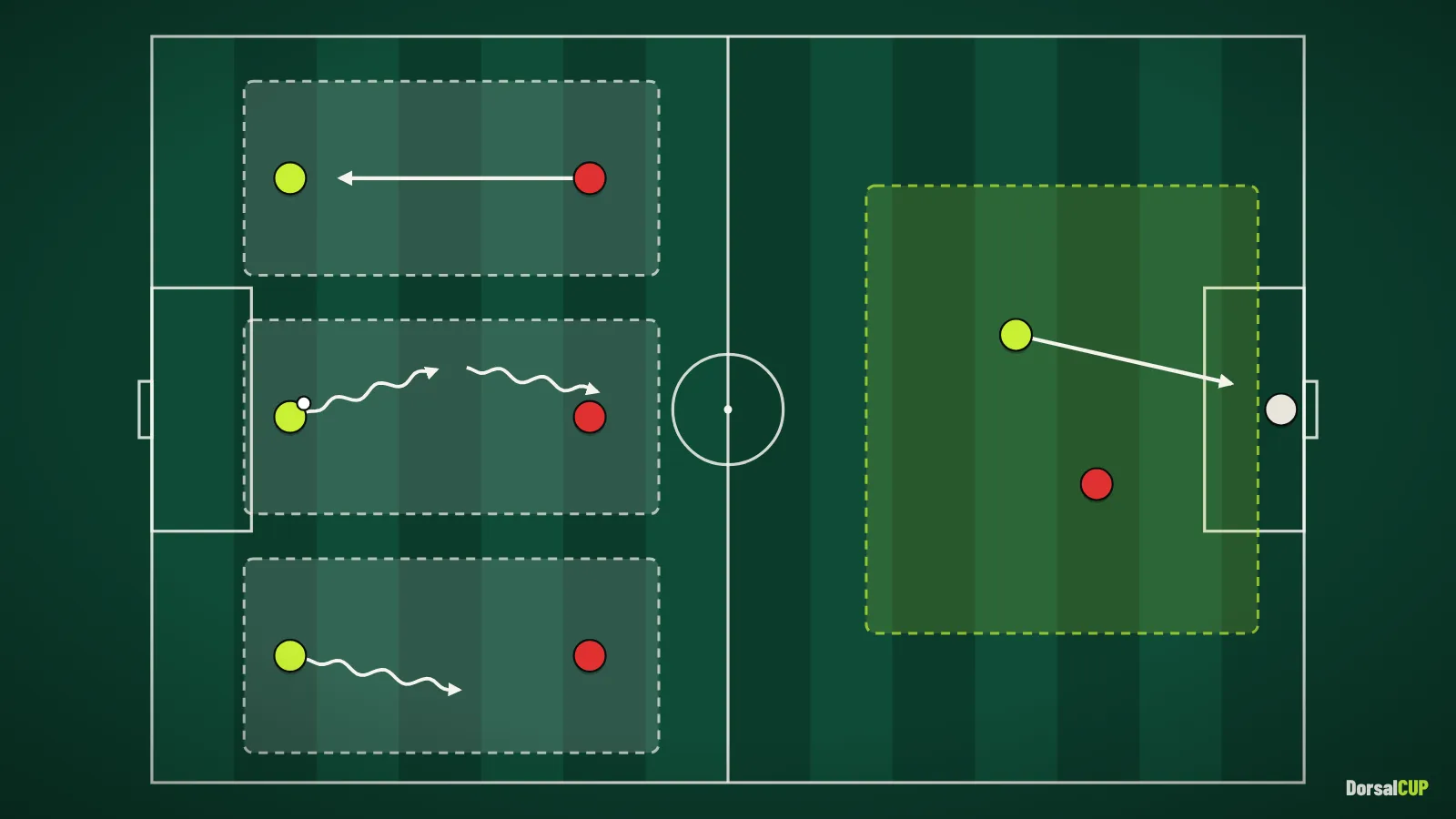
- Three or four channels of 10×15 m, one pair per channel, with players waiting at the ends (no more than two per channel).
- The defender passes to the attacker on the opposite line and closes down. The attacker scores by stopping the ball with the sole on the defender's line.
- If the defender wins the ball, they can score by stopping it on the attacker's line.
- Each duel lasts up to 10 seconds. Five duels each as attacker, then swap roles. Two or three rotations, changing opponents.
Variants
- Easier: the defender must start by touching a cone 3 m behind them, giving the attacker time to approach.
- Harder: narrow the channel to 8 m, or the attacker scores by dribbling through one of two 2 m gates on the line instead of anywhere on it.
Coaching points
- Attack the defender quickly with the ball close, then slow down just before them. The change of speed creates the moment to go past.
- Use the body: shoulder between the defender and the ball when they get close.
- After beating the defender, take a bigger touch into space so they cannot recover.
- Ask: 'did you go past on the side where the defender had more space or less space?'
Common mistakes: running straight into the defender without changing speed, or too many touches when the defender is still far away. A useful prompt: 'go fast while they are far, be clever when they are close'.
Exercise 2: 1v1 to goal with finishing
This exercise links the 1v1 to the finish. It also introduces the idea that losing the ball means having to defend straight away.
Organisation
- Area 20 m wide and 25 m deep in front of the 5v5 goal, with a goalkeeper. Two mini-goals on the line furthest from goal.
- Attackers line up on one side, defenders on the other (maximum three per line; with more players, set up a second goal).
- The coach passes to the attacker, who attacks the goal. The defender starts on the opposite side and can chase as soon as the pass is played.
- If the defender wins the ball, they score in either mini-goal. Rotate: attacker becomes defender, defender joins the attacking line. Goalkeeper changes every three minutes.
- Two blocks of 7 minutes with a 2-minute drink break.
Variants
- Easier: the defender starts 3 m further back, so the attacker has time to shoot.
- Harder: 2v1 with a second attacker joining from behind; the ball carrier decides whether to go alone or pass.
Coaching points
- Look at the goalkeeper before the shot: is there more space at the near or far post?
- Shoot early if the defender is closing; dribble past the goalkeeper only if there is time.
- Low, placed shots with the inside of the foot or the laces, not the toe.
- Defenders: get goal-side quickly and slow the attacker down rather than diving in.
At tournaments and festivals, what you train during the week shows up in several games in a row. DorsalCUP runs the draw, the schedule and live results for free, and the tournament matchday checklist helps you forget nothing.
Final game: 5v5 with a dribble bonus
U8 and U9 teams in England play 5v5 matches (four outfield players and a goalkeeper) on pitches of about 37×27 m with 12×6 ft goals. The final game uses that format with one condition that rewards the theme of the session.
- Two teams of five; with more players, play two smaller games (4v4 to mini-goals) side by side or rotate a team every 4 minutes.
- A goal counts double if the scorer, or the player who passed to them, beat an opponent with a dribble in the move.
- Restarts from the touchline by pass or dribble. Goalkeeper restarts with a pass or a dribble, no long kicks.
- Three games of 6 minutes with 2 minutes' rest; change the goalkeeper each game.
Coaching points
- When you have space in front of you, carry the ball forward. When a defender comes, decide: go past or pass.
- Team-mates spread out so the 1v1 has room to happen. Ask: 'if everyone is near the ball, where is the space to dribble?'
- Freeze the game no more than twice. Use questions, not lectures.
What to look for
Watch three things during the game and note them for the next session. First, how many children try a 1v1 at all: if only the two most confident players dribble, the bonus is not enough, so make the dribble goal worth three. Second, where the duels happen: a 1v1 near the opponent's goal is worth the risk, a 1v1 in front of your own goalkeeper usually is not, and eight-year-olds can start to feel that difference if the coach asks about it after the game. Third, what happens straight after a loss of the ball: the player who lost it should be the first to try to win it back. Praise that reaction as much as the goals.
For more small-sided formats that fit this age group, see small-sided games; for the step before this session, see the U7 session plan.
How to adapt the session
- One coach: run Exercise 1 and the warm-up yourself; in Exercise 2, a parent can serve the balls while you coach the defenders. Keep the channels next to the goal so you see both.
- More players (14–20): six channels in Exercise 1, two goals in Exercise 2, and two 5v5 games at the end.
- Little space: channels of 8×12 m; replace Exercise 2 with 1v1 to two mini-goals in each channel.
- Mixed abilities: in the channels, rotate opponents so the strongest meet each other and the less confident get early success. In the final game, a player who has not scored can score with a shot from anywhere.
- Nervous children: start them as attackers against a passive defender who may only shadow, not tackle, for the first two duels.
If players are 8 and starting to pass more, the session that follows this one in the series moves the focus from the dribble to passing and receiving at U10.
Frequently asked questions
What are good football drills for 7 year olds?
Ball mastery in a box, tag games with the ball, 1v1 and 2v1 duels in small channels, and small-sided games of 3v3 to 5v5. Each activity should keep every child active, with no more than two players waiting at any time.
How do you teach a 7 year old to beat a defender?
Use short 1v1 duels where the attacker must change speed or direction to score. Show one simple move (for example a drag-back or a hook), then let them try it under pressure. Praise the attempt, and ask where the space was after they went past.
How many players are on a U8 and U9 team in England?
U8 and U9 play 5v5, with four outfield players and a goalkeeper, on pitches of about 37×27 m. Check your league handbook for local rules on match length, retreat lines and restarts.
Should every child play in goal at U8 and U9?
Yes. Rotating the goalkeeper gives every child experience of the position and helps outfield players understand finishing. Specialisation can wait until later age groups.
How long should training be for 8 year olds?
About 60 to 75 minutes is enough, with drinks breaks every 15–20 minutes. Keep each activity to 10–15 minutes and finish with a game.
Sources
Verified in October 2026. Rules and age groups vary by association and by season; check your local regulations.