
Football Drills for 6 Year Olds: A Complete U7 Session Plan
Good football drills for 6 year olds share three features: every child has a ball or is one pass away from it, nobody stands in a queue, and the session ends with a real game. This U7 session plan runs for 60 minutes (with a 45-minute version) and moves from ball mastery to chasing games, 2v2 to mini-goals and a 3v3 festival in the format the FA uses for U7 from 2026/27.
Do you organise tournaments? Create yours for free on DorsalCUP.
In this article
The session at a glance
Group: U7 (school Year 2, most players aged six; the same plan works for five-year-olds in a U6 or 'mini kickers' group). Numbers: 8–12 players, one or two coaches. Kit: one size 3 ball per child, 30–40 flat discs, four to six mini-goals, bibs in two colours. Space: about 30×40 m of grass or artificial turf. Duration: 60 minutes, including two drinks breaks.
Objective: lots of touches with both feet, changes of direction and speed with the ball, and the first decisions of the game: keep the ball, beat a player, score. At this age children are still largely egocentric in play; they want the ball for themselves, and that is normal. The session does not try to force passing patterns. It builds confidence on the ball and lets cooperation appear through small numbers, where a pass becomes the obvious solution.
Physically, six-year-olds tire quickly and recover quickly. Short, intermittent activity with frequent changes suits them far better than long continuous exercises. Attention spans are short too, so explanations stay under 30 seconds and each activity lasts 8–12 minutes.
| Part | Time | Activity | Objective |
|---|---|---|---|
| Arrival | 0–8 min | Busy bees (ball mastery box) | Touches, both feet, heads up |
| Chasing games | 8–24 min | Tail tag with a ball; gates game | Change of direction and speed |
| Main game | 24–36 min | 2v2 to four mini-goals | Beat a player, choose a goal |
| Final game | 36–56 min | 3v3 festival | Play the real game, score |
| Close | 56–60 min | Questions and high fives | Recall one idea |
Arrival and warm-up: busy bees
The first activity starts as soon as the first child arrives. Each player takes a ball into a 20×20 m box and dribbles freely. Latecomers join without any explanation needed.
Organisation and rules
- Box of 20×20 m marked with four corner discs; 8–12 players, one ball each.
- Children dribble anywhere in the box without touching another ball.
- The coach calls a challenge every 20–30 seconds: 'only your left foot', 'sole of the foot', 'stop the ball with your bottom', 'touch four corners', 'freeze when I clap'.
- Two blocks of 3 minutes with a short drink in between.
Variants
- Easier: a bigger box; the coach demonstrates each challenge first.
- Harder: shrink the box to 15×15 m; 'how many fingers am I showing?' to force heads up while dribbling.
Coaching points
- Small touches keep the ball close: 'can you keep the ball near enough to touch it with your foot at every step?'
- Look up between touches: ask questions that can only be answered by looking at the coach.
- Use both feet and different surfaces; praise attempts with the weaker foot rather than success.
Common mistake: kicking the ball far ahead and chasing it. Correct it with the 'freeze' call: children who can stop the ball within one step of the call are winning.
Chasing games with the ball
Chasing games give the children something they already understand (tag) and add the ball. They produce changes of direction, accelerations and quick looks around without the coach having to teach them.
Tail tag with a ball (8 minutes)
- Area 25×20 m; every child has a ball and a bib tucked into the back of the shorts as a tail.
- Two catchers, also dribbling, try to pull tails. Catchers change every 60–90 seconds.
- A child who loses a tail is not eliminated: they dribble to the coach's cone, do a skill (for example, three sole rolls) and take the tail back.
- Four rounds of about 90 seconds with 30 seconds' rest.
Easier: catchers play without a ball. Harder: catchers have a ball and players must keep their own ball to stay 'alive'. Ask: 'where is the space away from the catchers?' and 'what can you do with the ball to escape quickly?'
Gates game (8 minutes)
- Area 25×25 m with eight gates of 2 m made with discs.
- Each player dribbles through as many gates as possible in 60 seconds, counting out loud. The same gate cannot be used twice in a row.
- Rounds of 60 seconds, 30 seconds' rest; children try to beat their own score.
- From round three, two defenders without a ball 'guard' gates by standing in them. Attackers must find a free gate.
Coaching points: look for the next gate before passing through the current one; slow down to turn, speed up after the gate. Common mistake: queues at one gate. Stop the game and ask 'which gate is free?'. The answer is the point of the exercise.
Football drills for 6 year olds: 2v2 to mini-goals
After the individual work, opponents and a team-mate appear. 2v2 is the smallest game that contains every basic decision: dribble or pass, attack or defend, which goal to choose. With four goals the ball carrier always has an option, which keeps the game flowing at an age where most children see only the ball.
Organisation and rules
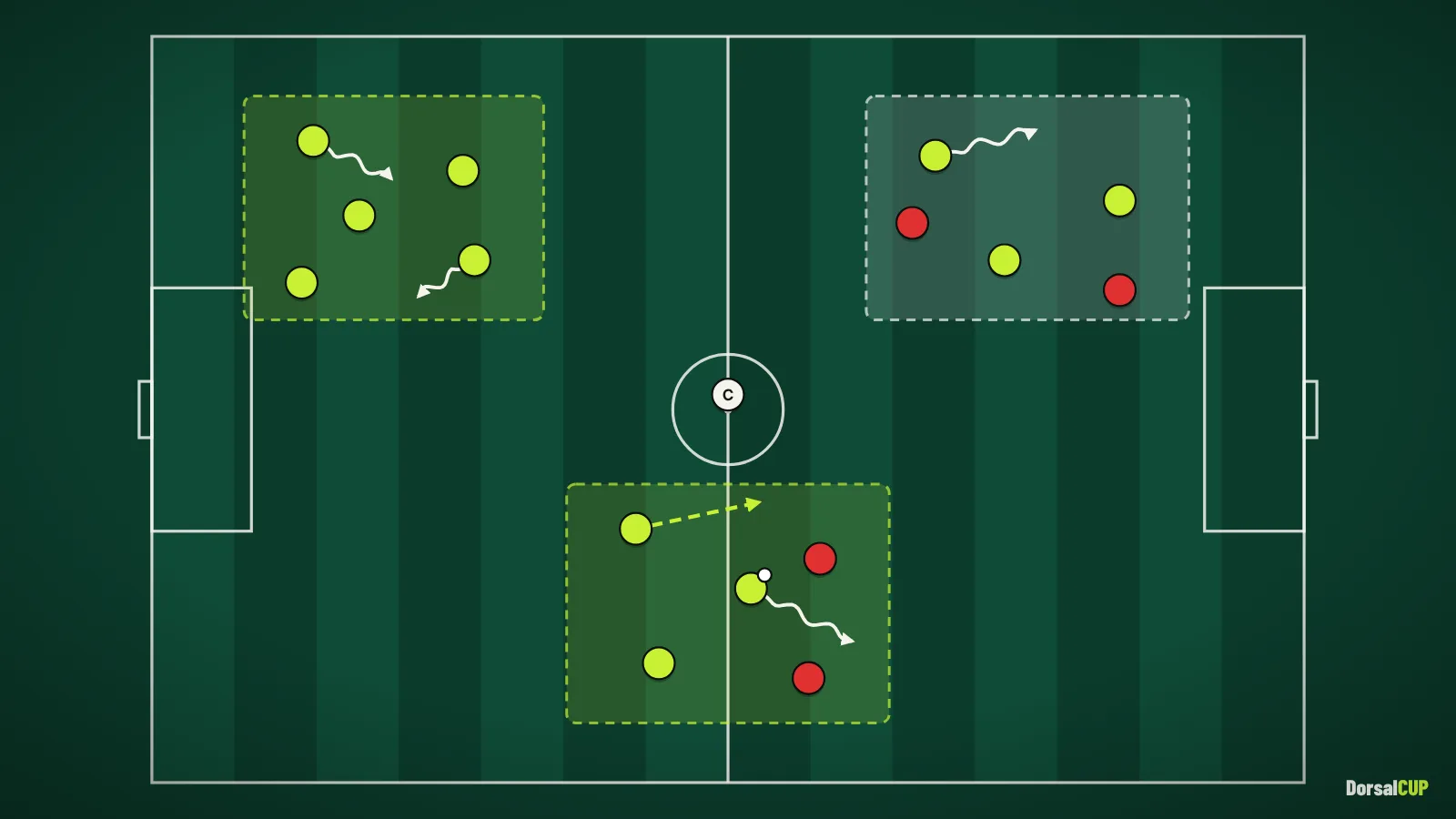
- Pitch of 15×20 m with two mini-goals on each end line, 10 m apart. Teams of two; with 12 players, run three pitches side by side.
- Each team attacks two goals and defends two. No goalkeepers.
- Restart from the end line by dribbling in; opponents step back three big steps (about 3 m).
- Games of 3 minutes, then rotate opponents. Three or four rounds; 30–45 seconds' break between games while the coach changes the pairings.
Variants
- Easier: 2v1, with the coach rotating the defender every minute. Or a goal counts double after a dribble past a player.
- Harder: goals only count if the player shoots before the ball crosses a line 4 m from goal, so attackers have to get past the defender earlier.
Coaching points
- 'Which goal has nobody in front of it?' — scanning for the free target is the first tactical decision.
- Run at the defender with the ball close, then change direction or speed when they get near.
- Without the ball, the team-mate moves to a place where the ball carrier can see them. Do not script it; praise it when it happens.
- When the ball is lost, try to win it back straight away rather than stopping to complain.
Common mistakes: both players chasing the ball in the same spot. Ask 'if your friend has the ball, where could you go to help?'. Children also tend to shoot from too far; the 4 m line variant fixes this without instruction.
Ending a training block with an in-house tournament or a festival with nearby clubs gives players a goal and plenty of minutes. The tournament fixture generator builds the matches and times in minutes, no sign-up, and the formats for 8, 12 and 16 teams help you choose the structure.
Final game: 3v3 festival
From the 2026/27 season the FA uses 3v3 as the match format at U7, with no goalkeepers, games of six to ten minutes, dribble or pass restarts and no heading. Training the same format means children rehearse exactly what they will meet on match day. Check your league's handbook for local details.
Organisation and rules
- Two (or more) pitches of 15×20 m. The FA's 3v3 guidance allows pitches from 10×15 m to 15×20 m with goals of about 120×75 cm.
- No goalkeepers. Every restart is a dribble or pass in; opponents keep 3 m away. After a goal, the team that conceded restarts from its goal line.
- Games of 6–8 minutes. After each game, winners move one pitch to the left and losers one to the right, so opponents keep changing and close games become more likely.
- No substitutes on the pitch: with an odd number, the extra player joins the team that is losing or plays as a neutral for both teams.
Coaching points
- Let the game be the teacher. Stop it no more than once per game and only for a 10-second question.
- Encourage the player without the ball to spread out: 'if all three of you are next to the ball, who can receive it?'
- Praise brave actions (a dribble, a shot, a tackle) more than results.
Adapting the session
- More players (14–20): add a third and fourth 3v3 pitch, and run the chasing games in two areas. With one coach, see the ideas below.
- One coach only: set up all areas in a line so you can see everything from one point. Use parents as 'pitch facilitators' for the 3v3 (the FA's model uses one adult per pitch), with one instruction: keep the ball in play and do not coach from the side.
- Little space: shrink the boxes by 5 m and remove the gates game. The 2v2 and 3v3 can share one 20×25 m area divided into two pitches.
- Mixed abilities: in the 2v2, pair a confident child with a less confident one, or match equal pairs so every game is close. Both work; change it from week to week.
- 45-minute version: busy bees (6 min), tail tag (8 min), 2v2 (10 min), 3v3 festival (18 min), close (3 min).
Keep the closing minutes short. Ask one question ('when did you use your left foot today?') and finish with high fives. For more ideas for this age range, see the football warm-up drills with a ball and the next stage of this series, the U8–U9 session.
Frequently asked questions
What football drills are good for 5 and 6 year olds?
Drills where every child has a ball and nobody waits: ball mastery boxes, tag games with the ball, gates games and very small games such as 1v1, 2v2 and 3v3 to mini-goals. Avoid drills with lines, laps or long explanations. Each activity should last 8–12 minutes.
How long should a U7 football session be?
45 to 60 minutes is enough. Short, intermittent activities with frequent drinks breaks match the attention and energy of five and six-year-olds. More than an hour usually adds tired, distracted children rather than learning.
Is U7 football 3v3 or 5v5 in England?
From the 2026/27 season the FA introduces 3v3 as the match format at U7, without goalkeepers, with 5v5 at U8 and U9. Local leagues set some details, so check your league or county FA handbook.
Should 6 year olds be taught to pass?
Yes, but through the game rather than through passing drills in pairs. In 2v2 and 3v3 a pass becomes useful naturally; the coach praises it and asks questions about it. Dribbling confidence comes first at this age.
Sources
Verified in October 2026. Rules and age groups vary by association and by season; check your local regulations.