
Veterans Football Training Session: A Safe 75-Minute Plan
A good veterans football training session is built around one aim: everyone plays on Sunday and turns up again next week. That means a warm-up that is longer and more structured than in a youth team, technical work that raises the heart rate gradually, no flat-out sprints before the body is ready, and a game at the end that is competitive but controlled. This 75-minute plan for 14–18 adult players covers each block, the rules that keep it safe, and how to adapt it when numbers or fitness levels vary.
Do you organise tournaments? Create yours for free on DorsalCUP.
In this article
Who this veterans football training session is for
The plan is written for a veterans or recreational adult squad: players aged roughly 35 to 60, one training night a week, a game at the weekend, a mix of former semi-pro players and people who came back to football after ten years off. The usual numbers are 14–18 players, one coach (often a player-coach) and half of a full-size 3G or grass pitch for 75 minutes.
The priorities are different from those of a youth or first team. Older players do not lose the game; they lose elastic power, tendon tolerance and recovery speed. Calf, hamstring and Achilles problems tend to appear in the first explosive actions of the evening or late in a session when fatigue reduces control. A sensible session therefore raises intensity in steps, places the hardest work in the middle, and keeps the volume of maximal sprinting low and controlled.
- Players: 14–18 adults, two goalkeepers if possible.
- Space: half a full-size pitch, or a 60×40 m 3G area.
- Equipment: 15 balls, 30 cones, 8 bibs in two colours, two full-size or portable goals.
- Duration: 75 minutes, of which about 25 minutes is game play.
- Objective: sharp passing and receiving, keeping the ball under light pressure, finishing, and a controlled game, without unnecessary injury risk.
| Part | Time | Activity | Objective |
|---|---|---|---|
| 1 | 0–18 min | Structured warm-up (FIFA 11+ based) | Raise temperature, prepare calves, hamstrings, groin |
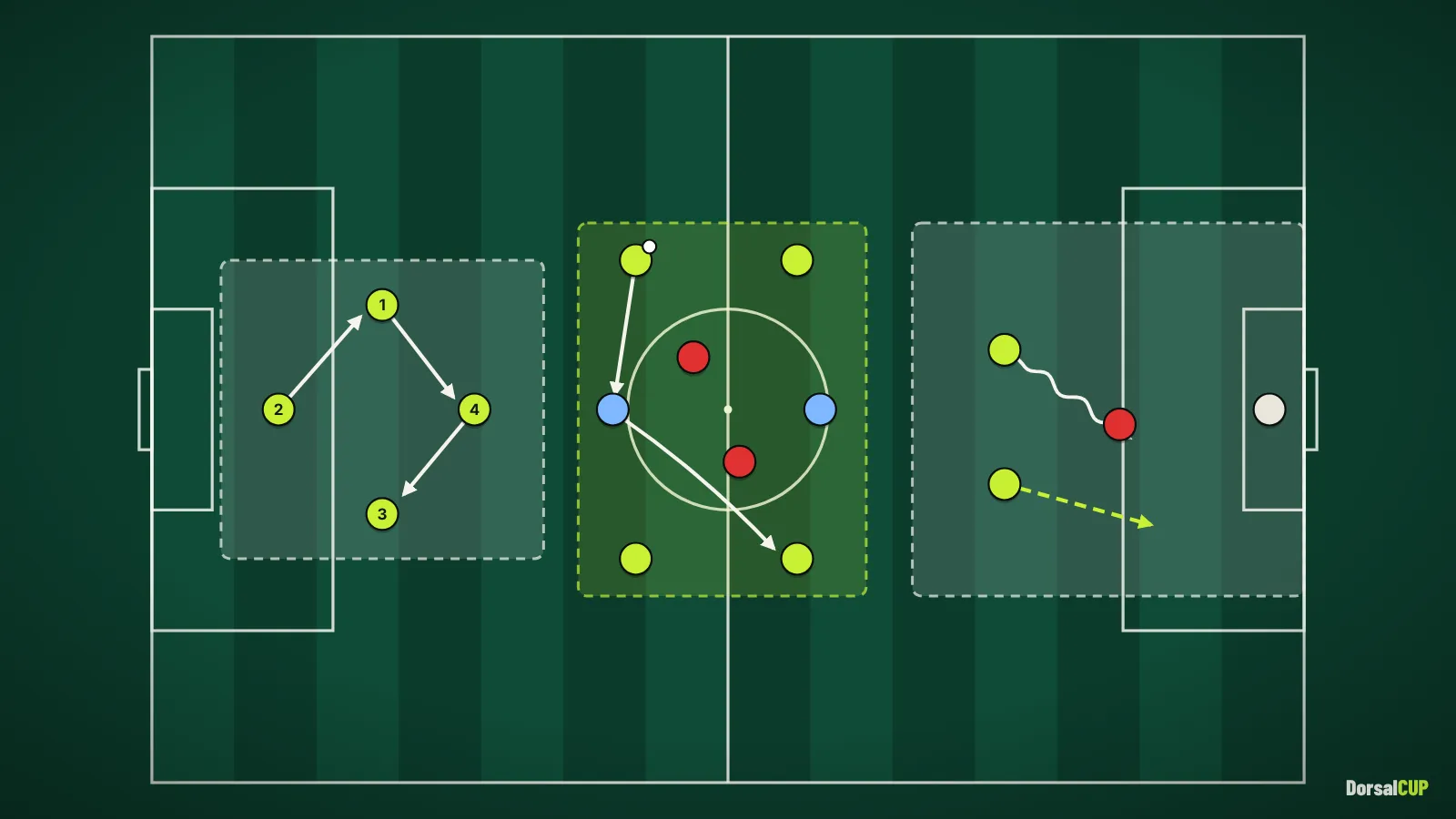
| 2 | 18–30 min | Passing diamond with movement | Quality of first touch, rhythm, gradual intensity |
| 3 | 30–44 min | 4v4+2 possession box | Support angles, scanning, pressing as a group |
| 4 | 44–56 min | 2v1 finishing waves | Decision in the final third, finishing |
| 5 | 56–72 min | 7v7 game with goalkeepers | Apply the session in a controlled match |
| 6 | 72–75 min | Cool-down and feedback | Walk, light mobility, fluids |
Part 1: a structured warm-up for over-35s (18 min)
The warm-up is the most important part of a veterans session and the one most often rushed. Use a structure based on the FIFA 11+, a warm-up programme for players aged 14 and over with three parts: running at slow speed with active stretching and controlled partner contacts, strength, plyometric and balance exercises with several levels of difficulty, and running at higher speed with changes of direction. Trials in amateur players reported fewer injuries in teams that used it regularly; the benefit depends on doing it consistently, twice a week or more where possible.
Organisation: two lines of six cones, 20 m long and 5 m apart. Players work in pairs, one pair per lane, jogging out and back.
- Running (7 min): straight jog; hip out; hip in; circling partner; shoulder-to-shoulder contact jump; quick forwards and backwards. Each out and back twice.
- Strength and balance (8 min): plank and side plank (2×20 s each side); Nordic hamstring lowers, 3–5 slow reps with a partner holding the ankles; single-leg stance passing a ball with a partner, 2×30 s each leg; squats to a comfortable depth, 2×10.
- Running (3 min): run across the pitch at about 75–80% of maximum speed; bounding; plant-and-cut. No full sprints yet.
Coaching points: knees stay over the toes in squats and landings; the hip does not drop in single-leg work; Nordics are lowered slowly and stopped when control is lost. Players who arrive late do the full warm-up before joining in. That rule is non-negotiable and should be agreed with the group at the start of the season, not argued about on the night.
Common mistakes: static stretching for long periods before playing, which does little to prepare muscles for sprinting; shooting at the goalkeeper at full power in the first five minutes; and skipping the third part, which is the one that prepares the body for sudden accelerations.
Part 2: passing diamond with movement (12 min)
Objective: good first touch and accurate passing with a steady rise in heart rate. This is also where the coach sets the technical standard for the evening.
Organisation: a 20×20 m diamond with one cone at each point. Four to five players per diamond; with 16 players, run three or four diamonds side by side. Two players start at the bottom cone with the ball.
- Pass and follow: the ball goes around the diamond, each player runs to the cone they passed to. 3 min each direction.
- Wall pass at the left and right cones: the receiver bounces the ball back with one touch, receives the return on the half-turn and plays forward. 3 min.
- Third-man pattern: bottom plays to top, top lays off to the side cone, side plays forward into the run of the player who started. 3 min.
Load: continuous at moderate pace, 30 s drink break between variations. The running between cones is short, so no-one is sprinting yet.
Coaching points: receive with the foot furthest from the ball; open the body before the ball arrives; pass to the correct foot; call the name. Ask: "Where do you want to play next before you receive?"
Make it easier: two touches allowed, larger diamond. Make it harder: one touch only, a passive defender in the middle, two balls in circulation.
Part 3: 4v4+2 possession box (14 min)
Objective: keep the ball under pressure, create passing angles and press as a small unit. This is the most intense block of the session and sits in the middle, when everyone is warm.
Organisation: a 25×20 m box. Two teams of four plus two neutrals who play with the team in possession, one at each end line. With 16–18 players, run two boxes; spare players rotate in as neutrals.
Rules: the team in possession scores a point for 8 consecutive passes or for a pass from one end-neutral to the other through the team. Two-touch maximum for neutrals. No slide tackles and no tackles from behind. Restart from the coach at the side when the ball leaves the area.
Load: 4 × 3 min work, 2 min rest. Walk and drink during the rest. Rest periods are deliberately longer than for a youth or first team; recovery between efforts is where veterans gain most from good planning.
Coaching points: in possession, the players without the ball move to create a triangle with the ball carrier; scan before receiving; play away from pressure. Out of possession, press in twos: the nearest player closes, the second covers the inside pass. Ask: "Who is free when they press you?"
Common mistakes: everyone standing on the edge of the box, so the ball goes around the outside; and one player chasing alone. Freeze the play once or twice to show the gap between the two pressing players.
Variations: easier: 4v4+3 with a central neutral. Harder: three-touch limit for all, or the point only counts after a split pass between two defenders.
Ending a training block with an in-house tournament or a festival with nearby clubs gives players a goal and plenty of minutes. The tournament fixture generator builds the matches and times in minutes, no sign-up, and the formats for 8, 12 and 16 teams help you choose the structure.
Part 4: 2v1 finishing waves (12 min)
Objective: a clear decision in front of goal (shoot, pass or dribble) and calm finishing. Short, repeated, game-like actions with built-in recovery.
Organisation: the attacking third, one goalkeeper in a full-size goal. Attackers in two queues 30 m from goal; defenders in one queue by the post. The defender passes to one attacker and steps out to defend. The attack has 8 seconds to finish. Then the next wave starts from the other side.
Load: around 10 actions per player, 6–8 s each, with at least 40 s between actions because of the queues. That is plenty for the hamstrings.
Coaching points: the ball carrier runs at the inside shoulder of the defender to fix him; the second attacker holds width and times the run to stay onside; the finish is placed, not blasted. Ask: "What was the defender doing when you decided to pass?"
Variations: 3v2 with a recovering defender from the halfway line; finish with one touch only; goalkeeper starts the action by throwing to an attacker.
Final game and cool-down
7v7 with goalkeepers (16 min)
A 7v7 game on a 50×35 m pitch with goalkeepers, two halves of 7 minutes with a 2-minute break. With 18 players, play 8v8 on a slightly bigger area or use rolling substitutions. Rules: no slide tackles; a goal scored after the team has played through the middle third counts double; normal throw-ins.
Coaching points: the referee (coach) blows early for late challenges. In veterans football, the standard on the night shapes the standard on Sunday. Encourage the team to keep the ball rather than play long and chase.
Cool-down and feedback (3 min)
Two minutes of walking and gentle jogging, light calf and hamstring mobility, and fluids. One sentence of feedback from the coach and one question to the group: what worked in the possession game? A cool-down does not prevent soreness on its own, but it gives the coach a moment to spot anyone limping before they go home and play on Sunday.
How to adapt the session
- 10–12 players: one diamond, 4v4+2 with all remaining players as neutrals rotating every 3 min, 5v5 final game on 40×30 m.
- 20+ players: three diamonds, two possession boxes, finishing on both goals, and two final games across the pitch.
- One coach who also plays: set up all areas before the session. Appoint one experienced player to lead each warm-up lane. The coach plays in the final game only.
- Mixed fitness levels: in the possession box, the fitter players can be the team without the ball for longer, or play with a three-touch limit while the others play free. In the final game, the coach controls the tempo with rolling substitutions rather than asking anyone to sit out for long.
- Returning from injury: warm-up, passing diamond and finishing as a server only; no possession game or final game until back to full training on a graded plan.
- Wet or cold night: extend the running part of the warm-up by 3–4 minutes, keep the ball on the ground and shorten the rest in the possession box only if players are getting cold.
Frequently asked questions
How often should veterans footballers train?
One structured session a week plus the match is enough for most veterans squads. A second short session of strength or mobility work at home, or the FIFA 11+ strength part done twice a week, helps tendons and muscles cope with match demands.
What warm-up should over-35s do before football?
A structured warm-up of 15–20 minutes, such as one based on the FIFA 11+: slow running with movement drills, strength and balance work, then faster runs and changes of direction. It should finish with short accelerations before the first sprint of the game.
Should veterans do static stretching before football?
Long static stretches are better kept for after the session or for separate mobility work. Before playing, dynamic movements, running drills and progressive accelerations are more useful.
How can veterans avoid calf and hamstring injuries?
Warm up fully every time, avoid flat-out sprints until the end of the warm-up, include eccentric work such as Nordic hamstring lowers in small volumes, and leave enough rest between intense efforts. Players with recurring problems should get individual advice from a physiotherapist.
Sources
Verified in October 2026. Rules and age groups vary by association and by season; check your local regulations.