
Semi-automated offside, VAR and goal-line technology explained
Semi-automated offside technology, VAR and goal-line technology answer different questions. Goal-line technology tells the referee within a second whether the ball crossed the line. VAR lets video officials check a small set of match-changing decisions. Semi-automated offside uses tracking cameras and, at major tournaments, a sensor in the ball to place the offside line, with humans confirming the call. None of them is designed for grassroots football, but cheaper video review and referee education tools are getting closer.
Do you organise tournaments? Create yours for free on DorsalCUP.
In this article
Three systems, three different jobs
Refereeing technology is often discussed as one thing. In practice each system has a narrow, defined role under the Laws of the Game, and confusing them leads to wrong expectations about what technology can decide.
| System | What it decides | Introduced | Who makes the call |
|---|---|---|---|
| Goal-line technology (GLT) | Whether the whole ball crossed the goal line | Approved by IFAB in July 2012; first used at the FIFA Club World Cup in December 2012 | Automatic signal to the referee's watch |
| Video assistant referee (VAR) | Clear and obvious errors or serious missed incidents in defined match-changing situations | Written into the Laws on 3 March 2018; first World Cup in 2018 | The referee, after advice or an on-field review |
| Semi-automated offside technology (SAOT) | Position of attacker and defenders at the moment the ball is played | Trialled at FIFA tournaments in 2021; used at the 2022 World Cup | Video officials validate; the referee confirms |
Goal-line technology: the one fully automatic decision
Goal-line technology is the only system that gives a decision directly. It answers a single factual question, whether the whole ball has crossed the line between the posts and under the crossbar, and sends a vibration and visual signal to the referee's watch within one second. Only match officials receive the signal.
- Camera-based systems use several high-speed cameras around each goal to triangulate the ball's position.
- Magnetic-field systems use a ball with an embedded sensor and fields generated around the goal frame.
- Licensing. Systems are tested under the FIFA Quality Programme, every stadium installation must pass a final test, and the referee checks that the system works before each match.
In England, the Premier League introduced goal-line technology for the 2013/14 season, and the 2014 World Cup was the first men's World Cup to use it. The Laws permit it but do not require it, and the cost of certified installation per stadium keeps it out of amateur football.
How does VAR work?
VAR is a team of video match officials who watch every match situation, but may only intervene in specific categories: goals and offences leading to a goal, penalty decisions, direct red cards, and mistaken identity when a card is given. The threshold is a clear and obvious error, or a serious missed incident. The on-field referee always makes the final decision, either by accepting the VAR's factual information or by reviewing footage at the pitchside monitor.
The IFAB's annual meeting in February 2026 extended the scope where there is clear evidence: VAR may review a sending-off that results from a clearly incorrect second yellow card, cases where the wrong team is penalised and a card goes to the wrong player, and, if the competition chooses, a clearly incorrectly awarded corner kick, provided the check is immediate and does not delay the restart. The 2026/27 Laws also allow referees to wear chest- or head-mounted body cameras as a competition option, after their use at the 2025 FIFA Club World Cup.
Semi-automated offside technology, step by step
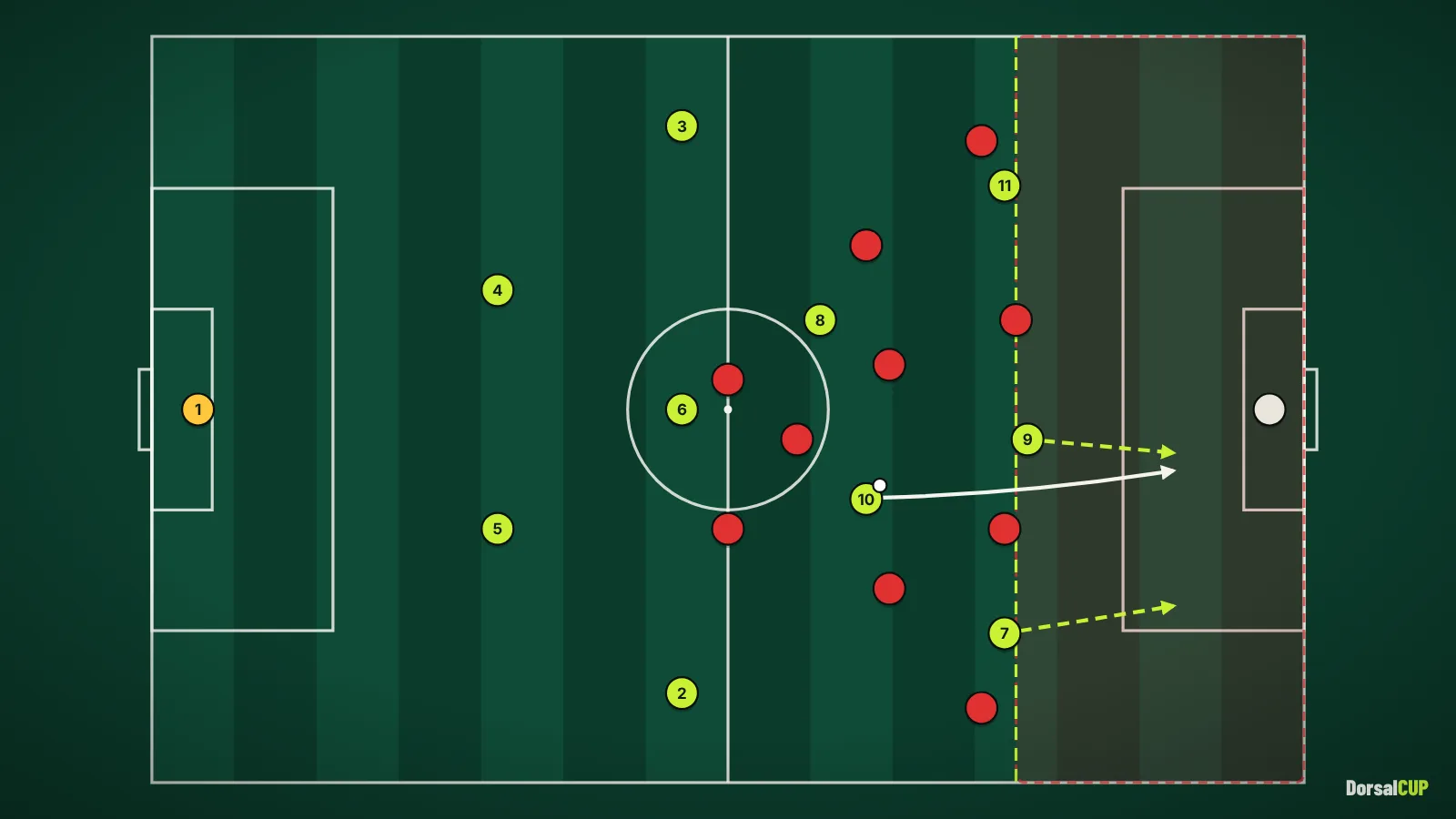
Offside is a geometry problem at a precise moment: where the attacker's relevant body parts are, relative to the second-last defender and the ball, at the instant a team-mate plays the ball. Standard VAR solved it by stopping the video at the kick frame and drawing lines by hand, which was slow and depended on the frame chosen.
- Tracking. For the 2022 World Cup, FIFA described 12 dedicated cameras under the stadium roof tracking up to 29 data points on each player, 50 times per second.
- Kick point. A sensor in the centre of the match ball sent data 500 times per second, identifying the exact moment the ball was played.
- Alert. When an attacker in an offside position receives the ball, the system alerts the video officials.
- Validation. The video officials check the proposed decision, including whether the attacker actually became involved in play, and inform the referee, who confirms it.
- Communication. The same data generates a 3D animation shown on stadium screens and to broadcasters.
UEFA first used SAOT at the 2022 UEFA Super Cup in Helsinki and in the Champions League from the 2022/23 group stage. The Premier League introduced it in April 2025, first using it in Matchweek 32 on 12 April, with a system based on optical player tracking. At the 2026 World Cup, FIFA used an advanced version that sends clear positional offsides directly to the on-pitch assistant referees, with every player 3D-scanned for more accurate avatars, and 16 optical tracking cameras in each stadium.
Limits that technology does not remove
- Interpretation stays human. SAOT measures position. Whether an attacker interfered with an opponent or the play is a judgement, and the 2026 advanced system still covers positional offside only.
- Measurement has tolerances. Camera frame rates, body-point estimation and the kick-point moment all carry small uncertainties; very tight calls are decided within the system's precision, not with absolute certainty.
- Delays and flow. Even fast checks interrupt celebration and rhythm; competitions trade some flow for accuracy.
- Cost and infrastructure. Calibrated cameras, connected balls, video operation rooms and trained officials are only feasible at professional level.
Running tournaments is one of the most time-consuming jobs at a grassroots club: registrations, the draw, the schedule and results. DorsalCUP does it for free, and the tournament fixture generator builds a one-day schedule in minutes, no sign-up.
What can reach amateur and youth football
The closest thing to video review for lower levels is Football Video Support (FVS), a FIFA-led trial in which coaches can challenge a decision and the referee reviews it at a pitchside monitor using the available camera angles. It was first used at the 2021 FIFA Futsal World Cup, has since been used at FIFA youth and women's youth tournaments, and has been announced by some national competitions. Each team has a limited number of challenges, and an unsuccessful one uses it up. It needs cameras, a replay operator and trained officials, so it is still a professional or semi-professional tool.
- No video review in grassroots matches. Under the Laws, decisions cannot be changed on the basis of a parent's phone video; video review exists only in authorised competitions following the official protocols.
- Referee development. Footage, used with consent and the safeguards set out in filming youth football and data protection, is valuable for referee mentors to review positioning and decisions with young officials.
- AI-assisted education. Tools that auto-clip incidents can help clubs and county referee groups build training clips; treat any automatic offside line from a single amateur camera as an illustration, not evidence.
- Behaviour first. Most grassroots refereeing problems are about respect and touchline behaviour, not accuracy. See respect the referee.
For coaches explaining the rules to young players and parents, the football rules guide for parents covers offside at each format.
Frequently asked questions
How does semi-automated offside technology work?
Tracking cameras follow body points on every player many times per second, and at major tournaments a sensor in the ball marks the moment it is played. The system alerts video officials when an attacker in an offside position receives the ball; they validate it and the referee confirms.
When was semi-automated offside first used?
It was trialled at the FIFA Arab Cup and FIFA Club World Cup in 2021, used at the 2022 World Cup, by UEFA from August 2022, and in the Premier League from April 2025.
What decisions can VAR review?
Goals and offences leading to them, penalties, direct red cards and mistaken identity. From 2026, competitions can also allow checks on clearly wrong second yellow cards, cards to the wrong player and, optionally, clearly wrong corner kicks.
Is goal-line technology compulsory?
No. The Laws permit it, and competitions decide whether to use it. Systems must be licensed under the FIFA Quality Programme and tested at each stadium.
Will VAR come to grassroots football?
Not in its current form, because it needs multiple cameras, a video room and trained officials. The coach-challenge model of Football Video Support is cheaper but still being trialled at higher levels.
Sources
- Inside World Football — IFAB approves goal-line technology (July 2012)
- Wikipedia — Goal-line technology (dates and requirements)
- NBC Sports — Historic call: VAR voted into Laws of the Game
- Wikipedia — Video assistant referee
- SVG Europe — Semi-automated offside technology to be used at FIFA World Cup 2022
- Tech Xplore — Champions League to get new camera tech for offside calls (August 2022)
- NBC Sports — Premier League to introduce semi-automated offside (April 2025)
- FIFA — Offside decisions, referee body cams and innovation at the World Cup 2026
- FIFA/IFAB — Further measures to improve match flow and player behaviour (February 2026)
- Wikipedia — Football video support
Verified in October 2026. Rules and age groups vary by association and by season; check your local regulations.